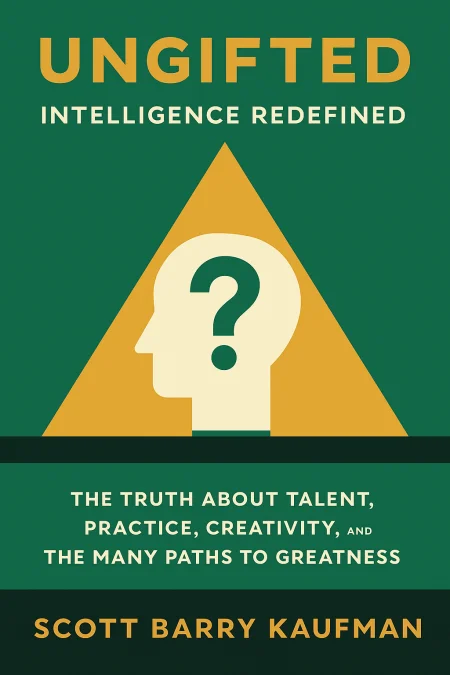
Ungifted: Intelligence Redefined
The Truth About Talent, Practice, Creativity and the Many Paths to Greatness
Book Edition Details
Summary
Beneath the shadow of society's obsession with prodigies and perfect scores, Scott Barry Kaufman redefines what it means to be intelligent in his groundbreaking work, "Ungifted." With the soul of a storyteller and the mind of a cognitive psychologist, Kaufman dismantles the narrow confines of traditional intelligence assessments, challenging the tyranny of IQ. Rooted in his own experiences as a child shunted into special education, Kaufman presents a vivid tapestry of research that spans genetics to positive psychology. He champions a broader, more inclusive vision of human potential, one that honors the unique paths of late bloomers, prodigies, and everyone in between. "Ungifted" is a clarion call to appreciate the myriad ways greatness can be realized, proving that brilliance often defies conventional measure.
Introduction
The conventional wisdom surrounding human intelligence rests on a precarious foundation of standardized testing and rigid categorization that has shaped educational systems and individual destinies for over a century. This systematic examination challenges the fundamental assumptions underlying traditional intelligence measurement, revealing how current practices may actually constrain rather than reveal human potential. The prevailing paradigm treats cognitive ability as a fixed quantity that can be precisely measured and permanently labeled, creating artificial hierarchies that often become self-fulfilling prophecies. The critique emerges through careful analysis of scientific evidence from neuroscience, developmental psychology, and educational research, demonstrating that intelligence operates as a dynamic, multifaceted phenomenon rather than a static, unitary construct. This reconceptualization has profound implications for how societies identify, nurture, and develop human talent, suggesting that current approaches systematically underutilize cognitive potential by focusing on narrow metrics while ignoring the contextual factors that enable exceptional performance to flourish. The investigation proceeds through systematic deconstruction of established testing paradigms, exploration of alternative frameworks for understanding cognitive development, and reconstruction of intelligence theory based on engagement, motivation, and environmental factors. This approach illuminates pathways toward more inclusive and effective methods for recognizing and cultivating the diverse forms of intellectual excellence that characterize human potential.
The Fundamental Flaws of Traditional Intelligence Testing
Traditional intelligence testing operates on several problematic assumptions that fundamentally distort our understanding of human cognitive capacity. The most significant flaw lies in treating statistical abstractions as biological realities, transforming mathematical constructs derived from test score correlations into presumed entities residing within individual minds. This reification error has led to the widespread belief that intelligence can be precisely measured and ranked, creating artificial hierarchies that ignore the complex, dynamic nature of human cognition. The testing environment itself introduces systematic biases that favor certain cognitive styles while penalizing others. Standardized assessments typically emphasize rapid processing of decontextualized problems under time pressure, privileging individuals who excel at working memory tasks and abstract pattern recognition. However, these artificial conditions bear little resemblance to how intelligence operates in natural settings, where problems are embedded in meaningful contexts, resources can be accessed, and solutions emerge through sustained engagement rather than quick responses. Cultural and socioeconomic factors further compromise test validity by creating systematic advantages for certain populations. Performance correlates strongly with educational opportunities, family resources, and cultural familiarity with testing formats, leading to the mislabeling of environmental advantages as innate abilities. Students from privileged backgrounds arrive at testing sessions with extensive preparation in the specific cognitive skills that tests measure, while those from different contexts may possess equally sophisticated intellectual abilities that remain invisible to standardized instruments. The temporal limitations of brief testing sessions prevent assessment of crucial cognitive processes that unfold over extended periods. Many forms of intelligence require sustained engagement, reflection, and iterative refinement of ideas that cannot be captured in standardized encounters. This systematic bias leads to chronic underestimation of intellectual potential among individuals whose cognitive strengths manifest through different temporal patterns or require meaningful contexts for expression.
Multiple Pathways to Excellence: Evidence for Dynamic Human Potential
Human excellence manifests through diverse cognitive pathways that extend far beyond the narrow band of abilities measured by conventional assessments. Research across multiple domains reveals that outstanding achievement emerges from various combinations of cognitive strengths, personality traits, and environmental factors rather than from single, identifiable characteristics. This multiplicity challenges the notion that optimal cognitive profiles exist for success in any given field, suggesting instead that different minds can reach exceptional performance through distinct developmental trajectories. The phenomenon of savant syndrome provides compelling evidence for the independence and modularity of cognitive systems. Individuals with severe deficits in general intellectual functioning can demonstrate extraordinary abilities in specific domains such as music, mathematics, or visual arts, revealing that the brain contains specialized processing systems capable of exceptional performance even when other functions are impaired. These dissociations suggest that intelligence comprises multiple, semi-independent systems rather than a unified general capacity that can be captured through single numerical scores. Longitudinal studies of creative achievement demonstrate that early test performance poorly predicts later accomplishment across many domains. Individuals showing modest performance on standardized measures during childhood can develop into highly creative and productive adults when they discover areas that match their interests and cognitive strengths. The key factors in this transformation appear to be sustained engagement, domain-specific learning, and expertise development through deliberate practice rather than initial assessment scores. Cross-cultural research reveals dramatically different patterns of cognitive development and expression across societies, with cultures emphasizing collective problem-solving, practical intelligence, or artistic expression producing individuals with sophisticated abilities that remain unrecognized by Western testing paradigms. These findings suggest that intelligence represents a culturally shaped phenomenon that takes different forms depending on societal values and practices, rather than a universal construct that can be measured through standardized instruments developed within particular cultural contexts.
Beyond Traditional Metrics: Engagement, Practice, and Personal Growth
The relationship between engagement and cognitive development represents one of the most significant discoveries challenging static views of intelligence. Rather than being predetermined by genetic endowment or early experiences, intellectual capacity emerges through dynamic interactions between individual interests, sustained engagement, and progressive skill development. This process creates positive feedback loops where initial curiosity leads to deeper involvement, which develops greater competence and further engagement, ultimately transforming cognitive performance in ways that traditional testing cannot predict or measure. Neuroplasticity research demonstrates that intensive engagement with cognitive challenges produces measurable changes in brain structure and function throughout the lifespan. The brain continuously reorganizes itself in response to experience and practice, with focused activity leading to increased gray matter density, enhanced connectivity between regions, and more efficient neural processing. These findings reveal that what we call intelligence largely represents accumulated neural adaptations resulting from sustained cognitive activity rather than fixed biological endowments. The concept of deliberate practice illuminates how expertise develops through focused, effortful engagement with progressively challenging tasks. Unlike mere repetition or casual involvement, this specialized form of training involves systematic attempts to overcome specific limitations through targeted effort and feedback. The process can transform cognitive performance across diverse domains, with exceptional ability typically resulting from thousands of hours of such focused practice rather than innate talent or high test scores. Motivational factors play crucial roles in sustaining the engagement necessary for cognitive development, with individuals who find personal meaning and satisfaction in particular activities more likely to persist through the challenges characterizing skill acquisition. Intrinsic motivation appears more important for long-term development than external rewards or pressures, suggesting that educational approaches should prioritize cultivating genuine interest and passion rather than emphasizing comparative performance or standardized achievement metrics.
Toward Personal Intelligence: A Framework for Individual Development
The convergence of research findings points toward a fundamentally different conception of intelligence that transcends traditional psychometric approaches by recognizing the dynamic integration of cognitive abilities, motivational factors, and environmental opportunities in pursuit of individually meaningful goals. Personal intelligence shifts focus from comparative ranking to individual development, acknowledging that intellectual capacity manifests differently across individuals and contexts while serving adaptive functions in real-world environments rather than artificial testing situations. This framework emphasizes the importance of person-environment fit in the expression of intellectual potential, recognizing that different individuals possess varying cognitive profiles that may be well-suited to some challenges while being poorly matched to others. Rather than viewing this variation as reflecting hierarchies of general ability, personal intelligence recognizes it as representing the diversity of human cognitive adaptations and the multiplicity of valuable contributions that different minds can make to society. The theory has profound implications for educational practice, moving beyond standardized curricula toward personalized learning approaches that recognize and develop each individual's unique cognitive strengths. Such approaches provide multiple pathways to achievement, allowing students to demonstrate competence through various means while developing their full intellectual potential. The goal becomes cultivating diverse forms of excellence rather than producing uniform outcomes based on narrow performance metrics. Practical applications involve creating learning environments that offer multiple ways to demonstrate understanding, engage with content, and express knowledge through project-based learning, collaborative problem-solving, and authentic assessment methods. These approaches reveal hidden talents and motivate continued learning by connecting academic content to personal interests and real-world applications, empowering individuals to understand and develop their own unique forms of intelligence rather than conforming to external standards that may not reflect their true capabilities.
Summary
The evidence overwhelmingly demonstrates that traditional intelligence testing provides a fundamentally flawed and limited view of human cognitive potential, one that constrains rather than reveals the full spectrum of intellectual capacity through rigid categorization and artificial hierarchies. The emerging understanding of intelligence as a dynamic, multifaceted phenomenon that develops through engagement, practice, and environmental interaction offers a more accurate and hopeful vision of human capability, suggesting that virtually all individuals possess significant intellectual potential that can be cultivated through appropriate opportunities and sustained effort. This reconceptualization challenges the deterministic assumptions that have long dominated educational and social policy, pointing toward approaches that recognize, nurture, and celebrate the diverse forms of intelligence that characterize our species while providing pathways for everyone to discover and develop their unique cognitive strengths.
Related Books
Download PDF & EPUB
To save this Black List summary for later, download the free PDF and EPUB. You can print it out, or read offline at your convenience.
By Scott Barry Kaufman
