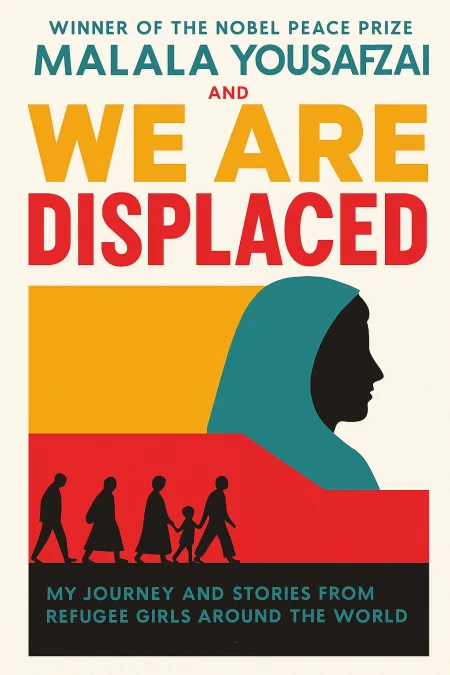
We Are Displaced
My Journey and Stories from Refugee Girls Around the World
Book Edition Details
Summary
A tapestry of resilience and survival unfolds in Malala Yousafzai's "We Are Displaced," where the human heart beats amidst staggering statistics. María, Zaynab, Sabreen, and Ajida—each a portrait of courage—navigate worlds torn apart by violence and war. Their stories, stitched together by the hands of a Nobel laureate, reveal the untold depths of the displaced experience. Malala, whose own life has been marked by displacement, weaves her narrative with theirs, crafting a compelling testament to the strength found in unity and hope. In a world embroiled in migration crises, this powerful narrative reframes the discourse, reminding us that behind each number is a dreamer, a survivor, a young soul yearning for home.
Introduction
In the quiet moments before dawn, when the world holds its breath between darkness and light, millions of people around the globe are making impossible choices. They are mothers clutching sleeping children, fathers gathering precious documents, teenagers leaving behind everything they've ever known. They are the displaced, the refugees, the internally displaced persons whose stories of survival and resilience illuminate the very best of human courage in the face of unimaginable adversity. Among these voices stands Malala Yousafzai, the youngest Nobel Peace Prize laureate, whose own journey from displacement to global advocacy exemplifies the transformative power of hope. Her story intertwines with those of countless others who have been forced to leave their homes due to violence, persecution, and conflict. Through her encounters with displaced girls and women across continents, we witness not just tales of loss and hardship, but profound narratives of strength, determination, and the unwavering human spirit. In these pages, readers will discover the complex emotions that accompany displacement, the universal desire for safety and belonging, and the remarkable ways in which education and advocacy can create ripples of change that extend far beyond individual lives.
From Paradise to Exile: Malala's Displacement Journey
The Swat Valley of Pakistan, once known as the Switzerland of the East, was Malala's paradise. In this mountainous region where pine forests met snowcapped peaks and rivers rushed through verdant valleys, she spent her earliest years surrounded by family, friends, and the promise of education. Her father Ziauddin ran schools that welcomed both boys and girls, and the young Malala thrived in an environment where learning was celebrated and dreams seemed attainable. The sounds of children playing in the streets, the aroma of her mother's cooking, and the gentle hum of daily life created a tapestry of security and belonging. But paradise was not immune to the darkness spreading across the region. Beginning in 2004, when Malala was just six years old, extremist groups began infiltrating their peaceful valley. What started as distant radio broadcasts preaching rigid interpretations of religion gradually escalated into a reign of terror that would transform their world beyond recognition. The Taliban's presence grew more menacing with each passing month, as they imposed increasingly harsh restrictions on daily life, banned music and entertainment, and most devastatingly for Malala's family, declared girls' education to be un-Islamic. The systematic destruction of schools became a nightly occurrence, with over 400 educational institutions bombed or destroyed during this period. Malala watched helplessly as her female classmates disappeared from school one by one, until her own beloved institution was forced to close. The vibrant girl who had once walked confidently to school each morning now found herself confined to her home, her dreams deferred by forces beyond her control. Yet even in these darkest moments, neither she nor her father would be silenced, continuing to speak out for girls' right to education through media interviews and her anonymous blog for the BBC. The final blow came in May 2009, when government authorities ordered a complete evacuation of the Swat Valley. Within forty-eight hours, Malala's family joined over two million people in a desperate exodus from their homeland. As their overcrowded car inched through streets flooded with refugees carrying plastic bags of belongings, pushing elderly relatives in wheelbarrows, and walking barefoot toward uncertain destinations, eleven-year-old Malala experienced her first taste of true displacement. The girl who had once taken her beautiful valley for granted now understood, with heartbreaking clarity, that safety and home were privileges that could be stolen in an instant.
Voices of the Displaced: Stories from Around the World
Displacement knows no borders, affecting millions across continents in ways both devastating and transformative. From Zaynab's harrowing escape from Yemen with her sister Sabreen, where civil war had turned their homeland into a battlefield of indiscriminate bombings and sectarian violence, to Marie Claire's childhood flight from the Democratic Republic of Congo, where armed rebels murdered her mother before her eyes, these stories reveal the universal trauma of forced migration. Each narrative carries its own unique geography of loss, yet they share common threads of impossible choices, dangerous journeys, and the weight of leaving everything familiar behind. The paths to safety are rarely straightforward or guaranteed. Sabreen's nine-day odyssey across the Mediterranean in overcrowded fishing boats, where four hundred people were crammed into vessels meant for one hundred, exemplifies the deadly risks displaced people face in seeking refuge. Similarly, Analisa's journey from Guatemala through Mexico to the United States involved crossing rivers filled with crocodiles, hiding in warehouses, and trusting smugglers who treated their human cargo with shocking cruelty. These young women's experiences illuminate how displacement often involves multiple stages of danger, uncertainty, and exploitation before any semblance of safety is achieved. Perhaps most striking is how displacement affects families differently, even within the same household. While Zaynab received a visa to the United States, her younger sister Sabreen was denied, forcing them to say goodbye at a Cairo airport with no guarantee of reunion. This arbitrary separation of loved ones represents one of displacement's cruelest aspects - how bureaucratic decisions and random chance can determine who finds safety and who remains in limbo. The emotional toll of such separations often proves as difficult to bear as the original trauma that forced families to flee. What emerges from these diverse experiences is not just a catalog of suffering, but a testament to human adaptability and the fierce determination to survive. Whether it's Muzoon advocating for education in Jordanian refugee camps, María creating documentaries about displacement in Colombia, or Ajida building clay stoves for fellow Rohingya refugees in Bangladesh, these voices demonstrate how displaced people become agents of change and hope within their new circumstances, refusing to be defined solely by their status as refugees.
Finding Hope in New Homes: Resilience and Adaptation
The transition from refugee to resident involves far more than simply securing legal status or finding shelter. For many displaced individuals, the process of adaptation becomes a delicate balance between honoring their heritage and embracing new cultures, languages, and ways of being. Marie Claire's arrival in Lancaster, Pennsylvania, exemplifies this complex journey - from her initial amazement at running water and electric appliances to her determination to complete high school despite being older than her classmates. Her American "mother," Jennifer, witnessed firsthand how seemingly simple luxuries like microwave popcorn could appear magical to someone who had lived without electricity, while also observing the deep grief that accompanied every milestone celebration where Marie Claire's biological mother was absent. Language barriers often represent the first and most persistent challenge facing displaced individuals. Zaynab's early days in a Minneapolis high school, where she wrapped her scarf around her face to protect against unfamiliar bitter cold and relied on Arabic-speaking classmates to navigate her new environment, illustrate how communication becomes both obstacle and bridge to integration. The relief of finding others who shared her linguistic background provided not just practical assistance but emotional connection in a landscape where everything from food to social customs felt foreign and sometimes hostile. Cultural adaptation involves constant negotiation between maintaining identity and achieving acceptance. Farah's Canadian upbringing demonstrates how refugee families often make strategic choices about assimilation, speaking only English at home, celebrating non-Muslim holidays, and emphasizing gratitude for their host country's generosity. Yet this approach, while promoting integration, can also create generational gaps and identity confusion, particularly for children who grow up with limited knowledge of their family's displacement experience and the trauma that brought them to their new home. Success in new environments often requires displaced individuals to become bridges between worlds, translating not just languages but entire ways of life. Whether it's Najla advocating for herself at the United Nations, Analisa navigating American immigration systems, or Muzoon mobilizing education campaigns in refugee camps, these young women demonstrate how displacement can foster remarkable adaptability, advocacy skills, and cross-cultural competence. Their resilience becomes not just personal triumph but community asset, as they use their experiences to help others navigate similar journeys and challenge stereotypes about refugee capabilities and contributions.
The Power of Education and Advocacy
Education emerges as both catalyst for displacement and pathway to recovery throughout these interconnected stories. The Taliban's ban on girls' schooling in Swat Valley not only triggered Malala's activism but also represented the broader pattern of extremist groups targeting education as a means of social control. Yet this same education becomes the foundation upon which displaced individuals rebuild their lives and advocate for systemic change. Malala's transformation from anonymous BBC blogger to Nobel laureate illustrates how educational opportunities, even when interrupted by violence, can evolve into platforms for global influence and policy transformation. The pursuit of education in displacement contexts requires extraordinary determination and creativity. Muzoon's tent-to-tent advocacy in Jordanian refugee camps, convincing families to send their daughters to makeshift schools rather than into early marriages, demonstrates how education becomes both individual aspiration and community organizing principle. Her work revealed how displacement can actually create opportunities for challenging traditional gender roles and family expectations, as crisis situations sometimes open space for new conversations about girls' rights and futures. Access to quality education in host countries often determines long-term integration success, yet barriers abound. Marie Claire's persistence in convincing school administrators to give her a chance at high school graduation, despite her age and academic gaps, exemplifies the self-advocacy skills that displaced students must develop. Similarly, Zaynab's acceleration through multiple grade levels and creation of her school's first refugee soccer team illustrates how educational environments can become spaces for cultural bridge-building and leadership development when supportive systems exist. The ripple effects of educational access extend far beyond individual achievement to community transformation and policy influence. Displaced individuals who achieve educational success often become powerful advocates for others facing similar challenges, using their platforms to humanize refugee experiences and challenge discriminatory policies. When Marie Claire addressed the United Nations General Assembly or Najla spoke to world leaders about Yazidi rights, their educational journeys provided both credibility and communication skills necessary for global advocacy. Through education, displacement transforms from personal tragedy to social justice catalyst, creating networks of support and systems of change that benefit entire communities of displaced people worldwide.
Summary
The stories woven throughout this remarkable collection reveal that displacement, while born of loss and trauma, can become a crucible for extraordinary human resilience, advocacy, and connection across cultures and continents. These young women's journeys from forced exile to global citizenship demonstrate that the human capacity for adaptation, hope, and service to others can flourish even in the most challenging circumstances. Their experiences challenge us to see beyond the statistics of global displacement to recognize the individual dreams, talents, and contributions that refugees bring to their new communities. From these narratives, we learn that supporting displaced individuals requires more than providing basic shelter and safety - it demands creating pathways to education, fostering environments where cultural identities can be preserved while new ones are embraced, and building systems that recognize refugees as assets rather than burdens. Perhaps most importantly, these stories remind us that anyone, anywhere, can become displaced through circumstances beyond their control, and that our shared humanity calls us to respond with empathy, practical support, and policy changes that protect the most vulnerable among us.
Related Books
Download PDF & EPUB
To save this Black List summary for later, download the free PDF and EPUB. You can print it out, or read offline at your convenience.
By Malala Yousafzai
