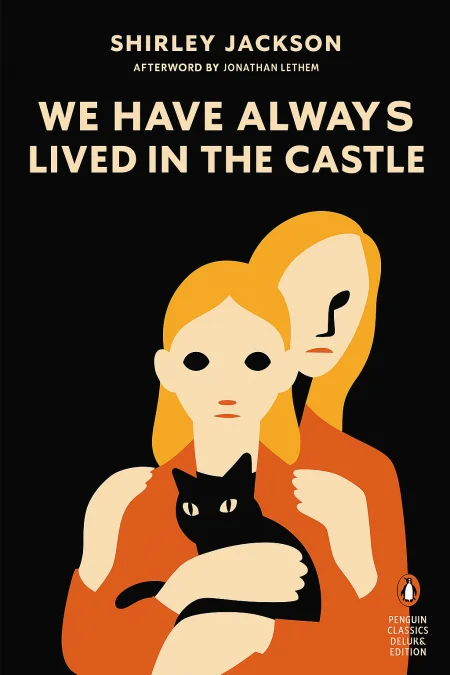
We Have Always Lived in the Castle
Enter a Disturbing Labyrinth of Family Secrets and Dark Neurosis
byShirley Jackson, Jonathan Lethem
Book Edition Details
Summary
Beneath the genteel veneer of the Blackwood estate lies a chilling enigma, where the eccentric Mary Katherine and her sister Constance reside in solitude, shadows of a bygone tragedy looming large. Shirley Jackson's "We Have Always Lived in the Castle" spins a web of psychological intrigue, drawing readers into the sisters' cloistered lives, where whispers of madness and murder are never far. When a long-lost cousin intrudes upon their guarded world, dormant secrets stir, challenging the fragile balance of their existence. This masterclass in gothic suspense teases the boundaries of family loyalty and the haunting grip of the past, inviting readers to question: what truly happened within these walls?
Introduction
In the shadowed corners of American Gothic literature lies a tale that begins with one of the most chilling opening lines ever written: "My name is Mary Katherine Blackwood. I am eighteen years old, and I live with my sister Constance. I have often thought that with any luck at all I could have been born a werewolf." This haunting declaration introduces us to a world where isolation breeds its own peculiar magic, where the remnants of a once-prominent family live barricaded against a hostile village that both fears and despises them. The story unfolds in a decaying mansion where two sisters exist in carefully constructed routines, tending to their invalid Uncle Julian while the outside world presses against their gates with malicious curiosity. Six years earlier, a family dinner ended in tragedy when arsenic found its way into the sugar bowl, leaving only these three survivors in a house that has become both sanctuary and prison. The younger sister, Merricat, weaves protective spells from buried treasures and whispered incantations, while Constance, acquitted of murder but forever marked by suspicion, tends her garden and maintains the rituals of a genteel life that no longer exists. This masterpiece explores the thin boundaries between love and possession, protection and destruction, sanity and madness. Through the eyes of an unreliable narrator who sees the world through a lens of magical thinking and fierce devotion, we witness a profound meditation on family loyalty, social ostracism, and the lengths to which love will go to preserve what it cherishes most. The story reveals how isolation can transform ordinary people into something both more and less than human, creating their own rules in a world that has rejected them completely.
The Blackwood Sisters' Isolated World
The Blackwood house stands like a fortress against the world, its gates locked and its grounds protected by more than mere fences. Inside this sanctuary, eighteen-year-old Mary Katherine Blackwood, known as Merricat, has created an intricate system of magical protections. She buries silver dollars by the creek, nails books to trees, and arranges her treasures in patterns that she believes will keep her small family safe from the malevolent forces beyond their property line. Her world is governed by rituals and superstitions, by the careful placement of objects and the precise repetition of protective words. Constance, her older sister, tends to the domestic sphere with the same devotion that Merricat brings to her magic. She cooks elaborate meals, maintains an immaculate kitchen, and preserves food in endless rows of gleaming jars that line the cellar like a poem written by generations of Blackwood women. Though she never leaves the property, Constance creates beauty and order within their shrinking domain, transforming their isolation into something almost sacred. Her garden blooms with careful attention, and her meals are prepared with the precision of religious ceremony. Uncle Julian, the third member of their household, spends his days in a wheelchair, obsessively documenting the events of six years past when the rest of the Blackwood family died of arsenic poisoning. His papers and notebooks contain endless variations of that fatal evening, each detail examined and re-examined as he struggles to make sense of the tragedy that left him an invalid and his two nieces forever marked by suspicion. He serves as both witness and chronicler, his failing memory the only record of a family that once commanded respect in their small village. Together, these three survivors have created a world complete unto itself, where time moves according to their own rhythms and the outside world exists only as a source of threat and contamination. Their days follow patterns as rigid as any religious observance, each ritual serving to reinforce the barriers between their sanctuary and the hostile world beyond. In this carefully constructed isolation, they have found a strange kind of peace, sustained by love and protected by the very forces that the outside world sees as madness.
Charles Blackwood's Intrusion and Disruption
The arrival of Cousin Charles Blackwood shatters the delicate equilibrium of the sisters' existence like a stone thrown through glass. He appears at their kitchen door during a spring rainstorm, claiming kinship and offering help, but Merricat recognizes him immediately as something dangerous, a ghost or demon wearing the face of their dead father. Charles brings with him the contamination of the outside world, along with an unsettling familiarity with the house's layout and the location of the family safe. From the moment he crosses their threshold, Charles begins to unravel the protective systems that have kept the sisters safe. He questions their isolation, criticizes their routines, and speaks of bringing them back into normal society. His presence awakens something in Constance that Merricat had thought safely buried, a longing for the world beyond their gates and a desire for what he calls a "normal life." Charles talks of taking Constance away, of selling the property, of forcing Uncle Julian into a hospital where he belongs. The house itself seems to rebel against this intrusion. Charles complains of the cold, of strange sounds in the night, of an atmosphere that makes him uncomfortable. He finds his belongings mysteriously displaced, his room filled with leaves and broken sticks, his father's watch stopped and his mirror cracked. Merricat wages a silent war against him, using every magical protection at her disposal, but Charles proves remarkably resistant to her spells. He settles into their father's room, wears their father's watch and chain, and begins to speak of the family's money as though it were already his. Uncle Julian, in his confusion, sometimes mistakes Charles for his long-dead brother, leading to conversations that reveal uncomfortable truths about the family's past. Charles grows increasingly frustrated with the old man's rambling stories about the poisoning, trying to silence him whenever he begins to speak of that fatal dinner. The tension in the house builds like pressure in a sealed vessel, with Merricat's protective magic straining against Charles's determination to drag them all back into the world that had rejected them so completely.
The Village's Violent Retribution
The fire begins in Charles's room, sparked by his carelessly abandoned pipe among the leaves and debris that Merricat had placed there. As flames consume the upper floors of the Blackwood house, the volunteer fire department arrives not as saviors but as harbingers of destruction. Led by Jim Donell, they bring their hoses and axes, but also something darker, a mob mentality that has been festering in the village for six years of resentment and fear. What begins as firefighting quickly transforms into something far more sinister. The villagers pour through the broken doors and shattered windows, not to save the house but to destroy what remains of the Blackwood legacy. They smash the Dresden figurines, overturn Constance's harp, and trample the rose brocade furniture that had been carefully preserved for generations. In the drawing room where their mother's portrait watches serenely from the wall, they tear down the fourteen-foot silk drapes and scatter the contents of every drawer and cabinet. The destruction takes on a ritualistic quality, as though the villagers are performing an exorcism to rid themselves of the Blackwood presence once and for all. They sing the cruel children's rhyme that has haunted Merricat for years, their voices rising in a chorus of hatred and fear. The kitchen, Constance's sacred domain, becomes a battlefield of broken dishes and scattered food, every jar of preserves smashed against the walls in an orgy of waste and spite. Through it all, Constance and Merricat huddle together on the front porch, hidden behind the vines and watching their world dissolve into chaos. The villagers circle them like predators, taunting and threatening but never quite daring to touch them directly, as though some primitive fear still holds them back. Only the news of Uncle Julian's death, his heart finally giving out from the shock and excitement, brings the destruction to a halt, shame and superstition finally overcoming the mob's bloodlust as they remember they stand in the presence of death.
Embracing Complete Isolation and Freedom
From the ashes of their former life, Merricat and Constance create something entirely new, a existence pared down to its essential elements and made perfect by its very limitations. The upper floors of their house are gone, open to the sky and overgrown with vines, but the kitchen remains intact, and that is all they need. They salvage what they can from the wreckage, creating a sparse but sufficient household from the fragments of their former grandeur. The destruction has paradoxically freed them from the last vestiges of their connection to the outside world. With no possibility of return to conventional life, they embrace their isolation completely, transforming their ruined house into a fortress that no outsider can penetrate. Merricat builds barricades from the debris, boards up the windows, and creates new magical protections from the remnants of their former life. The house becomes truly theirs now, shaped by their needs rather than the expectations of a society that had rejected them. To their surprise, the villagers begin leaving offerings on their doorstep, baskets of food that appear in the darkness like tributes to mysterious deities. The same people who had destroyed their home now seem compelled to feed them, as though guilt or superstition drives them to make amends. Constance accepts these gifts with gracious dignity, transforming the simple offerings into elegant meals that maintain the rituals of civilized life even in their reduced circumstances. In their final transformation, the sisters become something beyond human society, creatures of legend who exist at the margins of the ordinary world. Children dare each other to approach their steps, lovers whisper in their garden after dark, and travelers point out their vine-covered ruins as a local curiosity. They have achieved the perfect isolation that Merricat always desired, protected by their reputation and sustained by the very fear that had once threatened to destroy them. In losing everything, they have gained a kind of immortality, becoming the mysterious ladies of the ruined house who watch the world from behind their barriers and find it good.
Summary
This haunting tale stands as a masterpiece of psychological horror and Gothic literature, exploring the complex dynamics of love, protection, and isolation with unprecedented depth and nuance. Through the unreliable narration of Merricat, readers are drawn into a world where the boundaries between sanity and madness, love and obsession, protection and destruction become increasingly blurred. The story reveals how trauma and social rejection can transform ordinary people into something both more and less than human, creating their own moral universe where conventional rules no longer apply. The work's enduring power lies in its unflinching examination of how society creates its own monsters through fear, prejudice, and the relentless need to find scapegoats for inexplicable tragedies. The villagers' hatred and the sisters' response to it form a cycle of violence and isolation that ultimately consumes both sides, leaving only the strange peace of complete separation. The author's genius lies in making readers complicit in Merricat's worldview, gradually revealing the truth while maintaining sympathy for characters who exist far beyond the boundaries of conventional morality. Ultimately, this is a story about the terrible price of love and the lengths to which devotion will go to preserve what it cherishes most. In their final transformation, the sisters achieve a kind of transcendence, becoming creatures of legend who exist outside the normal world while remaining utterly, recognizably human in their needs and desires. The tale serves as both a condemnation of social cruelty and a celebration of the human capacity to create meaning and beauty even in the most reduced circumstances, offering readers a profound meditation on the nature of family, loyalty, and the courage required to live entirely on one's own terms.
Related Books
Download PDF & EPUB
To save this Black List summary for later, download the free PDF and EPUB. You can print it out, or read offline at your convenience.
By Shirley Jackson
