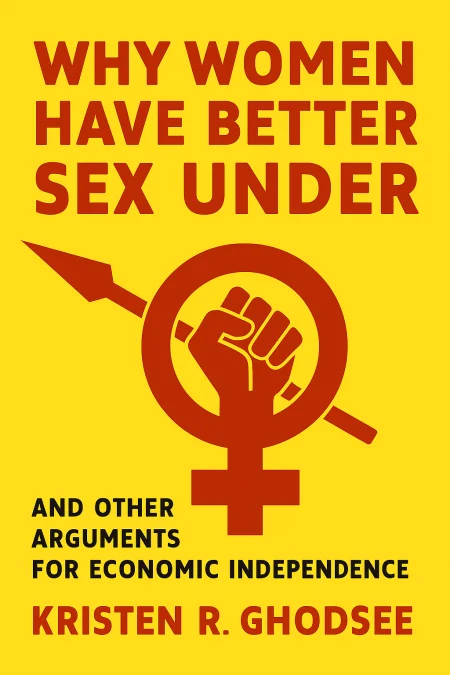
Why Women Have Better Sex Under Socialism
And Other Arguments for Economic Independence
Book Edition Details
Summary
Is capitalism letting women down? Kristen Ghodsee, with her sharp wit and incisive research, makes a compelling case that it is. Her provocative work, "Why Women Have Better Sex Under Socialism," goes beyond mere titillation to explore the broader impact of economic systems on women's lives. Ghodsee, a seasoned ethnographer, draws on decades of research, comparing the lived experiences of women under state socialism, democratic socialism, and neoliberal capitalism. Her insights reveal a striking truth: unbridled capitalism often leaves women in the lurch, affecting everything from their work-life balance to their intimate relationships. With a rising tide of women questioning the status quo and embracing socialism, this book is a clarion call to reevaluate our economic principles and reclaim a system that serves all genders equitably. Through humor and deep analysis, Ghodsee invites readers to imagine a future where equality isn't just an ideal but a lived reality.
Introduction
The relationship between economic systems and gender equality presents one of the most compelling yet underexplored dimensions of political theory. Through rigorous examination of historical evidence from twentieth-century state socialist societies in Eastern Europe, a provocative argument emerges: capitalism systematically disadvantages women through market mechanisms that commodify their sexuality and limit their economic autonomy. This thesis challenges conventional wisdom about free markets and gender relations by demonstrating how socialist policies—despite the authoritarian contexts in which they were implemented—created conditions for greater female economic independence and more authentic intimate relationships. The analysis draws upon comparative data from East and West Germany, survey research from multiple socialist states, and demographic studies spanning several decades to construct a compelling case for redistributive policies. The argument proceeds through careful examination of how competitive labor markets discriminate against women, how motherhood becomes a liability under capitalism, why women remain underrepresented in leadership positions, and how economic dependence distorts sexual relationships. Rather than nostalgic romanticism about failed political systems, this represents a methodical investigation into which specific policies might enhance women's lives in contemporary democratic societies.
The Socialist Argument: Economic Systems and Women's Liberation
Competitive labor markets systematically discriminate against women because employers view female workers as inherently riskier investments due to their reproductive capacity. This discrimination operates through what economists term "statistical discrimination"—employers make hiring decisions based on demographic averages rather than individual qualifications, assuming women are more likely to leave for family reasons. The result creates a vicious cycle: women receive lower wages because they might quit, which makes them more likely to quit when family responsibilities arise. Free markets amplify this problem because private employers have incentives to minimize labor costs and maximize productivity without regard for social equity. Socialist economic systems, by contrast, can interrupt this discriminatory cycle through state intervention and public employment. When governments serve as major employers and implement policies like guaranteed employment, equal pay mandates, and comprehensive social services, women gain economic independence that fundamentally alters their social position. The argument extends beyond mere policy prescriptions to examine how economic structures shape intimate human relationships and personal autonomy. The theoretical foundation rests on nineteenth-century socialist feminist analysis, particularly August Bebel's insight that women's liberation requires their full incorporation into the workforce under conditions of collective ownership. This perspective recognizes that legal equality means little without economic independence, and that achieving such independence requires challenging the fundamental organization of capitalist production and distribution. The evidence suggests that when women can meet their basic needs through their own labor rather than dependence on male partners, the entire social dynamic shifts toward more egalitarian relationships based on mutual affection rather than economic transaction.
Historical Evidence: State Socialist Women's Experiences vs. Capitalist Systems
Comparative data from socialist and capitalist societies provides compelling evidence for systematic differences in women's experiences across economic systems. In 1975, women comprised nearly 50 percent of the Soviet workforce and over 43 percent in Eastern Europe, compared to only 37 percent in North America and 33 percent in Western Europe. These statistics reflect deliberate policies to incorporate women into formal employment while providing state-funded childcare, maternity leave, and social services that reduced the conflict between work and family responsibilities. East German research from the 1980s documented higher rates of female sexual satisfaction compared to West Germany, with studies showing 75 percent of East German women reporting satisfaction with their intimate relationships versus only 46 percent of West German women. These findings emerged from surveys comparing societies with nearly identical cultural backgrounds but different economic systems, suggesting that structural factors rather than cultural differences explained the disparity. The collapse of state socialism after 1989 created a natural experiment demonstrating how rapidly market forces can erode women's position. Across Eastern Europe, the transition to capitalism coincided with dramatic declines in female labor force participation, cuts to childcare funding, and the reimposition of traditional gender roles. Birth rates plummeted as women faced the impossible choice between economic security and family formation without adequate social support. Hungarian survey data from the early 1970s revealed that young people in socialist societies viewed relationships based on economic exchange far less favorably than their capitalist counterparts, with 80 percent of Hungarians describing prostitution as "never justifiable" compared to only 63 percent of Americans. This suggests that economic systems shape not just material conditions but fundamental attitudes toward sexuality and relationships.
Critical Analysis: Sexuality, Power, and Economic Dependency Under Capitalism
Sexual economics theory, developed by psychologists Roy Baumeister and Kathleen Vohs, inadvertently provides a framework for understanding how capitalism commodifies women's sexuality. Their research demonstrates that sex functions as a female-controlled resource exchanged for male-provided benefits including money, commitment, protection, and social advancement. While intended as descriptive analysis, this theory reveals the transactional nature of relationships under market-based systems where women's economic insecurity creates incentives to strategically deploy their sexuality. The theory predicts that women's sexual behavior varies inversely with their economic opportunities—when women have fewer paths to financial independence, they restrict sexual access to drive up its "price" in terms of male investment. Conversely, when women enjoy economic autonomy, they engage in sexual relationships based on personal preference rather than material calculation. Cross-cultural research confirms these predictions, showing that countries with greater gender equality exhibit more liberal sexual attitudes and behaviors. This analysis illuminates how capitalism transforms intimate relationships into market transactions, reducing human affection to economic exchange. When women must consider the financial implications of romantic choices, authentic emotional connections become difficult to distinguish from strategic positioning. Men operating within this system learn to view women's attention as purchasable, while women must constantly evaluate the economic value of their romantic investments. The psychological costs of this commodification extend beyond individual relationships to shape broader cultural attitudes toward sexuality, love, and human worth. Young people increasingly report depression and anxiety as they navigate romantic relationships structured by economic inequality and financial insecurity, suggesting that market-based approaches to intimate life produce widespread emotional dysfunction.
Future Implications: Democratic Socialism and Women's Political Power
Contemporary demographic trends suggest that young women possess unprecedented political power to implement redistributive policies that could fundamentally alter gender relations in democratic societies. Millennials and Generation Z voters, particularly women, express far more favorable attitudes toward socialist policies than previous generations, with surveys showing 44 percent of young Americans preferring socialist economic arrangements to capitalist ones. This shift reflects lived experience with capitalism's failures rather than ideological indoctrination. The policy implications extend far beyond traditional welfare state measures to encompass fundamental restructuring of how societies organize work, family, and citizenship. Universal basic income, job guarantees, universal healthcare, subsidized childcare, and mandated parental leave could reduce women's economic dependence on male partners while creating space for more authentic relationships. Corporate board quotas and political representation requirements could increase female leadership and challenge masculine-coded assumptions about authority and competence. Northern European countries demonstrate that combining market economies with robust social democratic institutions produces the world's highest levels of gender equality and reported happiness. These societies invest heavily in public services, maintain strong labor protections, and actively promote women's economic participation through policy interventions that modify market outcomes rather than accepting them as natural or inevitable. The historical evidence suggests that achieving meaningful gender equality requires conscious political action to counteract market forces that systematically disadvantage women. This means moving beyond individual solutions like "leaning in" toward collective approaches that reshape the structural conditions within which all women make choices about work, family, and relationships.
Summary
The fundamental insight emerging from this analysis reveals that economic systems profoundly shape the most intimate aspects of human experience, including sexuality, love, and family formation. By examining how state socialist policies created conditions for women's economic independence—despite occurring within authoritarian political contexts—we gain crucial understanding of how market forces systematically commodify women's bodies and constrain their choices. The evidence demonstrates that women's liberation requires not just legal equality but economic structures that enable genuine autonomy and authentic relationships freed from transactional considerations. Rather than accepting capitalism's reduction of human relationships to market exchanges, democratic societies can learn from both the successes and failures of twentieth-century experiments to design policies that enhance women's freedom and dignity. For readers seeking to understand how political economy intersects with gender relations and personal autonomy, this analysis provides essential tools for envisioning more just and humane social arrangements.
Related Books
Download PDF & EPUB
To save this Black List summary for later, download the free PDF and EPUB. You can print it out, or read offline at your convenience.
By Kristen R. Ghodsee
