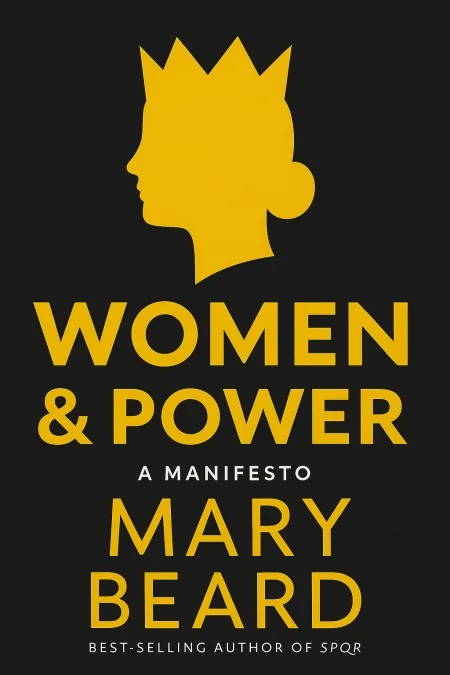
Women and Power
A Manifesto
Book Edition Details
Summary
In a world where the echoes of ancient myths still shape modern discourse, Mary Beard’s "Women & Power" shatters the silence imposed on women throughout history. With her signature wit and incisive scholarship, Beard unravels the persistent threads of misogyny that bind figures from Medusa to Hillary Clinton, questioning the very foundations of authority. This isn’t just a history lesson; it’s a rallying cry. Beard challenges us to rethink power itself, exposing the systemic barriers that have long excluded women. Through personal anecdotes and historical analysis, she paints a vivid portrait of the struggle for female voice and agency, urging a revolution in how we perceive strength and leadership. For those ready to confront the entrenched narratives of gender, Beard’s work is both a revelation and a call to arms.
Introduction
The systematic exclusion of women from positions of authority represents one of Western civilization's most enduring and deeply embedded cultural patterns. This phenomenon extends far beyond mere political underrepresentation or workplace discrimination; it reflects fundamental assumptions about whose voices deserve to be heard and whose perspectives carry weight in public discourse. The roots of this exclusion stretch back thousands of years, creating a complex web of cultural narratives, linguistic patterns, and symbolic frameworks that continue to shape contemporary power structures. By examining the intersection of ancient Greek and Roman traditions with modern political dynamics, a striking continuity emerges in the mechanisms used to silence women or delegitimize their authority. From classical mythology to contemporary social media, similar patterns of exclusion and marginalization persist across millennia. The analysis reveals how seemingly separate phenomena—from internet trolling to parliamentary heckling—actually share common historical and cultural foundations that have been refined and transmitted through generations of Western thought and practice. Understanding these deep structures requires moving beyond surface-level observations about gender inequality to examine the fundamental assumptions that underpin our concepts of authority, expertise, and power itself. This investigation challenges readers to recognize how ancient prejudices continue to influence modern institutions and to consider whether meaningful progress requires not just including more women in existing power structures, but fundamentally reimagining what power looks like and how it operates.
The Classical Foundations of Women's Public Silencing
The Western tradition of excluding women from public discourse begins at the very origins of recorded literature, establishing patterns that would persist for millennia. In Homer's Odyssey, the moment when young Telemachus instructs his mother Penelope to return to her domestic quarters represents more than a simple family dynamic; it crystallizes a fundamental principle that equated masculine maturity with the control of public speech. The Greek concept of muthos—authoritative public discourse—was explicitly distinguished from the everyday conversation or gossip deemed appropriate for women, creating a linguistic hierarchy that positioned male speech as inherently more valuable and legitimate. Ancient Greek and Roman cultures systematically reinforced this division through legal, social, and literary means. The rare women who did speak publicly were typically characterized as monstrous aberrations who threatened social stability. Roman writers described female orators using dehumanizing language, comparing their voices to animal sounds and treating their public participation as unnatural freakishness. When women were permitted to speak, it was only in highly circumscribed contexts: as victims announcing their own deaths, or as representatives advocating exclusively for women's sectional interests, never for the community as a whole. The theoretical framework supporting these exclusions went beyond practical discrimination to establish public speaking as a defining characteristic of masculinity itself. Roman ideals explicitly linked male citizenship with oratorical skill, while treatises on natural philosophy claimed that deep male voices indicated courage and authority, whereas higher-pitched female voices suggested cowardice and instability. Classical writers even theorized that widespread female participation in public discourse would corrupt language itself and threaten the health of the state, creating a comprehensive ideological justification for women's exclusion. These ancient patterns established enduring cultural templates that continue to influence modern assumptions about authority and expertise. The classical equation of deep voices with wisdom, the characterization of women's public speech as disruptive or illegitimate, and the restriction of female discourse to specifically gendered concerns all persist in contemporary political and professional contexts, demonstrating the remarkable durability of these foundational exclusionary mechanisms.
Modern Manifestations of Ancient Gender Hierarchies
Contemporary language surrounding women's public participation reveals striking continuities with classical exclusionary patterns. Women who speak assertively are routinely described as "strident," "whining," or "shrill"—terminology that echoes ancient Roman characterizations of female speech as barking or mooing rather than legitimate human discourse. This linguistic framework systematically undermines the authority and credibility of women's contributions, repositioning their interventions as domestic complaints rather than serious political or professional commentary. The phenomenon extends beyond individual encounters to encompass structural patterns of dismissal and marginalization. The archetypal "Miss Triggs" scenario—where a woman's suggestion goes unacknowledged until a man repeats it—represents a widespread experience that transcends professional boundaries and cultural contexts. This pattern reveals how deeply embedded assumptions about authority continue to shape professional interactions, creating invisible barriers that operate independently of formal policies or conscious discrimination. Digital platforms have amplified these traditional exclusionary mechanisms while revealing their underlying logic. Online harassment targeting women frequently focuses specifically on silencing tactics, with threats aimed at removing women's capacity to speak rather than simply expressing disagreement with their positions. The content of women's contributions matters less than the mere fact of their participation in traditionally male-dominated discourse, suggesting that the fundamental issue remains women's claim to public voice rather than any particular political or professional stance. The resistance women encounter when entering traditionally masculine discursive territory—from sports commentary to mainstream political debate—demonstrates how ancient territorial boundaries persist in modern contexts. The intensity of backlash often correlates not with the controversy of women's positions but with their encroachment onto domains previously reserved for male expertise, revealing the continued operation of classical assumptions about whose knowledge and perspective deserves serious consideration.
Power Redefined: Beyond Male-Coded Authority Structures
Traditional conceptions of power remain fundamentally masculine in their imagery, assumptions, and operational logic. The cultural template for authority continues to envision leaders as possessing traditionally male characteristics, forcing women to adopt masculine presentation styles—from clothing choices to vocal training—in order to approximate legitimacy within existing frameworks. This dynamic reveals how power structures themselves are coded as masculine rather than simply being dominated by men, creating deeper obstacles than numerical representation alone can address. The symbolic vocabulary used to describe women's relationship to power consistently positions them as outsiders breaking into foreign territory. Metaphors of "storming citadels," "smashing glass ceilings," and "grabbing power" all reinforce the assumption that authority belongs naturally to men, while women's access represents either an achievement against odds or an illegitimate appropriation. This linguistic framework shapes both public discourse and women's own self-perception, making power feel like an alien domain that must be conquered rather than a natural sphere of operation. Classical mythology continues to provide the symbolic resources for contemporary resistance to women's authority. The Medusa figure, representing the dangerous potential of female power that must be violently suppressed, appears repeatedly in political imagery targeting female leaders across cultures and contexts. The persistence of this ancient narrative framework demonstrates how deeply embedded cultural patterns continue to shape modern political imagination, providing ready-made templates for delegitimizing women's claims to authority. The phenomenon extends beyond individual psychology to encompass institutional and cultural resistance patterns. Female politicians face different standards of evaluation, with failures treated more harshly and successes attributed to exceptional rather than normal circumstances. The underlying assumption that women in power represent anomalies rather than natural occupants of leadership positions creates ongoing pressure to prove legitimacy rather than simply exercise authority, fundamentally altering the experience and effectiveness of female leadership.
Toward Inclusive Models of Effective Leadership
Meaningful progress requires reconceptualizing power itself rather than simply increasing women's access to existing hierarchical structures. Current definitions of authority remain narrowly focused on individual charisma, public prestige, and competitive dominance—characteristics that correlate with traditionally masculine social patterns while excluding collaborative, consensus-building, and collective empowerment approaches that might better serve complex contemporary challenges. This suggests that the goal should not be fitting women into masculine power templates but developing more inclusive and effective models of leadership. The distinction between power-as-possession and power-as-capacity offers a framework for this reconceptualization. Rather than viewing authority as a finite resource controlled by individuals, alternative approaches emphasize the ability to create change, build consensus, and mobilize collective action. This shift moves away from celebrity-focused leadership models toward approaches that recognize the contributions of organizers, facilitators, and movement builders whose work creates systemic transformation without requiring traditional markers of prestige or dominance. Contemporary examples of effective collective action demonstrate the potential of these alternative approaches. Movements that have achieved significant social and political impact often operate through distributed leadership networks rather than hierarchical command structures, suggesting that the most pressing challenges may require collaborative rather than competitive approaches to power. These models offer ways for women to exercise meaningful influence without conforming to masculine authority templates or accepting marginalization within existing frameworks. The challenge lies in developing cultural narratives and institutional practices that support these alternative approaches while maintaining effectiveness in contexts that still operate according to traditional power dynamics. This requires simultaneous work on multiple levels: changing individual assumptions about authority, modifying institutional practices that privilege certain leadership styles, and creating new cultural narratives that expand definitions of effective leadership beyond historically masculine templates.
Summary
The exclusion of women from meaningful participation in power structures represents a continuity of cultural patterns that stretch from ancient Greece to contemporary digital platforms, demonstrating remarkable consistency in the mechanisms used to silence and marginalize female voices across millennia. The solution requires more than increasing representation within existing hierarchical frameworks; it demands a fundamental reconceptualization of power itself, moving from competitive, possession-based models toward collaborative approaches that recognize diverse forms of expertise and leadership capacity. This transformation challenges both individual assumptions about authority and institutional practices that continue to privilege traditionally masculine approaches to leadership, suggesting that meaningful progress requires cultural change as profound as the original exclusionary patterns it seeks to address.
Related Books
Download PDF & EPUB
To save this Black List summary for later, download the free PDF and EPUB. You can print it out, or read offline at your convenience.
By Mary Beard
