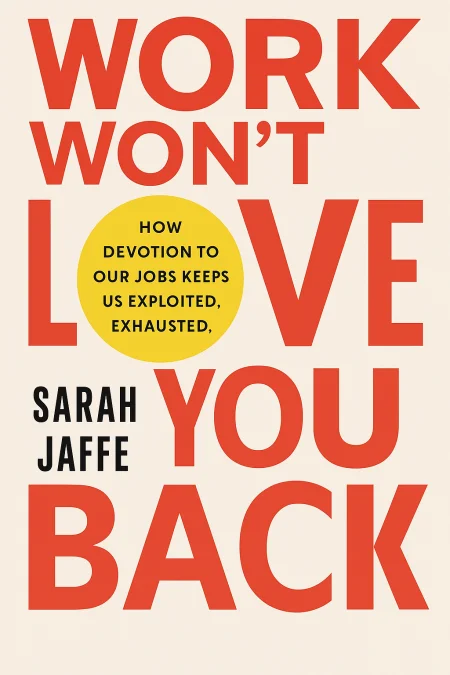
Work Won't Love You Back
How Devotion to Our Jobs Keeps Us Exploited, Exhausted, and Alone
Book Edition Details
Summary
In a world where passion often masquerades as a paycheck, Sarah Jaffe’s "Work Won't Love You Back" uncovers the seductive snare of the "labor of love" myth—a modern trap that blurs the line between vocation and exploitation. Jaffe takes readers on a profound journey through the lives of diverse workers, from relentless nurses to unpaid interns, unveiling the harsh truth behind the feel-good mantra: doing what you love can often lead to doing too much for too little. With keen insight and compelling narratives, Jaffe dissects the historical and cultural forces that have convinced us to trade fulfillment for financial insecurity. This book is both an exposé and a rallying cry, urging us to reclaim our time and redefine what truly brings joy and satisfaction in our professional lives.
Introduction
Contemporary capitalism has engineered a profound deception that transforms exploitation into devotion, convincing workers that their labor should be an expression of personal passion rather than economic necessity. This ideological transformation represents one of the most sophisticated mechanisms of control ever developed, weaponizing human emotional needs to extract greater value while simultaneously reducing material compensation and job security. The seductive promise that meaningful work can provide fulfillment, purpose, and even love has become a tool for systematic exploitation across industries, from education and healthcare to technology and creative fields. The mythology operates by appropriating genuine human desires for purpose and connection, redirecting these fundamental needs toward corporate profit maximization rather than authentic human flourishing. Workers find themselves trapped in a psychological bind where advocating for fair treatment appears to contradict their professional identity and moral commitments. This emotional manipulation proves remarkably effective because it appeals to our highest aspirations while serving interests fundamentally opposed to worker welfare. Dismantling this mythology requires rigorous analysis of how passion-based exploitation functions across different sectors, how it developed historically, and how workers are beginning to resist its psychological grip. The examination reveals that genuine fulfillment cannot emerge from employment relationships designed to extract value, but only through activities chosen freely and relationships built on mutual care rather than economic coercion.
The Ideological Construction of Passion-Based Labor Exploitation
The transformation of work into an expression of personal calling represents a deliberate ideological project that emerged alongside neoliberalism's rise. Historical analysis reveals how this shift replaced the post-war social contract of stable employment and rising wages with a more insidious proposition: find your passion, pursue your dreams, and work will become a source of personal fulfillment rather than mere survival. This transition coincided strategically with the entry of women and marginalized groups into professional workforces, redefining their positions as opportunities for self-actualization rather than extending traditional labor protections. The psychological architecture of this ideology operates through several interconnected mechanisms. First, it transforms basic human needs for meaning and community into vulnerabilities that can be systematically exploited. Second, it creates self-disciplining workers who internalize responsibility for workplace problems, viewing professional struggles as personal failings rather than structural issues. Third, it provides moral justification for below-market compensation by suggesting that workers receive non-monetary rewards in the form of personal satisfaction and social purpose. The framework's effectiveness depends on maintaining artificial separations between different types of work while obscuring their common structural features. Care work appears to occupy the realm of selfless service while creative work seems to represent individual expression, yet both rely on the same fundamental mechanism of extracting unpaid emotional labor through appeals to workers' values and identities. This false distinction prevents workers from recognizing their shared interests and building collective resistance. The ideology's power extends beyond individual workplaces to reshape entire sectors of the economy. By normalizing the expectation that certain workers should be grateful for the opportunity to serve, it creates a two-tier system where some labor commands market rates while other work is systematically devalued, typically along lines that reinforce existing hierarchies of race, gender, and class.
From Care Work to Creative Industries: Universal Devaluation
The expansion of labor-of-love ideology across diverse economic sectors reveals its adaptability as a mechanism of control and value extraction. In care work, the framework manifests through assumptions that those who tend to children, elderly, or disabled individuals are motivated primarily by compassion rather than economic necessity. This naturalization of caring labor as an extension of feminine instinct rather than skilled work deserving fair compensation creates systematic wage depression for essential services while maintaining their profitability for employers and institutions. Educational workers exemplify this dynamic through constant pressure to prioritize students' needs over their own working conditions. The rhetoric of teaching as a calling obscures the reality that educators require living wages, reasonable class sizes, and adequate resources to perform effectively. When teachers organize for better conditions, they face accusations of betraying children rather than recognition as legitimate labor disputes, forcing them to choose between professional identity and material interests. Creative industries represent perhaps the purest expression of passion economy logic, where the opportunity to pursue artistic expression is presented as compensation for economic precarity. Artists, writers, and cultural workers are expected to accept unpaid internships, exposure-based payment, and unstable employment as natural features of creative careers. This normalization of artistic poverty maintains a vast pool of skilled cultural laborers willing to work for minimal compensation, subsidizing cultural production while concentrating profits among intermediaries and platforms. Technology workers, despite their relatively privileged position, experience their own version of this exploitation through corporate cultures that blur boundaries between work and life. The promise of changing the world through innovation justifies extreme working hours and total commitment to company missions, while stock option possibilities create gambling mentalities that obscure the reality of wage labor relationships. Even highly skilled programmers find themselves subject to expectations that their work should provide intrinsic satisfaction beyond material compensation.
Worker Resistance Against Emotional Manipulation and False Consciousness
Recognition of passion-based exploitation's manipulative nature has sparked diverse forms of worker resistance that address both material conditions and ideological frameworks. Successful organizing efforts have learned to distinguish between authentic commitment to work quality and institutional structures that exploit these feelings, developing strategies that validate workers' genuine care while challenging systems that weaponize their dedication. Teachers' strikes have proven particularly effective at reframing labor disputes around student welfare rather than against it, arguing that educator working conditions directly impact learning environments. By connecting their own needs to broader educational quality, teachers build public support for demands that might otherwise be dismissed as selfish, demonstrating that professional ethics actually require adequate resources and fair compensation to ensure effective instruction. Healthcare workers have similarly challenged the expectation that professional dedication requires personal sacrifice, explicitly rejecting false choices between caring for patients and advocating for worker rights. Nursing strikes and physician organizing efforts demonstrate that quality care depends on adequate staffing, safe working conditions, and sustainable compensation structures rather than individual heroism and self-sacrifice. Creative workers increasingly organize around the principle that cultural production requires sustainable economic foundations, rejecting exposure economy logic while building alternative models that support artistic work. Writers' unions, artists' collectives, and entertainment industry organizing efforts establish professional standards that recognize creative labor as skilled work deserving market compensation, challenging the notion that artistic expression should substitute for payment. The most promising resistance movements focus on building solidarity across different types of love-labor, recognizing shared experiences of having emotional investment weaponized against economic interests. This cross-sector organizing enables broader coalitions that challenge fundamental assumptions underlying contemporary work arrangements rather than simply addressing symptoms within particular industries.
Beyond Work: Reclaiming Human Connection from Capitalist Appropriation
The ultimate challenge posed by labor-of-love ideology extends beyond workplace reform to fundamental questions about the relationship between human fulfillment and economic activity. Genuine liberation requires creating space for care, creativity, and connection that exists independently of employment relationships designed to extract value. This reclamation involves distinguishing between work as economic necessity and activity as human expression, recognizing that many activities currently performed as wage labor could be reconceptualized as forms of social contribution existing outside market relationships. The vision encompasses reimagining social organization around human flourishing rather than economic productivity, potentially involving reduced working hours that create space for genuine leisure, community engagement, and personal development. Universal basic services could decouple survival from employment, allowing people to engage in meaningful activity without the coercion of economic necessity, while cooperative structures and mutual aid networks could support creative and caring work outside capitalist frameworks. Such transformation requires collective action that extends beyond workplace organizing to encompass broader social movements for economic justice and human dignity. The labor-of-love myth can only be fully dismantled through alternative social arrangements that provide security, purpose, and connection without requiring their subordination to profit maximization, representing not just institutional reform but fundamental reimagining of relationships between individual fulfillment and collective well-being. This path forward involves reclaiming time and energy currently captured by work demands, redirecting our capacity for love and care toward relationships and communities rather than employers and corporate missions. The shift requires understanding that problems lie not in desires for meaningful activity, but in systems that manipulate these desires to serve interests fundamentally opposed to human welfare and authentic connection.
Summary
The systematic weaponization of human desires for meaning and connection through labor-of-love ideology represents contemporary capitalism's most sophisticated form of psychological control, transforming genuine needs for purpose into mechanisms of exploitation that span industries and professional categories while preventing collective recognition of shared interests. The mythology's power lies not in direct coercion but in making workers complicit in their own exploitation by appealing to their highest moral commitments and aspirations for authentic contribution. Yet growing resistance across affected sectors demonstrates both the unsustainability of this system and possibilities for alternative arrangements that honor human dignity while recognizing the genuine value of socially necessary labor, pointing toward futures where fulfillment emerges from freely chosen activities and mutual care rather than employment relationships designed to extract maximum value from human emotional resources.
Related Books
Download PDF & EPUB
To save this Black List summary for later, download the free PDF and EPUB. You can print it out, or read offline at your convenience.
By Sarah Jaffe
