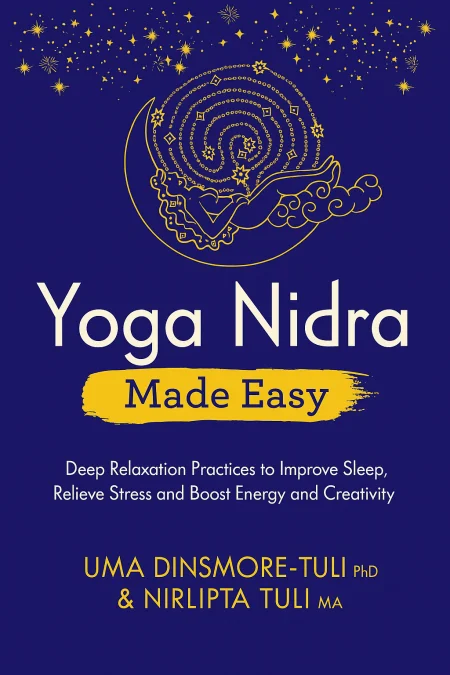
Yoga Nidra Made Easy
Deep Relaxation Practices to Improve Sleep, Relieve Stress and Boost Energy and Creativity
byUma Dinsmore-Tuli, Nirlipta Tuli
Book Edition Details
Summary
Picture a sanctuary where the chaos of daily life melts away, leaving only tranquility and renewal. In "Yoga Nidra Made Easy," seasoned guides Uma Dinsmore-Tuli and Nirlipta Tuli unveil the art of yogic sleep—a practice where profound rest meets mindful awareness, no physical exertion required. This sacred tradition, accessible to all, offers more than mere relaxation; it's a gateway to a realm of rejuvenation and inner clarity. With their expertise, you'll gain the tools to personalize your journey into this meditative state, explore fascinating case studies, and access exclusive audio resources designed to deepen your experience. Whether you seek restful slumber or a burst of creative energy, this guide promises a transformative path to harmonizing the rhythms of your life.
Introduction
Imagine lying down for twenty minutes and emerging feeling as refreshed as if you had slept for hours. This isn't fantasy—it's the remarkable experience of yoga nidrā, often called "yogic sleep." While it may appear that practitioners are simply taking a nap, something profound is happening beneath the surface. During yoga nidrā, the brain cycles through the same wave patterns experienced during deep sleep, yet consciousness remains gently aware, creating a unique state where the body rests while the mind observes. This ancient practice, rooted in goddess worship traditions dating back thousands of years, has captured the attention of modern neuroscientists and sleep researchers. Studies reveal that yoga nidrā can effectively reduce stress, manage pain, improve sleep quality, and enhance creativity. What makes this practice particularly fascinating is its adaptogenic nature—like a medicinal herb that provides exactly what each person needs, yoga nidrā responds to individual requirements, offering deep rest to the exhausted, creative inspiration to the blocked, and healing to the stressed. Through exploring the nine-stage cyclical process that guides practitioners into this liminal state between waking and sleeping, we discover how ancient wisdom perfectly complements our modern understanding of consciousness, brain function, and the vital importance of rest in our overstimulated world.
Understanding Yoga Nidrā: From Ancient Goddess Worship to Modern Science
The story of yoga nidrā begins not with modern yoga studios or relaxation techniques, but with the worship of Nidrā Shakti, the ancient Indian goddess who personified the power of sleep itself. In sacred texts dating back over a thousand years, this divine feminine force was so powerful that even the gods fell under her influence. The epic tale describes how Yoga Nidrā Shakti held Viṣṇu, the sustainer of the universe, in such deep yogic sleep that demons threatened to destroy all creation while he rested. Only when the other gods praised her with elaborate hymns did she release her hold, allowing Viṣṇu to awaken and save the world. This mythological foundation reveals something profound about yoga nidrā's essential nature—it represents a state of such deep rest that it transcends ordinary consciousness while maintaining awareness. Medieval yogis understood this paradox, describing yoga nidrā as a place where time becomes nonexistent, where practitioners could remain conscious while experiencing the profound restoration that typically occurs only in deep sleep. They recognized that this liminal state between waking and sleeping offered access to creative insights, healing, and spiritual awakening. Modern science has validated these ancient insights through brain wave studies conducted since the 1970s. Researchers discovered that during a twenty-minute yoga nidrā session, practitioners cycle through the same sequence of brain wave states experienced during a full night's sleep—from the alert beta waves of everyday consciousness, through the relaxed alpha waves, into the deeply creative theta waves, and sometimes even touching the profoundly restorative delta waves of deep sleep. This explains why the practice feels so refreshing and why many people report that twenty minutes of yoga nidrā can feel equivalent to hours of regular sleep. What makes yoga nidrā particularly relevant today is its adaptogenic quality—its ability to provide exactly what each practitioner needs in the moment. For the stressed executive, it offers deep relaxation and nervous system reset. For the creative artist, it unlocks inspiration and problem-solving insights. For the chronic pain sufferer, it provides relief and healing. This remarkable adaptability stems from the practice's fundamental structure: a nine-stage cyclical process that guides practitioners through settling, body awareness, paradox exploration, and gentle return to waking consciousness, allowing the innate wisdom of the body-mind to determine what unfolds in each session.
The Nine-Stage Process: Mastering the Natural Cycle of Yogic Sleep
Yoga nidrā follows a precise yet flexible nine-stage structure that mirrors the natural process of falling asleep while maintaining conscious awareness. This isn't arbitrary—it reflects the organic way consciousness naturally transitions between states, much like walking a labyrinth that spirals inward toward a center of deep rest before guiding you safely back out. Each stage has a specific purpose, building upon the previous one to create the optimal conditions for the profound relaxation and restoration that defines authentic yoga nidrā. The process begins with preparation and settling, establishing the physical and mental conditions necessary for the journey inward. Just as you might arrange pillows and blankets before sleep, these opening stages invite the body to release the day's tensions and the mind to let go of its usual preoccupations. The third stage introduces inner listening or intention setting, creating a gentle focus that guides the entire experience. This might be as simple as welcoming whatever arises or as specific as seeking insight into a particular challenge. The fourth stage, welcoming attention around the body, involves a systematic journey of awareness from head to toe, activating the sensory and motor cortices of the brain while simultaneously relaxing every part of the physical form. This rotation of consciousness serves multiple purposes: it occupies the thinking mind, promotes whole-body relaxation, and can even support healing and pain relief. The fifth stage explores paradox and integration, inviting practitioners to experience contrasting sensations or states simultaneously—perhaps feeling both heavy and light, or awake and asleep at the same time. The remaining stages mirror the inward journey but in reverse, guiding practitioners safely back to ordinary waking consciousness. The optional sixth stage connects with imaginative capacity, accessing the dream-like theta brain wave states where creative solutions and insights often arise. Stages seven through nine return to inner listening, externalize awareness, and complete the cycle, ensuring that practitioners emerge feeling refreshed and integrated rather than groggy or disoriented. This careful structure explains why yoga nidrā is so reliably restorative—it honors the natural rhythms of consciousness while providing a safe container for deep rest and renewal.
Brain Waves and Healing: How Yoga Nidrā Transforms Stress into Restoration
The healing power of yoga nidrā becomes clear when we understand how the practice influences brain wave activity and nervous system function. Our brains generate electrical activity that can be measured as brain waves, each type associated with different states of consciousness and healing processes. Beta waves dominate our waking hours, particularly the high beta states that accompany stress, anxiety, and the constant stimulation of modern life. While necessary for focused attention and problem-solving, prolonged high beta activity exhausts our systems and compromises our health. Yoga nidrā provides a systematic pathway out of these depleting brain wave states. Within minutes of beginning the practice, most people naturally shift into alpha waves—the relaxed yet alert state associated with meditation, creativity, and what athletes call "flow." This alpha state forms the foundation of yoga nidrā, providing a calm baseline from which practitioners can explore even deeper levels of rest and restoration. As the practice deepens, theta waves often emerge, bringing the surreal imagery and profound insights characteristic of the hypnagogic state between waking and sleeping. Most remarkably, yoga nidrā can guide practitioners into delta wave states—the slowest, most powerful brain waves associated with deep sleep, physical healing, and cellular repair. While we typically access delta waves only during unconscious sleep, yoga nidrā allows conscious experience of these profoundly restorative states. This explains why the practice can be so healing for chronic stress, pain, and even trauma. In delta states, the body's natural healing mechanisms activate while the mind experiences deep peace beyond thought and worry. The practice also occasionally produces gamma waves, associated with moments of insight, compassion, and higher cognitive function. These brief spikes of gamma activity often coincide with creative breakthroughs or profound realizations during or after yoga nidrā sessions. What makes this brain wave journey particularly powerful is that practitioners learn to recognize and navigate these different states consciously, developing skills they can apply outside the practice. Someone familiar with yoga nidrā's alpha state, for example, can more easily return to that calm, centered awareness when faced with daily stressors, transforming their relationship with challenge and difficulty through the embodied knowledge of how to access inner peace and restoration.
Practical Applications: Sleep, Pain Relief, and Creative Enhancement
The versatility of yoga nidrā shines through its practical applications for common modern challenges. For the millions struggling with insomnia and sleep disruption, yoga nidrā offers both direct relief and sleep education. Because the practice is essentially meditation on the process of falling asleep, regular practitioners develop greater familiarity with the natural transitions between waking and sleeping states. They learn to recognize their body's sleep signals and can use simplified versions of the settling techniques when lying in bed, transforming restless nights into opportunities for rest and restoration. The practice proves equally valuable for pain management, working through multiple mechanisms that complement conventional medical treatment. The systematic body awareness component of yoga nidrā can help practitioners develop a different relationship with pain, noticing areas of tension and consciously directing breath and attention toward relief. The deep relaxation states naturally reduce the muscle tension that often amplifies pain perception, while the profound rest allows the body's natural healing processes to function more effectively. Many chronic pain sufferers report that while yoga nidrā may not eliminate their condition, it significantly improves their quality of life and ability to cope. For creative enhancement and problem-solving, yoga nidrā's ability to access theta and gamma brain wave states makes it a powerful tool for innovation and insight. The practice creates optimal conditions for what researchers call "loose associations"—the kind of non-linear thinking that leads to breakthrough ideas and creative solutions. By occupying the analytical mind with the gentle tasks of body awareness and breath observation, yoga nidrā frees the unconscious mind to make novel connections and generate unexpected solutions. The beauty of these applications lies in their accessibility. Unlike many therapeutic interventions, yoga nidrā requires no special equipment, expensive treatments, or complex learning curves. A person dealing with insomnia can practice the settling techniques in bed, using the natural process of falling asleep as their teacher. Someone seeking pain relief can adapt the practice to their physical needs, perhaps practicing in a comfortable chair or supported side-lying position. Creative individuals can use specific intentions during the third stage of the practice, essentially programming their unconscious mind to work on particular challenges while they rest. This democratic accessibility, combined with the practice's profound effectiveness, makes yoga nidrā a valuable resource for anyone seeking to improve their sleep, manage pain, or enhance their creative capacity.
Summary
At its core, yoga nidrā reveals that conscious rest is not a luxury but a fundamental human capacity that can transform our relationship with stress, sleep, creativity, and healing. This ancient practice demonstrates that the liminal space between waking and sleeping—far from being empty downtime—represents a powerful state of consciousness where profound restoration and insight naturally occur. By learning to navigate the nine-stage process that guides us safely into and out of yogic sleep, we develop skills that extend far beyond the practice session itself, gaining tools for managing daily stress, accessing creative solutions, and honoring the natural rhythms that support human flourishing. As we continue to understand the neuroscience behind these ancient techniques, we might ask ourselves how our modern lives would change if we truly valued rest as much as we value productivity, and what insights might emerge if we regularly gave ourselves permission to explore the wisdom that lies in the space between thoughts. For readers drawn to the intersection of ancient wisdom and modern science, or those seeking practical tools for stress reduction and enhanced well-being, yoga nidrā offers a uniquely accessible path to discovering the transformative power that lies hidden in the simple act of conscious rest.
Related Books
Download PDF & EPUB
To save this Black List summary for later, download the free PDF and EPUB. You can print it out, or read offline at your convenience.
By Uma Dinsmore-Tuli
