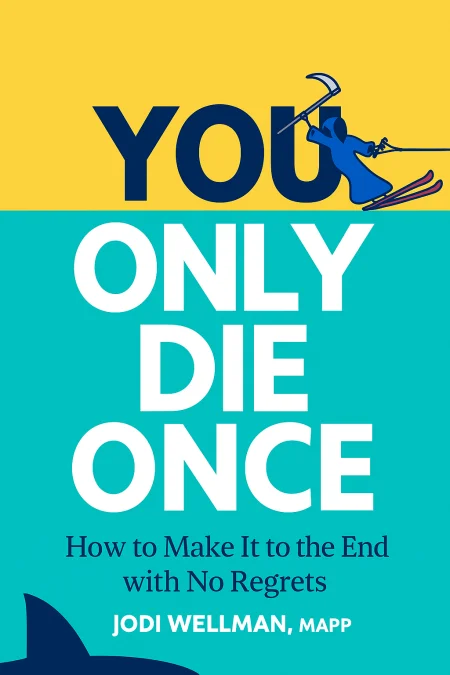
You Only Die Once
How to Make It to the End with No Regrets
Book Edition Details
Summary
Tick-tock goes the Monday clock, counting down the moments of your life's great narrative. In "You Only Die Once," Jodi Wellman flips the script on mundane existence with a vibrant wake-up call that intertwines positive psychology with the art of living deeply. Are you spending your finite allotment of 4,000 Mondays stuck in the drudgery of a job you dread, or are you sculpting a life that sets your spirit ablaze? Wellman's guide eschews preachy clichés for a spirited journey, offering captivating stories, soul-stirring exercises, and cheeky illustrations that coax out your inner adventurer. Whether you choose to embrace the kale or not, this book is your personal toolkit for re-igniting passion and curiosity, transforming each remaining Monday into a masterpiece of meaning.
Introduction
Sarah stared at her computer screen, watching the cursor blink in the empty document. Another Monday morning, another week of the same routine that had somehow become her life. Coffee at 7:30, emails until lunch, meetings that could have been emails, dinner while scrolling through social media, bed by 10. Rinse and repeat. When had living become so automatic, so devoid of the spark she once felt? The question that haunted her quiet moments was simple yet terrifying: "Is this all there is?" This feeling of sleepwalking through life, of existing rather than truly living, touches more of us than we care to admit. We find ourselves caught in the comfortable trap of routine, mistaking busyness for purpose, mistaking survival for vitality. Yet beneath the surface of our well-ordered days lies a deeper truth we rarely acknowledge: our time here is finite, precious, and slipping away faster than we realize. The paradox is profound. While we instinctively avoid thinking about death, it is precisely this awareness of our mortality that can awaken us to life's extraordinary possibilities. When we truly grasp that our days are numbered, something shifts. Priorities clarify. Courage emerges. The mundane transforms into the meaningful. This isn't about becoming morbid or fearful, but about using the reality of our finite existence as fuel for a more intentional, vibrant way of being. The question isn't whether we'll die, but whether we'll truly live before we do.
The Wake-Up Call: When Mortality Becomes Your Greatest Teacher
Maria discovered she had exactly 1,247 Mondays left to live. Not because of a terminal diagnosis, but because she had finally done the math. At fifty-five, with an average life expectancy stretching before her, she calculated her remaining weeks and felt something she hadn't experienced in years: urgency. Not the frantic urgency of deadlines and obligations, but the clarifying urgency of possibility. She bought a small silver coin engraved with a skull and the Latin phrase "memento mori" - remember you must die. Each morning, she held it briefly, whispering those words that had once seemed morbid but now felt like a gentle wake-up call. The practice transformed her days in unexpected ways. The coin in her pocket became a reminder to notice the warmth of sunlight streaming through her kitchen window, to really listen when her daughter called, to choose the scenic route home from work. She started saying yes to invitations she would have declined, began learning Spanish, and finally booked that trip to Morocco she'd been postponing for "someday." Her friends noticed the change - a lightness in her step, a brightness in her eyes, an infectious enthusiasm for experiences both grand and ordinary. Ancient philosophers understood what modern life often obscures: death is not life's opposite, but its greatest teacher. When we acknowledge our mortality not with fear but with acceptance, we discover an unexpected gift. The awareness of our finite nature doesn't diminish life's beauty; it amplifies it. Every sunset becomes more vivid, every conversation more precious, every opportunity more significant. This isn't about living in constant awareness of death, but about allowing that awareness to inform our choices, to guide us toward what truly matters, and to free us from the trivial concerns that so often consume our energy.
Breaking Free: Escaping the Comfortable Trap of Autopilot Living
David realized he had been living the same day for three years. The alarm at 6:30, the same breakfast, the same route to work, the same lunch spot, the same evening routine. Even his weekend had become predictable - groceries on Saturday morning, laundry in the afternoon, meal prep on Sunday. He felt like he was trapped in his own version of Groundhog Day, except Bill Murray's character eventually learned to break free. David wasn't sure he remembered how. The wake-up call came during a conversation with his eight-year-old nephew, who asked him what exciting thing he had done that week. David searched his memory and came up empty. Not just that week, but the month before, maybe even the season. He had been so focused on efficiency, on maintaining control through routine, that he had accidentally automated his entire existence. His habits, once helpful structures, had become invisible prisons. The following Monday, David made a small but radical decision: he took a different route to work. The ten-minute detour led him past a farmers market he never knew existed, through a neighborhood with murals that made him smile, and past a coffee shop that became his new morning ritual. That single change rippled outward. He started trying new restaurants, accepting invitations he would have declined, and even signed up for a pottery class. His life didn't become chaotic; it became colorful. Habits serve us until they don't. The routines that once provided stability can become the very things that drain life of its vitality. When we operate on autopilot, we miss the subtle magic of everyday moments and the opportunities for growth that surround us. Breaking free doesn't require dramatic upheaval, but rather small, intentional disruptions to our patterns. The goal isn't to eliminate all structure, but to ensure that our routines serve our aliveness rather than suppress it.
The Vitality-Meaning Framework: Building a Life Worth Celebrating
Elena plotted her life on a simple graph with two axes: vitality and meaning. The horizontal line represented how energized and engaged she felt day to day - her sense of aliveness, pleasure, and zest for experience. The vertical line captured how purposeful and significant her life felt - her connection to something larger than herself. As she marked her position, she found herself in what she came to call the "meaningfully bored" quadrant: her work as a social worker was deeply purposeful, but her life had become predictably flat, lacking the spark of adventure and joy. Her friend Marcus landed in a different spot entirely. His life was full of excitement - weekend trips, new restaurants, social events, and hobbies - but he felt hollow inside, as if he were living on the surface of his own existence. He was vitally empty, rich in experiences but poor in purpose. Both friends recognized they were living incomplete lives, missing essential elements that would make their remaining years truly fulfilling. The revelation led them to become accountability partners in what they called their "astonishing life project." Elena began incorporating more play and spontaneity into her weeks - salsa dancing lessons, impromptu road trips, and yes to invitations that scared her a little. Marcus started volunteering at a literacy program and exploring meditation, seeking the deeper currents that would give his adventures more meaning. Gradually, both moved toward that coveted upper-right quadrant where vitality and meaning intersect. Living fully requires both width and depth - the breadth of varied experiences and the depth of meaningful connection to purpose. Too much focus on either dimension alone leaves us incomplete. The vitally empty life feels hollow despite its excitement, while the meaningfully bored life feels flat despite its significance. The goal isn't perfection in both areas, but rather conscious attention to whichever dimension needs nurturing. When we tend to both our need for aliveness and our hunger for meaning, we create the conditions for a life that feels both fully lived and deeply satisfying.
Summary
The greatest tragedy isn't death itself, but reaching the end of our days with the haunting realization that we never truly lived. Through the stories of Sarah's awakening, Maria's transformation, David's liberation, and Elena and Marcus's journey toward wholeness, we see that the path to an extraordinary life isn't found in avoiding thoughts of mortality, but in embracing them as catalysts for change. Three profound truths emerge from this exploration. First, awareness of our finite nature doesn't diminish life's beauty but intensifies it, transforming ordinary moments into precious gifts and clarifying what truly deserves our attention and energy. Second, the habits and routines that once served us can become invisible cages, and breaking free requires the courage to disrupt our patterns and invite novelty back into our days. Third, a life worth living requires both vitality and meaning - the width of varied experiences and the depth of purposeful connection to something greater than ourselves. The invitation is clear: stop postponing your aliveness. Calculate your remaining Mondays not to create anxiety, but to inspire action. Let the reality of your mortality become the fuel for your most authentic choices. Whether it's taking a different route to work, learning a new skill, deepening relationships, or pursuing long-delayed dreams, the time for living fully is now. Your finite days are not a limitation but a gift - the very thing that makes each moment precious and every choice significant. The question isn't whether you'll die, but whether you'll choose to truly live before you do.
Related Books
Download PDF & EPUB
To save this Black List summary for later, download the free PDF and EPUB. You can print it out, or read offline at your convenience.
By Jodi Wellman
