
Shape
The Hidden Geometry of Information, Biology, Strategy, Democracy, and Everything Else
Book Edition Details
Summary
Geometry isn’t just the dusty remnants of your high school days; it’s the silent architect behind our world’s most pressing challenges and captivating wonders. From shaping fairer elections to decoding the mysteries of pandemics, geometry’s influence reaches far beyond the chalkboard. In "Shape," a New York Times bestseller by the acclaimed author of "How Not to Be Wrong," geometry’s vibrant tapestry is unraveled, revealing its role in everything from AI’s gaming mastery to the complex dance of political systems. This book is a delightful ode to the patterns that govern our universe, inviting even the math-averse to rediscover the elegance and power of geometric thinking in our everyday lives.
Introduction
Geometry operates as an invisible force shaping virtually every aspect of human experience, from the spread of diseases and the mechanics of democratic processes to the algorithms powering artificial intelligence and the patterns underlying biological systems. This exploration challenges the conventional view of geometry as merely an academic subject about shapes and measurements, instead revealing how geometric thinking serves as a fundamental framework for understanding complex systems that govern modern life. The investigation demonstrates that seemingly disparate phenomena across disciplines share common geometric structures that, once recognized, illuminate profound connections between areas as diverse as epidemiology, political science, computer science, and social networks. The analytical approach employed here transcends traditional disciplinary boundaries by identifying underlying mathematical patterns and examining how these patterns manifest across different contexts. Through systematic examination of real-world applications, historical developments, and theoretical frameworks, the analysis reveals how geometric principles provide both diagnostic tools for understanding complex problems and prescriptive guidance for designing effective solutions. The methodology involves tracing how abstract mathematical concepts translate into practical instruments for analyzing everything from viral transmission networks to electoral fairness, demonstrating that geometric literacy represents not merely technical competence but essential preparation for informed citizenship in an increasingly quantified world.
Why Geometric Thinking Reveals Universal Patterns Across Disciplines
Geometric reasoning provides a universal language for understanding relationships and structures that appear across vastly different domains of human knowledge and experience. The power of this approach lies in its ability to transform abstract problems into visual, spatial representations that human minds can more readily grasp and manipulate. When epidemiologists model disease transmission, they employ geometric concepts to understand how infections spread through social networks. When computer scientists design machine learning systems, they navigate high-dimensional geometric spaces to optimize algorithmic performance. When political analysts examine voting patterns, they use geometric tools to visualize ideological distances and detect systematic distortions in electoral systems. The universality of geometric patterns emerges from fundamental mathematical structures that govern how information flows, how networks form connections, and how optimization processes seek efficient solutions. These underlying structures remain consistent whether the specific application involves biological systems, technological networks, or social institutions. Random walk processes, originally developed to describe particle movement in physics, now illuminate everything from stock market fluctuations to epidemic spread to web page ranking algorithms. Network topology concepts reveal similar organizational principles in neural networks, transportation systems, and social media platforms. Geometric thinking also provides essential tools for bridging the gap between mathematical abstraction and practical application. Unlike purely algebraic approaches that often remain opaque to non-specialists, geometric methods offer visual and spatial metaphors that make complex ideas accessible to broader audiences. This accessibility becomes crucial when addressing societal challenges that require interdisciplinary collaboration and public understanding. The geometric perspective enables experts from different fields to communicate effectively about shared mathematical structures underlying their respective domains. The recognition of universal geometric patterns transforms how we approach complex problems by revealing that solutions developed in one domain often apply to seemingly unrelated challenges in other areas. Techniques for analyzing network robustness in computer science inform strategies for epidemic control in public health. Methods for detecting manipulation in electoral systems draw upon optimization algorithms developed for resource allocation problems. This cross-pollination of geometric insights accelerates problem-solving and innovation across multiple disciplines simultaneously.
How Mathematical Models Bridge Ancient Wisdom and Modern Algorithms
The evolution from classical geometric proofs to contemporary computational algorithms reveals remarkable continuity in mathematical thinking that spans millennia while adapting to increasingly complex challenges. Ancient geometric methods established rigorous standards for logical reasoning that continue to underpin modern technological innovations, demonstrating how timeless principles of systematic thinking translate into cutting-edge applications. The same commitment to step-by-step logical progression that characterized Euclidean demonstrations now informs the algorithms that power search engines, recommendation systems, and artificial intelligence applications. Classical geometry emphasized the importance of building complex conclusions from simple, self-evident starting points through rigorous deductive steps. This methodical approach created a template for systematic reasoning that extends far beyond mathematical contexts into legal argumentation, scientific methodology, and democratic discourse. Modern algorithms embody this same commitment to logical precision, breaking complex problems into manageable steps that computers can execute reliably while maintaining the geometric tradition of seeking elegant, generalizable solutions that reveal deeper structural principles. The transition from manual calculation to computational methods has dramatically expanded the scope of geometric applications without abandoning fundamental geometric intuition. Where ancient mathematicians could analyze relatively simple shapes and relationships, modern computers can process geometric problems involving millions of dimensions and astronomical numbers of variables. This computational power has unlocked new possibilities for applying geometric insights to previously intractable challenges in fields ranging from molecular biology to economic modeling, while still requiring human geometric understanding to provide the conceptual framework that guides algorithm development and interpretation. The most successful technological applications combine computational power with deep geometric insight, creating tools that leverage both human intuition and machine precision. Machine learning systems operate by navigating high-dimensional geometric spaces, making decisions based on spatial relationships that reflect the same fundamental principles that guided ancient geometric reasoning. This synthesis demonstrates how mathematical wisdom accumulated over centuries continues to inform cutting-edge innovation, suggesting that geometric literacy remains as relevant today as it was in ancient Greece, albeit applied to vastly more complex and consequential problems.
When Democratic Systems Fail: The Geometry of Fair Representation
Democratic representation presents complex geometric challenges that reveal the mathematical foundations underlying political fairness and expose how seemingly neutral procedures can systematically distort electoral outcomes. The process of dividing populations into electoral districts creates geometric puzzles with profound implications for democratic legitimacy, where the configuration of boundary shapes determines whether election results reflect genuine popular preferences or systematic manipulations that predetermine political outcomes. These challenges demonstrate that geometric literacy becomes essential for understanding and evaluating the fairness of modern democratic systems. Electoral district boundaries create geometric shapes that function as the fundamental building blocks of representative democracy, yet these shapes can be manipulated through sophisticated mathematical optimization techniques that guarantee predetermined political results while maintaining the appearance of procedural neutrality. The same mathematical methods that enable efficient resource allocation and fair distribution can be perverted to create electoral maps that violate democratic principles while satisfying formal equality requirements. This manipulation exploits the gap between mathematical fairness and democratic fairness, revealing how technical competence without ethical constraints can undermine the very systems it claims to serve. Advanced geometric techniques now enable researchers to generate thousands of alternative district configurations and compare their properties statistically, providing objective methods for detecting when existing boundaries represent extreme outliers that could only result from deliberate manipulation rather than neutral geographic considerations. These computational approaches create mathematical baselines against which actual electoral systems can be measured, transforming political debates into questions with clear analytical answers. Ensemble methods that explore vast spaces of possible configurations reveal whether observed outcomes fall within reasonable ranges of variation or represent statistically implausible results that indicate systematic bias. The mathematical analysis of electoral fairness illustrates broader challenges in applying geometric principles to democratic governance, where competing values and interests cannot be reduced to single numerical measures. Proportional representation, efficiency gaps, and compactness measures each capture some aspects of fairness while missing others, revealing that democratic fairness involves trade-offs between competing principles that mathematical analysis can illuminate but cannot automatically resolve. The geometric perspective provides essential tools for understanding these trade-offs and detecting manipulation, but ultimately requires human judgment to balance competing democratic values within mathematical constraints.
The Future Demands Mathematical Literacy for Democratic Citizenship
Mathematical literacy, particularly geometric thinking, will become increasingly crucial as society grapples with complex technological and social challenges that require citizens capable of understanding and evaluating data-driven decision-making processes across all sectors of society. The proliferation of algorithmic systems in everything from criminal justice to healthcare to financial services demands citizens who can comprehend geometric models, statistical analyses, and computational processes that increasingly shape individual lives and collective outcomes. This mathematical competency represents not merely an academic skill but a fundamental requirement for meaningful participation in democratic discourse and informed personal decision-making in the twenty-first century. The integration of artificial intelligence into daily life makes geometric understanding even more essential for maintaining democratic accountability and individual autonomy. Machine learning systems operate by navigating high-dimensional geometric spaces, making decisions based on spatial relationships and optimization processes that remain invisible to most users. Citizens who lack geometric intuition become vulnerable to manipulation by systems they cannot comprehend, while those with strong geometric foundations can better evaluate, challenge, and influence these technological tools. The democratic implications of this mathematical divide suggest that geometric education becomes a matter of civic empowerment and social justice. Educational systems must evolve to emphasize geometric thinking as a practical life skill rather than an abstract academic subject, connecting mathematical concepts to real-world applications in politics, technology, health, and economics. Students need to understand how geometric reasoning helps them evaluate everything from pandemic modeling to social media algorithms to electoral fairness, preparing them to engage critically with the mathematical dimensions of contemporary challenges. This educational transformation requires demonstrating that mathematical thinking provides essential tools for understanding and influencing the systems that shape modern life. The democratization of mathematical tools through improved software and educational resources creates unprecedented opportunities for widespread geometric literacy and broader public participation in mathematical analysis of social problems. As these tools become more accessible, the potential emerges for evidence-based democratic discourse about complex issues that currently remain opaque to most citizens. This development could fundamentally transform democratic society by enabling informed public evaluation of policy proposals, technological systems, and institutional designs that depend on mathematical principles. The future of democratic governance may well depend on successfully cultivating this mathematical citizenship that combines technical competence with civic engagement.
Summary
Geometric thinking emerges as an indispensable intellectual framework for understanding and navigating the complex systems that increasingly define modern life, providing both practical tools for problem-solving and conceptual foundations for critical thinking about the mathematical structures that govern social, political, and technological relationships. The discipline reveals profound connections between seemingly disparate phenomena while offering rigorous methods for analyzing trade-offs, detecting manipulation, and designing systems that balance competing values under realistic constraints. This geometric perspective transforms citizens from passive consumers of expert opinion into active participants capable of evaluating claims, understanding algorithmic decisions, and demanding accountability from both human and artificial systems in an increasingly quantified world where mathematical literacy becomes synonymous with democratic empowerment and informed citizenship.
Related Books
Download PDF & EPUB
To save this Black List summary for later, download the free PDF and EPUB. You can print it out, or read offline at your convenience.
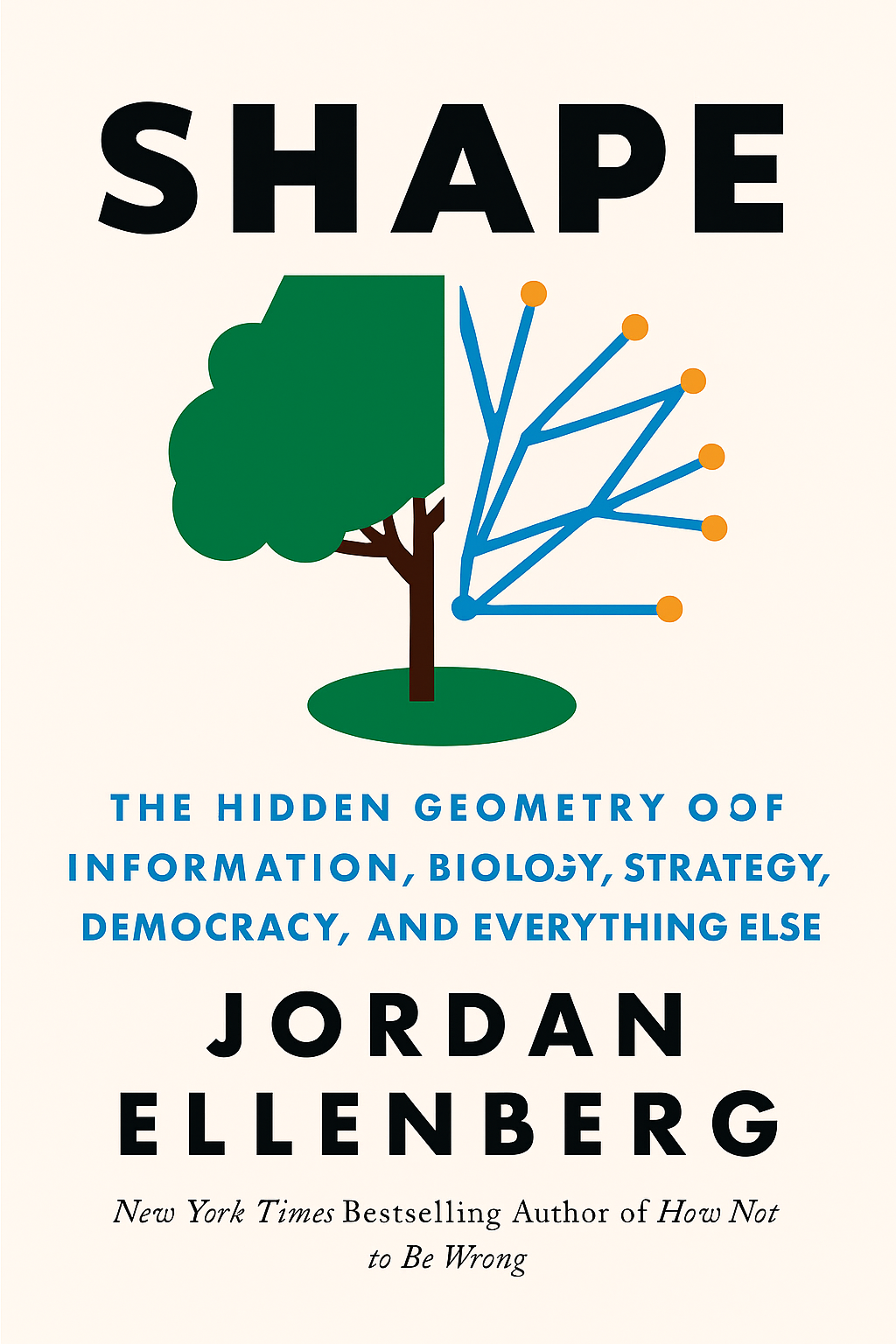
By Jordan Ellenberg
