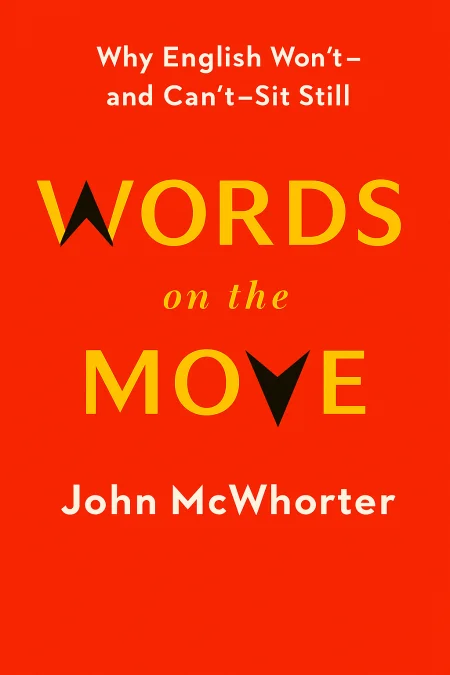
Words on the Move
Why English Won’t – and Can’t – Sit Still (Like, Literally)
Book Edition Details
Summary
Language is a living tapestry, and John McWhorter unravels its vibrant threads in "Words on the Move." Forget the doomsayers lamenting the demise of English; McWhorter invites us to witness its exhilarating evolution. With wit and wisdom, he dismantles the fear of change, showing how 'literally' can mean 'figuratively,' and how emojis and 'LOL' are not harbingers of doom but signs of linguistic vitality. This isn't just a history lesson; it's a celebration of words dancing through time, transforming and adapting. Did you know 'silly' once meant 'blessed'? Or that the -ly in adverbs harks back to 'like'? McWhorter’s narrative sparkles with such revelations, urging us to cherish the ever-shifting landscape of our mother tongue, where every twist and turn enriches our collective expression.
Introduction
Have you ever wondered why teenagers say "literally" to mean the exact opposite of what the word originally meant, or why your grandmother pronounces certain words differently than you do? Perhaps you've noticed how new slang terms seem to appear overnight, spreading through social media like wildfire, while other expressions your parents used sound hopelessly outdated. These aren't random linguistic accidents or signs of language decay—they're glimpses into one of the most fascinating and misunderstood aspects of human communication: language is always moving. Most of us think of language as something fixed, like a dictionary frozen in time, but this couldn't be further from the truth. Language is more like a living organism, constantly evolving, adapting, and transforming in ways both subtle and dramatic. Every conversation you have, every text you send, every word you speak contributes to this endless dance of change. What seems like sloppy grammar or annoying modern habits are actually the same natural processes that transformed Old English into the language of Shakespeare, and Shakespeare's English into ours. Understanding how language moves—how words shift meanings, sounds change over time, and grammar evolves—reveals not just the hidden mechanics of communication, but also something profound about human nature itself. This journey will challenge everything you thought you knew about "correct" English and show you why language change isn't the enemy of good communication, but rather its most essential feature.
How Words Get Personal: The Evolution of Meaning
Words have a secret life that most of us never notice. While we think of them as having fixed meanings locked away in dictionaries, words are actually on a constant journey from the objective world of facts into the subjective realm of human feelings and attitudes. This transformation from neutral description to personal expression is one of the most fundamental ways language changes, and it's happening all around us every day. Consider the word "really." Originally, it simply meant "in reality" or "actually." But somewhere along its evolutionary path, "really" developed a more personal function. When someone says "I really don't want to go," they're not just stating a fact about reality—they're emphasizing their emotional commitment to that position. The word has become what linguists call a "factuality marker," a tool we use to underline our sincerity and personal investment in what we're saying. This isn't sloppy usage; it's language becoming more human. This personal evolution explains many linguistic puzzles that frustrate language traditionalists. Take "literally," which now often means "figuratively." Rather than representing linguistic decay, this shift follows the same pattern that has shaped countless words throughout history. "Very" started as meaning "truly" (from French "vrai"), and "really" followed a similar path from objective truth to subjective emphasis. Words that refer to truth or reality seem destined to become tools for expressing our personal feelings about the truthfulness of our statements. The process reveals something remarkable about human communication: we're not content to simply exchange information like computers. We need to constantly signal our attitudes, acknowledge others' perspectives, and smooth the social waters of interaction. Words like "totally," "actually," and even the much-maligned "like" serve as social lubricants, helping us navigate the complex emotional landscape of conversation. When we understand this "FACE" of language—Factuality, Acknowledgment, Counterexpectation, and Easing—we begin to see that what sounds like verbal sloppiness is actually sophisticated social machinery at work.
Sound Changes That Shape Language Over Time
The way we pronounce words is like a slow-motion dance that never stops. Every generation slightly mishears and reproduces the sounds of the previous one, creating tiny shifts that accumulate over centuries into dramatic transformations. This isn't laziness or carelessness—it's an inevitable consequence of how human mouths and ears work, and it's responsible for some of the most puzzling aspects of English pronunciation and spelling. To understand how sounds move, imagine vowels as bees buzzing around in the hive of your mouth. They never stay perfectly still, and when one vowel drifts into another's territory, it sets off a chain reaction. This is exactly what happened during the Great Vowel Shift of the 15th and 16th centuries, which explains why English spelling seems so crazy today. Words like "mate" and "meet" are spelled the way they are because they preserve pronunciations from before this massive sound change occurred. What once made perfect sense—"mate" pronounced "MAH-teh" and "meet" pronounced "MAYT"—became fossilized in spelling while the sounds moved on. The same process continues today in regional accents across America. In the Northern Cities Shift, vowels are playing musical chairs from Buffalo to Chicago, with "cat" becoming "keh-it" and "block" sounding like "black." Meanwhile, in California, different vowel movements are turning "bitch" into "betch" and making "pink" sound like "peenk." These aren't random quirks or signs of linguistic deterioration—they're systematic sound changes following the same orderly patterns that have always governed language evolution. Understanding vowel shifts helps us make sense of seemingly odd pronunciations in old movies or regional speech patterns. It also reveals why attempts to preserve "correct" pronunciation are ultimately futile. Sound change is like weather—it's not something that happens to language, it's something language does. The vowels in your mouth are moving right now, imperceptibly but inevitably, carrying English toward its next evolutionary stage. What seems strange or wrong to our ears is often just the sound of the future arriving one generation at a time.
When Words Become Grammar: The Birth of New Rules
One of language's most remarkable magic tricks is transforming ordinary words into the invisible scaffolding that holds sentences together. The grammar we think of as fundamental—words like "the," "can," and "used to"—didn't spring into existence fully formed. They started as regular words with concrete meanings and gradually evolved into the abstract tools that structure our thoughts and sentences. Take "used to," which seems like such a basic part of English grammar. Originally, "use" meant exactly what you'd expect—to make use of something. But when we say "She used to live in Columbus," we're not talking about using anything in the normal sense. The phrase has become a grammatical marker for habitual past action, pronounced "yoosta" rather than "yoozed to." This transformation from meaningful word to grammatical tool—called grammaticalization—is one of the primary ways languages acquire the complex machinery they need to express subtle relationships between ideas. The process works through a combination of frequent use and gradual reinterpretation. "Can" started as a word meaning "know"—you can still see this in related words like "cunning" and "uncouth" (originally "unknowing"). Through constant use in contexts where knowing something implied being able to do it, "can" shifted from meaning "I know how" to "I am able." Similarly, "ought" began as the past tense of "owe," evolving from financial obligation to moral obligation to grammatical necessity. This grammaticalization process is happening right now with words like "like," "totally," and even "ass" in phrases like "big-ass truck." What strikes many people as sloppy speech is actually language creating new grammatical tools to express nuances of meaning that didn't exist before. "Who all is coming?" uses "all" as a plural marker for "who," filling a gap in English grammar. These innovations aren't corruptions of the language—they're the same creative processes that gave us the grammatical structures we now consider essential to English. Understanding grammaticalization reveals that language isn't a fixed system handed down from authorities, but a living toolkit constantly upgraded by its users to meet evolving communicative needs.
Language in Motion: Why Change Is Natural and Unstoppable
The final piece of the language change puzzle involves understanding how words literally reproduce and create offspring. Just as biological evolution combines genetic material from different sources, linguistic evolution involves words mating and producing new combinations that eventually become independent entities. This process of word formation through combination and transformation is constantly refreshing the vocabulary and grammatical resources available to speakers. The "Backshift" phenomenon illustrates this reproductive process beautifully. When we combine two words like "black" and "board," something subtle but important happens to the pronunciation: the accent shifts to the first syllable, creating "BLACKboard" rather than "black BOARD." This accent change signals that we're no longer talking about any board that happens to be black, but about a specific thing—the slate writing surface in classrooms. The same process creates the difference between "ICE cream" (a specific frozen dessert) and "ice cream" (hypothetically, cream made from ice). This Backshift is happening in real time with terms that have entered our language recently. Listen to old movies and you'll hear people say "super-MARKET" and "Chinese FOOD" because these concepts were still new enough to be processed as descriptive phrases rather than unified concepts. As these terms became established, they underwent the Backshift to become "SUPERmarket" and "CHINESE food." The process continues today with terms like "CELL phone" (originally "cellular PHONE") and reveals itself in rapid linguistic evolution happening around us constantly. The word-mating process can go even further, creating true linguistic offspring that barely resemble their parents. "Breakfast" started as "break fast" but has become a single unit pronounced "breckfist" with no conscious connection to breaking a fast. "Daisy" originated from "day's eye" but evolved so completely that only etymology reveals its parentage. These transformations show language's remarkable creativity in constantly generating new resources from existing materials. Words don't just change their meanings—they combine, reproduce, and create entirely new linguistic life forms. This reproductive capacity ensures that language never runs out of ways to express new concepts and relationships, making it a truly living system rather than a static code.
Summary
Language is not a museum piece to be preserved unchanged, but a living system that thrives on transformation, constantly adapting to meet the evolving needs of human communication while maintaining its essential function of allowing us to share thoughts and feelings. The changes that often irritate us—from teenagers' use of "like" to regional pronunciation differences to new grammatical constructions—represent the same natural processes that have always driven language evolution, creating the rich, expressive communication system we use today. Rather than viewing linguistic change as decay or corruption, we can appreciate it as evidence of language's remarkable vitality and creativity, a testament to the dynamic nature of human culture itself. Understanding these processes transforms our relationship with language from one of anxious preservation to one of curious appreciation, allowing us to witness the fascinating spectacle of communication evolving in real time. How might recognizing language's fluid nature change the way you listen to conversations around you, and what new forms of expression might emerge as our communication technologies and social relationships continue to evolve? For anyone fascinated by the hidden mechanics of human communication or curious about how culture shapes the very words we speak, exploring the science of language change offers endless insights into both the past and future of human expression.
Related Books
Download PDF & EPUB
To save this Black List summary for later, download the free PDF and EPUB. You can print it out, or read offline at your convenience.
By John McWhorter
