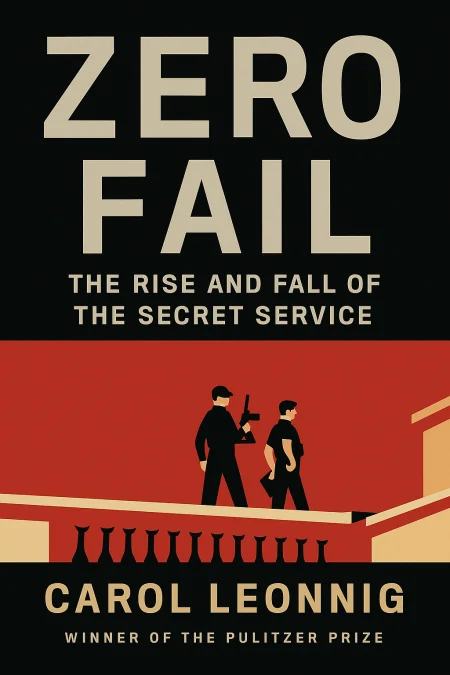
Zero Fail
The Rise and Fall of the Secret Service
Book Edition Details
Summary
Unmask the shadowy corridors of power with Carol Leonnig's searing exposé, where the Secret Service's storied past collides with its tumultuous present. From the haunting echoes of Kennedy's assassination to the chaotic spectacles under Trump and Obama, this account lays bare an agency caught in its own web of dysfunction. Leonnig, a Pulitzer Prize-winning journalist, unveils a narrative of ambition and blunder, chronicling the metamorphosis from a revered protector of presidents to a beleaguered institution tarnished by scandal and ineptitude. With gripping tales from insiders who dare to break their silence, "Zero Fail" confronts the staggering lapses in judgment and accountability that threaten the very foundations of this critical institution. A compelling must-read for those who seek to understand the perilous intersection of duty and failure at the heart of American democracy.
Introduction
On a rain-soaked afternoon in March 1981, six gunshots rang out on a Washington street corner, forever changing how America protects its presidents. In less than two seconds, a troubled young man nearly succeeded in killing Ronald Reagan, exposing dangerous cracks in what many considered the world's most elite security force. This moment crystallized a troubling paradox that had been building for decades: how did the Secret Service, born from the ashes of Lincoln's assassination and forged in the crucible of Kennedy's death, evolve from a small band of dedicated agents into a sprawling bureaucracy struggling to fulfill its most sacred duty? The story of presidential protection reveals far more than tales of heroic agents taking bullets for their commanders-in-chief. It unveils the hidden tensions between democracy and security, the corrupting influence of political power, and the human cost of an impossible mission. From the makeshift security arrangements that failed three presidents in the 19th century to the high-tech surveillance state of today, this evolution mirrors America's own transformation from an open republic to a security-conscious superpower. This chronicle will resonate with anyone fascinated by the intersection of power, politics, and human nature. Whether you're drawn to political history, organizational psychology, or simply compelling stories of ordinary people thrust into extraordinary circumstances, these pages illuminate how good intentions, bureaucratic inertia, and political pressures can undermine even the most critical institutions.
Foundation Through Crisis: Kennedy to Reagan Era (1963-1981)
The modern Secret Service was forged in the crucible of November 22, 1963, when President John F. Kennedy's assassination in Dallas shattered the agency's confidence and transformed its mission forever. In those terrible moments in Dealey Plaza, Agent Clint Hill's desperate sprint toward the presidential limousine came seconds too late to save Kennedy's life. The image of Hill climbing onto the back of the Lincoln Continental, shielding Jackie Kennedy as she reached for pieces of her husband's skull, became an indelible symbol of both heroic dedication and institutional failure. The Warren Commission's investigation exposed fundamental flaws in presidential protection that had persisted since the early 1900s. Agents had been pulled back from Kennedy's limousine at his request, creating fatal gaps in security. The Service lacked systematic threat assessment procedures and relied too heavily on local law enforcement. Most damaging was the revelation that some agents had been drinking late into the night before the Dallas trip, raising questions about their readiness to protect the president's life. These failures catalyzed the most comprehensive transformation in Secret Service history. Congress doubled the agency's budget and authorized two hundred new agents within two years. Director James Rowley, devastated by the loss but determined to honor Kennedy's memory, established the first systematic training programs, computerized threat assessment systems, and rigorous advance security protocols that became the foundation of modern presidential protection. The Service embraced cutting-edge technology and developed new protocols for motorcade security that would be tested repeatedly in the turbulent decades ahead. The lessons learned in Dallas were validated during the 1981 assassination attempt on Ronald Reagan outside the Washington Hilton. Agent Jerry Parr's instant decision to shove Reagan into his limousine and race to the hospital, rather than return to the White House, likely saved the president's life. Tim McCarthy's willingness to use his body as a human shield and the seamless coordination that followed demonstrated how far the Service had evolved since Kennedy's death, establishing the template for modern presidential security while revealing that split-second decisions and individual heroism remained as crucial as any systematic reform.
Political Pressures and New Threats: Clinton to Bush Years (1992-2008)
The Clinton presidency ushered in an era of unprecedented tension between the Secret Service's protective mission and the personal conduct of those they guarded, fundamentally altering the agency's relationship with the office of the presidency. From the campaign trail onward, agents found themselves navigating uncomfortable territory between professional duty and personal morality as they witnessed behavior that challenged their traditional role as silent guardians. Bill Clinton's pattern of using their protection as cover for romantic liaisons placed agents in impossible positions, culminating in the Monica Lewinsky scandal that would test the very foundations of the Service's discretionary culture. When Independent Counsel Kenneth Starr subpoenaed agents to testify about what they had witnessed in the White House, Director Lewis Merletti's attempt to assert "executive protection privilege" highlighted the fundamental tension between the Service's need for presidential trust and the demands of legal accountability. The eventual testimony of uniformed officers, despite leadership's fierce resistance, established a dangerous precedent that would haunt future administrations while undermining the absolute discretion that agents believed essential to their effectiveness. The period also witnessed the emergence of new security threats that would reshape the Service's mission entirely. The 1993 World Trade Center bombing and the 1995 Oklahoma City attack demonstrated that domestic terrorism posed unprecedented challenges, while Osama bin Laden's declaration of war against American forces abroad represented a new category of threat that traditional deterrence strategies could not address. When a stolen Cessna crashed on the White House South Lawn in 1994, it exposed the Service's lack of preparation for aerial attacks and forced a comprehensive security review that resulted in the closure of Pennsylvania Avenue. The Bush years brought the additional challenge of adapting to post-9/11 security demands while grappling with the agency's transfer to the newly created Department of Homeland Security. This bureaucratic reshuffling diluted the Service's direct relationship with the president while subjecting it to broader governmental dysfunction. Budget constraints and competing priorities within DHS began eroding the Service's operational capabilities, creating conditions where the old model of reactive security became increasingly obsolete against enemies conducting long-term surveillance and planning coordinated attacks that could overwhelm even the most dedicated protective details.
System Breakdown and Scandals: Obama Through Trump (2008-2021)
Barack Obama's presidency confronted the Secret Service with its greatest challenge yet: protecting the first African American president amid a surge of racially motivated threats while the agency itself struggled with internal dysfunction and resource constraints that had been building for years. The threats against Obama were both more numerous and more virulent than those faced by previous presidents, with intelligence analysts estimating he received four times as many death threats as his predecessors, yet the Service's response was hampered by systemic problems that would soon explode into public view. The 2011 White House shooting incident marked a catastrophic failure of both immediate response and investigative follow-up. When Oscar Ortega-Hernandez fired multiple rounds at the presidential residence while family members were inside, the Service's initial dismissal of the attack as unrelated to the White House, followed by the four-day delay in discovering bullet damage, revealed an organization more concerned with avoiding embarrassment than confronting hard truths. This failure was compounded by the 2012 Cartagena prostitution scandal, which exposed a culture of entitlement and poor judgment that extended far beyond individual misconduct to reveal systemic problems with supervision, accountability, and leadership. The ultimate breakdown came during the Trump administration, which represented the culmination of the Secret Service's gradual transformation from nonpartisan protector to political instrument. Trump's relentless travel to his own properties drained agency resources while funneling taxpayer money to his businesses, creating unprecedented conflicts of interest that forced the Service into complicity with what critics characterized as constitutional violations. More insidious was the agency's increasing political alignment with Trump's authoritarian tendencies, culminating in the June 2020 Lafayette Square incident where Secret Service personnel participated in the violent clearing of peaceful protesters to facilitate a presidential photo opportunity. The agency's internal culture reflected broader societal polarization, with many agents openly supporting Trump's political agenda while viewing his opponents as enemies rather than fellow Americans. Trump's manipulation of Secret Service leadership, including the unprecedented appointment of detail leader Tony Ornato to a White House political position, completed the agency's transformation from guardian of democracy to instrument of political power. By the administration's end, the bright line between protective duties and political activities, carefully maintained for over a century, had been obliterated, leaving the Secret Service facing fundamental questions about its reliability as a democratic institution.
Summary
The Secret Service's evolution from elite guardian to compromised institution reveals a recurring cycle of tragedy, reform, and gradual decay that mirrors broader patterns in American institutional life. Each major failure prompted periods of intense innovation and improvement, only to be followed by complacency, political interference, and the slow erosion of hard-won capabilities. This pattern suggests that the agency's greatest weakness may not be external threats but its own inability to maintain vigilance and excellence without the motivation of fresh tragedy. The transformation from a small band of dedicated agents into a sprawling bureaucracy illustrates the challenges facing all elite organizations as they grow and mature. The intimate culture of mutual accountability that characterized the early Service gave way to hierarchical structures, political considerations, and institutional inertia that allowed problems to fester until they exploded into public view. The core tension revealed throughout this history centers on the impossible balance between absolute discretion and democratic accountability, as the agency's traditional insularity became both its greatest strength and fatal weakness. For contemporary leaders and citizens, the Secret Service's story offers crucial lessons about maintaining institutional integrity under pressure. Organizations must actively resist the tendency toward complacency that follows periods of success while insulating critical functions from political interference. Most critically, democratic societies must recognize that elite institutions require constant vigilance, robust oversight mechanisms, and cultural practices that prioritize mission over personal advancement. The health of our protective services reflects the broader condition of American democracy itself, reminding us that even the most essential institutions can be hollowed out by the very human frailties they were designed to transcend.
Related Books
Download PDF & EPUB
To save this Black List summary for later, download the free PDF and EPUB. You can print it out, or read offline at your convenience.
By Carol Leonnig
