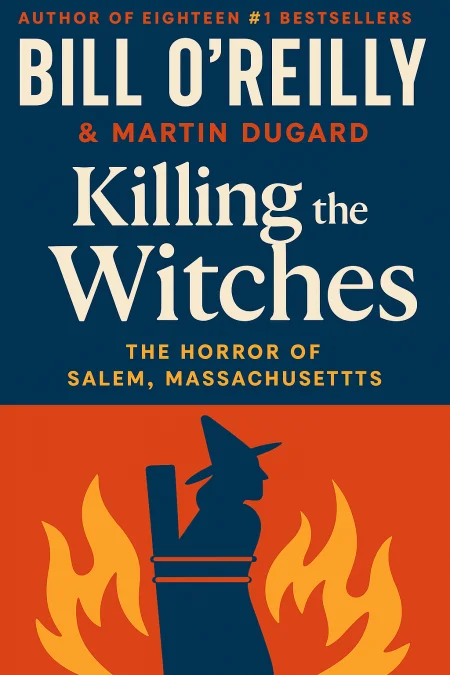
Killing the Witches
The Horror of Salem, Massachusetts
byBill O'Reilly, Martin Dugard
Book Edition Details
Summary
In the shadowy corners of history, where fear silences reason, lies Salem Village—a cauldron of suspicion and chaos in 1692. "Killing the Witches" unveils this haunting chapter of American past, where whispers of witchcraft spiraled into a frenzy, ensnaring over 200 souls in its merciless grip. Bill O'Reilly, a master of narrative history, delves deep into this harrowing saga, revealing how a community’s descent into paranoia forever scarred a nation. Through vivid recounting and meticulous research, this book lays bare the dark dance of good and evil, exploring the chilling power of hysteria and its echoes that still linger. Dive into this spellbinding account that challenges the boundaries between myth and truth, and ponder the fragile nature of justice and morality.
Introduction
Picture the weight of a nation resting on one person's shoulders, where every decision ripples through history and shapes the destiny of millions. From George Washington's reluctant acceptance of an office with no precedent to Benjamin Harrison's struggles with the complexities of a rapidly industrializing America, the early presidency was forged in the crucible of uncertainty, crisis, and human ambition. This exploration reveals the stark reality behind the marble monuments and heroic portraits that populate our national memory. We encounter leaders who were brilliant strategists yet deeply flawed individuals, visionary founders who owned slaves, and men of unshakeable principle who made decisions that nearly destroyed the republic they swore to protect. Through their personal struggles, political machinations, and moments of both triumph and catastrophe, we witness how individual character intersects with historical forces to determine whether a democracy survives or perishes. These stories matter because they illuminate the eternal tension between democratic ideals and human nature, between the concentration of power necessary for effective governance and the accountability essential for freedom. For anyone seeking to understand how leadership functions under extreme pressure, how democratic institutions evolve through crisis, or why certain patterns of political behavior repeat across generations, these presidential portraits offer invaluable insights into the complex relationship between power, character, and the fate of nations.
Founding the Republic: Setting Precedents (1789-1841)
The American presidency began not with fanfare but with profound uncertainty, as George Washington stepped into an office that existed nowhere else in the world. Every action he took, from how to address Congress to when to use executive power, would establish precedents that future leaders would either follow or fight against. Washington understood this burden acutely, writing that he walked "on untrodden ground" where there was "scarcely any part of my conduct which may not hereafter be drawn into precedent." The transfer of power from Washington to John Adams in 1797 represented the first test of whether American democracy could survive the peaceful transition between opposing factions. Adams, a Federalist, inherited a nation already splitting into partisan camps, while his vice president, Thomas Jefferson, led the opposition Democratic-Republicans. The bitter election of 1800, which Jefferson called "the revolution of 1800," proved that American democracy could indeed change direction without violence, but it also revealed the deep ideological fissures that would plague the republic for decades. Jefferson's presidency embodied the contradictions that would define American leadership throughout this era. The man who wrote that "all men are created equal" owned hundreds of slaves, while his Louisiana Purchase doubled the nation's size despite constitutional doubts about federal authority. His successors, from Madison through John Quincy Adams, each grappled with similar tensions between idealistic principles and practical governance, between federal power and states' rights, between national unity and sectional interests. The era culminated with Andrew Jackson's revolutionary presidency, which fundamentally altered the office's relationship with the American people. Jackson's appeal to the "common man" and his expansion of executive power through the spoils system and his war against the National Bank demonstrated how a strong personality could reshape democratic institutions. Yet his policies also intensified sectional divisions over slavery and federal authority, setting the stage for the crises that would dominate the next generation of American leaders.
Continental Expansion and Deepening Crisis (1841-1865)
The middle decades of the nineteenth century transformed America from a coastal republic into a continental empire, but this expansion came at a terrible price that nearly destroyed the nation. Each new territory acquired through war, purchase, or annexation forced Americans to confront the fundamental contradiction at their republic's heart: how could a nation founded on liberty continue to tolerate human bondage? William Henry Harrison's death after just thirty-one days in office thrust John Tyler into the presidency, beginning a pattern of weak leadership that would characterize this era. Tyler's conflicts with his own Whig Party over banking and internal improvements demonstrated how personal ambition and ideological rigidity could paralyze effective governance. His successor, James K. Polk, proved far more effective, achieving his ambitious agenda of continental expansion through the annexation of Texas and victory in the Mexican-American War, but these triumphs only intensified the slavery crisis by adding vast new territories to the Union. The Compromise of 1850, crafted during Zachary Taylor's brief presidency and implemented under Millard Fillmore, represented the last serious attempt to resolve the slavery question through legislative bargaining. The compromise temporarily eased tensions but satisfied no one completely, while the Fugitive Slave Act it contained outraged Northern abolitionists and pushed moderate opponents of slavery toward more radical positions. Franklin Pierce's presidency saw this fragile peace shatter completely with the Kansas-Nebraska Act, which opened previously free territories to slavery and led to violent conflict that earned the territory the nickname "Bleeding Kansas." James Buchanan's presidency marked the complete breakdown of the political system's ability to contain the slavery crisis. His support for the pro-slavery Lecompton Constitution in Kansas, his endorsement of the Dred Scott decision, and his paralysis in the face of Southern secession following Lincoln's election demonstrated how presidential weakness in moments of moral crisis can accelerate rather than prevent national catastrophe. By the time Lincoln took office in March 1861, seven states had already left the Union, and the choices available to the new president had narrowed to war or the dissolution of the republic.
Civil War Legacy and Industrial Transformation (1865-1889)
Abraham Lincoln's assassination in April 1865 thrust Andrew Johnson into a presidency that would define the post-war era's tragic failures. Johnson, a Southern Democrat who had remained loyal to the Union, possessed neither the political skills nor the moral vision necessary to heal a nation torn apart by four years of unprecedented bloodshed. His lenient policies toward the defeated Confederacy and his bitter conflicts with the Republican Congress over Reconstruction led to the first presidential impeachment in American history. Johnson's failures during Reconstruction allowed white supremacist groups to terrorize freed slaves and effectively nullify many of the Civil War's achievements. His pardoning of Confederate leaders and his opposition to civil rights legislation demonstrated how presidential weakness and personal prejudice could squander the fruits of even the greatest military victories. The impeachment proceedings, while ultimately unsuccessful, established important precedents about the limits of executive power and the mechanisms available for removing presidents who abuse their authority. Ulysses S. Grant's presidency revealed both the possibilities and perils of Reconstruction-era leadership. While Grant successfully used federal power to crush the Ku Klux Klan and protect black voting rights in the South, his administration became synonymous with corruption and scandal. The Credit Mobilier affair, the Whiskey Ring, and other scandals demonstrated how the rapid economic growth following the Civil War created new opportunities for political corruption that even honest presidents like Grant struggled to control. The presidencies of Rutherford Hayes, James Garfield, Chester Arthur, Grover Cleveland, and Benjamin Harrison grappled with the challenges of governing during America's industrial transformation. The disputed election of 1876 that brought Hayes to power effectively ended Reconstruction by withdrawing federal troops from the South, while Garfield's assassination by a disappointed office-seeker led to civil service reform under Arthur. Cleveland's battles with high tariffs and his handling of labor unrest during the Pullman Strike illustrated the growing tensions between capital and labor that would dominate American politics for decades to come.
Summary
The journey from Washington to Harrison reveals the fundamental paradox that has defined the American presidency from its inception: the office must be powerful enough to meet national crises yet constrained enough to preserve democratic governance. Each president during this formative century faced the eternal tension between idealistic principles and practical politics, between popular will and constitutional limits, between immediate pressures and long-term consequences that would shape the nation's character for generations. The recurring patterns across these presidencies offer crucial insights that transcend their historical moment. Successful presidents like Washington, Jefferson, and Lincoln understood that leadership sometimes requires choosing principle over popularity, that compromise has limits when fundamental values are at stake, and that the presidency's true power lies not in commanding obedience but in persuading citizens to embrace a shared vision of national purpose. Conversely, the failures of Pierce, Buchanan, and Johnson demonstrate how avoiding difficult decisions, placing party loyalty above national interest, or underestimating the moral dimensions of political choices can have catastrophic consequences that echo through history. These historical lessons provide essential guidance for understanding democratic leadership in any era. Character matters more than competence alone because the presidency tests not just what leaders know but who they are when facing impossible choices under enormous pressure. Democratic institutions prove only as strong as the people who inhabit them, requiring constant vigilance and renewal from both leaders and citizens. Most importantly, the greatest presidential failures often stem not from dramatic mistakes but from gradual erosions of principle and purpose, reminding us that preserving democracy requires the courage to act on our highest ideals precisely when the stakes are greatest and the path forward seems most uncertain.
Related Books
Download PDF & EPUB
To save this Black List summary for later, download the free PDF and EPUB. You can print it out, or read offline at your convenience.
By Bill O'Reilly
