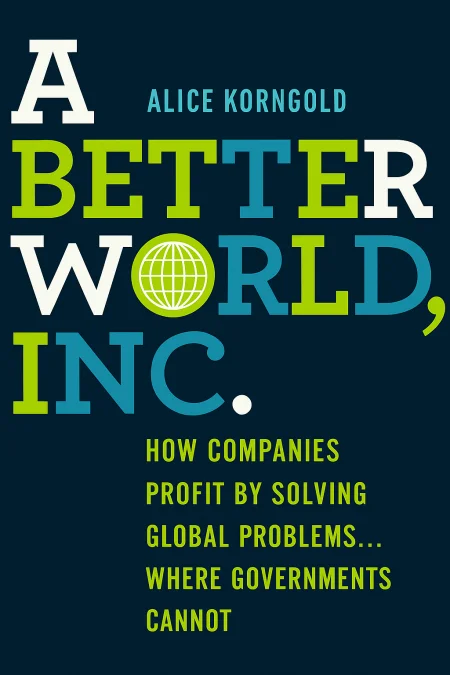
A Better World, Inc.
How Companies Profit by Solving Global Problems...Where Governments Cannot
Book Edition Details
Summary
When the world's greatest challenges loom large, from environmental crises to social inequities, "A Better World, Inc." boldly proposes that the heroes of the story are not who we might expect. Alice Korngold unveils the potential of global corporations to lead the charge in crafting sustainable solutions that benefit both society and their bottom lines. Through the lens of compelling case studies featuring giants like Nike and GlaxoSmithKline, this book presents a strategic blueprint for businesses to foster a thriving planet while securing their financial future. Korngold argues with clarity and conviction that only corporations possess the necessary resources and incentives to drive genuine change. This powerful guide demystifies the synergy between corporate success and global betterment, laying out essential practices in stakeholder collaboration, accountability, and innovative governance. Prepare to see the corporate world in a new light—one where profit and purpose unite for a brighter tomorrow.
Introduction
The fundamental assumptions underlying modern capitalism face unprecedented scrutiny as traditional shareholder primacy models prove inadequate for addressing systemic global challenges. Environmental degradation accelerates while social inequality widens, creating a profound disconnect between corporate operations and societal needs that demands urgent reconsideration of business purpose. This examination challenges the conventional wisdom that profit maximization automatically generates optimal outcomes for society, presenting compelling evidence that authentic stakeholder capitalism represents both moral imperative and strategic opportunity. Environmental, Social, and Governance frameworks emerge not as compliance exercises but as catalysts for fundamental business model transformation. The analysis employs rigorous examination of corporate governance evolution, strategic partnership dynamics, and measurable impact assessments to demonstrate how companies can align profit motives with planetary and social wellbeing. Through systematic evaluation of board composition changes, cross-sector collaboration models, and accountability mechanisms, a comprehensive framework emerges for understanding how corporate leadership can drive systemic change while generating superior long-term returns. The evidence reveals patterns where companies embracing integrated stakeholder approaches become powerful agents of transformation, challenging readers to reconsider basic assumptions about the role of business in addressing humanity's most pressing challenges.
The Strategic Business Case for Stakeholder Capitalism Integration
Stakeholder capitalism represents a fundamental paradigm shift from narrow profit maximization toward integrated value creation that serves multiple constituencies simultaneously. Traditional economic theory positioned shareholder returns as the singular corporate objective, assuming market mechanisms would automatically optimize broader societal outcomes. However, mounting empirical evidence demonstrates that this approach generates significant negative externalities while failing to capture long-term value creation opportunities that emerge from stakeholder-centric business models. The financial performance data increasingly supports stakeholder-oriented approaches across multiple dimensions and time horizons. Companies with strong Environmental, Social, and Governance practices consistently demonstrate lower volatility, reduced regulatory risks, enhanced innovation capacity, and improved access to capital markets. These organizations attract top talent more effectively, build stronger customer loyalty, and develop more resilient supply chains that withstand disruption. The correlation between stakeholder orientation and financial outperformance becomes particularly pronounced during periods of economic uncertainty, suggesting that stakeholder capitalism provides superior risk management capabilities. Beyond risk mitigation, stakeholder capitalism unlocks growth opportunities that pure profit-maximizers systematically miss. Companies that understand and respond to diverse stakeholder needs identify emerging markets, develop innovative products and services, and build competitive advantages rooted in authentic relationship building. This approach enables organizations to navigate complex global challenges while creating shared value across their entire business ecosystem, transforming potential conflicts between profit and purpose into mutually reinforcing dynamics. The business case extends to systemic considerations where individual company success becomes inseparable from broader economic and social health. Stakeholder-oriented companies recognize their interdependence with communities, suppliers, and environmental systems, leading to investment decisions that strengthen entire value chains rather than extracting value from them. This systems thinking approach generates sustainable competitive advantages while contributing to the resilience and prosperity of the broader economic ecosystem.
Partnership-Driven ESG Implementation: Cross-Sector Collaboration Models
Effective ESG implementation requires sophisticated partnership strategies that leverage complementary capabilities across institutional boundaries. No single organization possesses the resources, expertise, or reach necessary to address complex environmental and social challenges independently. Strategic partnerships enable companies to amplify their impact while sharing risks and costs associated with ambitious sustainability initiatives, creating multiplicative effects that exceed the sum of individual contributions. Cross-sector collaborations between corporations, non-governmental organizations, academic institutions, and government agencies generate powerful synergies through the strategic combination of distinct institutional strengths. Corporations contribute capital, operational efficiency, and global reach while NGOs provide specialized expertise, community relationships, and mission-driven focus. Academic institutions offer research capabilities and analytical rigor while government agencies provide regulatory authority and policy frameworks. Successful partnerships establish clear governance structures, aligned incentives, and shared accountability mechanisms that ensure meaningful contribution from all participants. Public-private partnerships prove particularly valuable for addressing systemic challenges that require coordinated action across multiple stakeholders and jurisdictions. Climate change mitigation, circular economy development, and social equity advancement all benefit from collaborative approaches that pool diverse capabilities and perspectives while distributing implementation responsibilities. These partnerships enable companies to tackle issues beyond their direct operational control while building industry-wide standards and practices that create level playing fields for sustainable business practices. The most impactful partnerships focus on creating scalable solutions rather than isolated projects or one-time interventions. They establish platforms for knowledge sharing, develop replicable methodologies, and build institutional capacity that extends impact beyond individual partnership boundaries. This approach transforms partnerships from tactical collaborations into strategic investments in systemic change, generating lasting value for all participants while advancing broader societal objectives through sustainable, self-reinforcing mechanisms.
Governance Transformation and Evidence-Based Impact Measurement
Board composition and governance structures fundamentally determine corporate ESG performance and stakeholder value creation capabilities. Traditional boards dominated by financial and operational expertise lack the diverse perspectives and specialized knowledge necessary to navigate complex environmental and social challenges effectively. Transforming board composition becomes essential for companies seeking authentic ESG integration rather than superficial compliance with external expectations or regulatory requirements. Effective ESG governance requires directors with deep expertise in sustainability science, social impact measurement, stakeholder engagement methodologies, and systems thinking approaches. These board members bring critical perspectives on long-term risks and opportunities that traditional financial metrics often overlook or undervalue. They challenge management assumptions, ask probing questions about stakeholder impacts, and ensure that ESG considerations receive appropriate attention in strategic planning and resource allocation decisions across all business functions. Governance transformation involves restructuring board processes, committee structures, and accountability mechanisms to integrate ESG considerations into all corporate decision-making rather than relegating them to separate sustainability committees. This integration ensures that environmental and social factors receive equal consideration alongside financial metrics in strategic decisions, capital allocation choices, and performance evaluation systems. Regular stakeholder engagement, comprehensive impact measurement, and transparent reporting become standard governance practices that demonstrate authentic commitment to stakeholder capitalism principles. Robust measurement systems provide the foundation for effective ESG implementation and continuous improvement over time. Without reliable metrics and accountability mechanisms, ESG initiatives risk becoming superficial exercises that generate limited stakeholder value while consuming significant organizational resources. Comprehensive measurement frameworks must capture both quantitative outcomes and qualitative stakeholder experiences while enabling meaningful comparisons across organizations, industries, and time periods to support learning and best practice development.
Scaling Corporate Solutions: From Individual Initiatives to Systemic Change
Individual company ESG initiatives, regardless of their effectiveness or resource investment, generate limited societal impact unless they can be replicated and adapted across broader networks and entire industries. Scaling successful solutions requires systematic approaches to knowledge transfer, capacity building, and institutional development that address barriers to adoption while providing implementation support and creating incentive structures that encourage widespread participation in sustainable business practices. The most impactful scaling efforts focus on transforming entire industries and market systems rather than simply expanding individual programs or replicating specific interventions. This approach involves developing industry standards, influencing regulatory frameworks, and creating market mechanisms that reward sustainable practices while penalizing harmful behaviors. Companies working to change the fundamental rules of economic competition rather than simply operating within existing constraints can generate exponential impact that extends far beyond their direct operations. Effective scaling strategies recognize that systemic change requires collective action and coordinated investment across multiple stakeholders and time horizons. Successful companies invest in ecosystem development, partner capacity building, and enabling infrastructure that supports broader adoption of sustainable practices. They engage in industry collaboration, policy advocacy, and standard-setting processes that create favorable conditions for sustainable business model innovation while reducing competitive disadvantages associated with early adoption of responsible practices. The transition from individual initiatives to systemic change demands sophisticated understanding of leverage points, feedback loops, and intervention strategies that can shift entire systems toward more sustainable configurations. Companies that achieve significant scale typically develop replicable models, create enabling conditions for broader adoption, and invest in the institutional infrastructure necessary to support widespread transformation. This systems-level approach requires patient capital, collaborative mindsets, and commitment to shared value creation that extends beyond traditional competitive boundaries.
Summary
Corporate ESG leadership in the twenty-first century demands fundamental reconceptualization of business purpose, moving beyond narrow profit maximization toward integrated value creation that serves all stakeholders while generating sustainable financial returns and competitive advantages. The convergence of environmental crisis, social inequality, and governance failures creates both urgent imperatives and unprecedented opportunities for companies willing to embrace authentic transformation through strategic partnerships, governance evolution, and rigorous impact measurement. Through systematic collaboration with diverse stakeholders, board-level commitment to stakeholder capitalism, and evidence-based scaling strategies, corporations can become powerful catalysts for systemic change while building more resilient and profitable business models that contribute to inclusive, sustainable prosperity for all participants in the global economy.
Related Books
Download PDF & EPUB
To save this Black List summary for later, download the free PDF and EPUB. You can print it out, or read offline at your convenience.
By Alice Korngold
