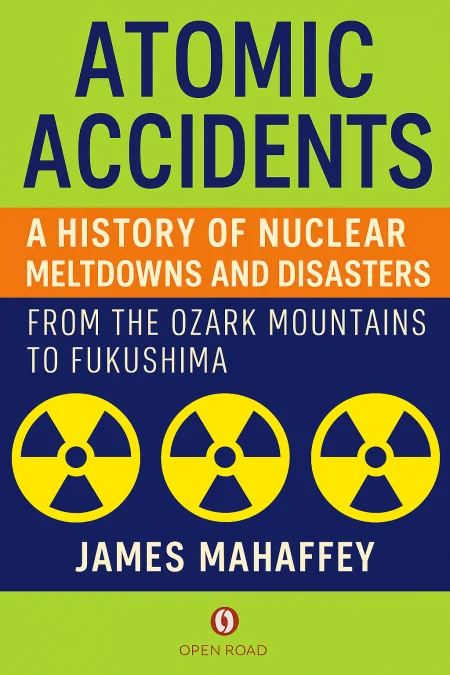
Atomic Accidents
A History of Nuclear Meltdowns and Disasters from the Ozark Mountains to Fukushima
Book Edition Details
Summary
When brilliance meets disaster, the chronicles of nuclear energy unfold with equal parts marvel and mayhem. In "Atomic Accidents," James Mahaffey unveils a vivid tapestry of ambition and error that has shaped the nuclear saga. From Marie Curie's enchanting yet hazardous glow of radium to the cataclysmic tremors of Chernobyl and Fukushima, Mahaffey dissects each pivotal moment with a keen eye for where science stumbled. These narratives, rich with lessons and revelations, navigate the razor's edge of innovation—where the atom's promise dances perilously close to catastrophe. This gripping exploration not only exposes the fissures in humanity's quest for power but also the relentless pursuit of understanding amidst the chaos.
Introduction
On a quiet morning in December 1942, beneath the football stands at the University of Chicago, Enrico Fermi slowly withdrew control rods from a pile of graphite blocks and uranium, achieving humanity's first controlled nuclear chain reaction. As neutrons began dancing through the atomic lattice, witnessing scientists realized they had crossed a threshold from which there would be no return. Yet in that moment of triumph, few could foresee that this same technology would write its history not just in scientific breakthroughs, but in a series of accidents that would reshape our understanding of both atomic power and human fallibility. The story of nuclear accidents reveals three profound truths about technological progress. First, it demonstrates how the gap between theoretical knowledge and practical mastery can exact a devastating human cost, as brilliant scientists and dedicated workers paid with their lives to bridge the chasm between laboratory theory and real-world application. Second, it illuminates the complex relationship between institutional culture and technological safety, showing how organizational pressures, secrecy, and overconfidence can transform manageable risks into catastrophic failures. Third, it exposes the enduring tension between humanity's boldest ambitions and our imperfect ability to control the forces we unleash. This chronicle serves engineers grappling with complex systems, policymakers weighing technological risks, historians studying the interplay between science and society, and citizens seeking to understand how transformative technologies emerge, evolve, and occasionally fail in ways that reshape entire civilizations. Through examining these atomic accidents, we gain insights that extend far beyond nuclear engineering into the fundamental challenges of managing powerful technologies in an imperfect world.
Early Nuclear Discoveries and Fatal Experiments (1879-1945)
The nuclear age began not with Einstein's famous equation, but with three Missouri hunters chasing a wildcat into a glowing cave in 1879. Bill Henry, John Dempsey, and Bill Boyceyer emerged from their underground adventure with more than strange stories. Henry suffered mysterious burns and paralysis that baffled doctors, marking what may have been the first recorded case of radiation poisoning, decades before scientists would even understand what radioactivity meant. When Marie and Pierre Curie isolated radium in 1898, they unleashed both a scientific revolution and a public health catastrophe. The element's ethereal blue glow captivated entrepreneurs who saw fortune in its mysterious properties. Radium became the miracle cure of the early twentieth century, marketed in everything from health tonics to cosmetics. Eben Byers, a wealthy socialite, consumed over 1,400 bottles of Radithor, a radium-laced health drink, believing it would cure his ailments. Instead, it systematically destroyed his bones and jaw, leading to his agonizing death in 1932. Simultaneously, thousands of young women working in watch dial factories were slowly poisoning themselves by pointing radium-tipped brushes with their lips, a technique that ensured precise application but delivered fatal doses of radioactivity. The Radium Girls' legal battles established radiation as a uniquely terrifying threat, invisible and insidious, capable of causing delayed death in the most horrible ways. Their tragedy created a template of fear that would influence every subsequent nuclear accident. The Manhattan Project transformed this scientific curiosity into humanity's most powerful weapon, but not without exacting a terrible price. At Los Alamos, physicists like Harry Daghlian and Louis Slotin manually assembled critical masses of plutonium, using screwdrivers and bare hands to probe the boundaries between controlled reaction and explosive destruction. Their deaths in separate criticality accidents revealed the exquisite sensitivity of fissile materials and established crucial safety protocols written in blood. These early tragedies demonstrated that humanity's relationship with atomic energy would be forever complicated by the specter of invisible death, setting the stage for the complex nuclear disasters that would follow.
Cold War Military Incidents and Research Accidents (1945-1970s)
The atomic bomb's success paradoxically created new forms of danger as the Cold War transformed nuclear technology from a wartime weapon into a peacetime obsession. Military forces deployed thousands of nuclear weapons across the globe, leading to sixty-five documented "Broken Arrow" incidents between 1950 and 1989. These accidents revealed the inherent tension between maintaining credible nuclear deterrence and ensuring public safety, as aircraft carrying hydrogen bombs crashed from Greenland to Spain, scattering radioactive debris across landscapes and requiring massive cleanup efforts. The most dramatic incident occurred in 1961 when a B-52 bomber broke apart over North Carolina, dropping two hydrogen bombs that went through most of their arming sequence before hitting the ground. Only a single safety switch prevented a nuclear detonation that could have devastated the eastern seaboard. These military accidents highlighted both the remarkable effectiveness of weapon safety systems and the razor-thin margins that separated routine operations from catastrophic failure. Simultaneously, the rush to develop peaceful nuclear applications created new categories of accidents. The world's first reactor meltdown occurred at Canada's NRX facility in 1952, introducing themes that would recur throughout nuclear history: inadequate instrumentation, operators second-guessing safety systems, and dangerous interactions between human judgment and automated controls. The cleanup required an international effort, including a young naval officer named Jimmy Carter, whose experience decontaminating radioactive debris would later influence his presidency. The period also witnessed Britain's Windscale reactor fire in 1957, the first major release of radioactive material into the environment from a civilian nuclear facility. Under pressure to produce materials for Britain's hydrogen bomb program, operators pushed their equipment beyond safe limits, leading to a graphite fire that burned for days and contaminated the surrounding countryside. The incident was initially covered up, establishing a pattern of secrecy that would plague the nuclear industry for decades. These Cold War accidents established crucial principles for nuclear safety while revealing the technology's fundamental contradiction: nuclear reactions could be both remarkably forgiving and utterly unforgiving, depending on circumstances that were not always predictable or controllable.
Commercial Nuclear Crisis: Three Mile Island to Chernobyl (1970s-1980s)
The promise of atoms for peace reached its zenith in the 1970s, only to be shattered by two accidents that forever changed public perception of nuclear power. The Three Mile Island accident in 1979 began with a simple stuck valve, but a cascade of human errors and design flaws transformed a minor malfunction into a partial meltdown that terrified the world. The operators, trained on submarine reactors, applied naval procedures inappropriate for large commercial plants, shutting down emergency cooling systems at the worst possible moment and allowing the reactor core to overheat and partially melt. The accident exposed critical weaknesses in reactor design, operator training, and emergency procedures that had been overlooked in the rush to commercialize nuclear technology. More significantly, it revealed how the complexity of commercial reactors could overwhelm even experienced operators when multiple systems failed simultaneously. Though no one died, the accident exposed the gap between engineering confidence and public trust, showing how technical success could coexist with social and political failure. Seven years later, the Chernobyl disaster of 1986 represented the ultimate failure of nuclear technology and institutional culture. The RBMK reactor design, with its positive void coefficient and graphite moderator, was inherently unstable under certain conditions. When operators conducted a poorly planned safety test, they inadvertently created conditions that led to a massive steam explosion and graphite fire that spread radioactive contamination across Europe, directly causing dozens of deaths with long-term health effects still being debated. The Chernobyl accident was not merely a technical failure but a systemic collapse of Soviet nuclear culture. The reactor's design flaws were known but ignored, safety procedures were routinely violated, and the initial response was characterized by denial and cover-up. The accident revealed how political systems that prioritize ideology over technical reality create conditions where catastrophic failures become inevitable. Together, these two accidents effectively ended the nuclear renaissance of the 1970s, demonstrating that nuclear technology, for all its promise, remained vulnerable to the fundamental human failings of overconfidence, poor communication, and institutional dysfunction that had plagued it since its inception.
Modern Nuclear Challenges: Fukushima and Future Safety (2011-Present)
The Fukushima Daiichi disaster of 2011 proved that even the most advanced nuclear nations remained vulnerable to the devastating combination of natural forces and design limitations. The magnitude 9.0 earthquake and subsequent tsunami overwhelmed the plant's defenses, flooding emergency generators and leaving three reactors without cooling for days. The resulting meltdowns and hydrogen explosions created the worst nuclear accident since Chernobyl, forcing the evacuation of hundreds of thousands of people and contaminating vast areas of Japan. The accident revealed how the nuclear industry's focus on design basis accidents had created a false sense of security. The plant was designed to withstand a certain level of earthquake and tsunami, but nature exceeded those assumptions with devastating consequences. More troubling, the accident highlighted the vulnerability of spent fuel pools and demonstrated how the interconnected nature of modern nuclear plants could transform a manageable emergency into a cascading disaster when common-mode failures affected multiple systems simultaneously. Contemporary nuclear accidents reveal evolving patterns of failure distinct from earlier eras. While early incidents often resulted from ignorance or recklessness, modern disasters typically involve complex interactions between multiple systems, organizations, and decision-makers operating within layers of technology, regulation, and bureaucracy that can both prevent and enable catastrophic failures. The human element remains crucial, but now operates in environments where the gap between expert assessment and public perception continues to widen. The industry has responded with improved designs promising enhanced safety through passive systems and inherent physical limitations, yet these remain largely untested at commercial scale. Meanwhile, aging reactor fleets worldwide face increasing maintenance challenges and the accumulated effects of decades of neutron bombardment. Perhaps most significantly, modern nuclear accidents have become as much about communication and public trust as technical safety, with social media and instant global communication amplifying every incident. The industry's technical achievements in safety improvement have not been matched by corresponding success in maintaining public confidence, suggesting that future nuclear accidents may be as much political and social events as engineering failures.
Summary
The history of nuclear accidents reveals a technology caught between its enormous promise and its capacity for spectacular failure, illuminating the central paradox that has defined the atomic age: while nuclear technology has proven remarkably safe in practice, its perceived dangers have profoundly influenced public policy and social attitudes. From the radium poisonings of the early twentieth century to the reactor meltdowns of the modern era, these disasters demonstrate that technological progress is never simply a matter of engineering prowess, but involves the intricate interplay of human psychology, organizational behavior, and social acceptance. Three crucial insights emerge from this historical record that remain relevant for managing any transformative technology. First, human factors consistently represent the most significant source of risk, whether through procedural violations, inadequate training, or organizational pressures that compromise safety margins. Second, the most effective safety improvements have come not from theoretical analysis but from learning from actual incidents and near-misses, suggesting that a culture of honest reporting and continuous learning is more valuable than one that seeks to avoid all mistakes. Third, public trust depends as much on transparency and honest communication as on actual safety performance, requiring institutions to acknowledge past failures while demonstrating genuine commitment to improvement. For our energy future, these lessons suggest that nuclear technology should be developed with robust safety cultures that prioritize learning over blame, regulatory frameworks that balance safety needs with recognition that perfect safety is impossible, and industry practices that engage honestly with public concerns rather than dismissing them as irrational. The nuclear age is far from over, and the accidents of the past century provide an essential roadmap for navigating future challenges while harnessing one of humanity's most powerful discoveries responsibly and safely.
Related Books
Download PDF & EPUB
To save this Black List summary for later, download the free PDF and EPUB. You can print it out, or read offline at your convenience.
By James Mahaffey
