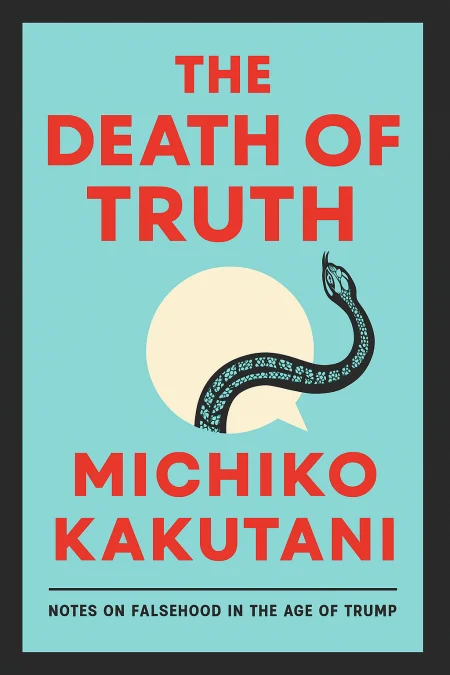
The Death of Truth
Notes on Falsehood in the Age of Trump
Book Edition Details
Summary
Reality teeters on a razor's edge in Michiko Kakutani's incisive exploration of America's truth crisis. "The Death of Truth" casts a spotlight on a world where facts are overshadowed by fervent beliefs and misinformation runs rampant. With a seasoned critic's eye, Kakutani delves into the cultural upheavals that have eroded our faith in objective reality, dissecting the roles of media, politics, and academia. This compelling narrative weaves together the ominous echoes of Orwell and Arendt with today's turbulent times, challenging readers to confront the disintegration of shared truths. It's a clarion call to reclaim reason and safeguard the fragile threads of integrity that bind society.
Introduction
Democratic societies have historically depended on a shared foundation of verifiable facts and rational discourse to function effectively. This fundamental assumption now faces unprecedented challenges as truth itself becomes a contested battlefield in contemporary political life. The erosion of objective standards for evaluating claims threatens to undermine the very mechanisms that enable citizens to make informed decisions and hold leaders accountable. The assault on truth operates through multiple interconnected channels: the deliberate distortion of language, the weaponization of cultural divisions, the exploitation of digital technologies, and the systematic undermining of institutions traditionally responsible for establishing factual baselines. These attacks are not merely tactical political maneuvers but represent a profound challenge to the epistemological foundations of democratic governance itself. Understanding this crisis requires examining how postmodern relativism has been co-opted by authoritarian movements, how digital media amplifies misinformation, and how psychological and social factors make populations vulnerable to manipulation. The stakes extend far beyond partisan politics to encompass the survival of democratic norms and the possibility of rational public discourse in an increasingly polarized world.
The Assault on Reason and Objective Reality
Enlightenment principles of reason, empirical evidence, and rational deliberation formed the intellectual foundation upon which modern democratic institutions were constructed. These principles assumed that through careful observation, logical analysis, and open debate, human societies could arrive at increasingly accurate understandings of reality and make informed collective decisions based on shared facts. Contemporary political movements have systematically attacked these foundational assumptions, rejecting not merely specific claims but the very possibility of objective truth. This assault manifests in the deliberate dismissal of scientific expertise, the elevation of ideological purity over empirical evidence, and the treatment of factual disputes as matters of personal preference rather than questions amenable to rational investigation. The consequences extend beyond academic philosophy into concrete policy failures. When decision-making processes abandon systematic analysis in favor of predetermined conclusions, the results include catastrophic miscalculations in areas ranging from public health to national security. The Iraq War exemplifies how the rejection of expert analysis and the manipulation of intelligence to support preconceived political objectives can produce devastating real-world consequences. This systematic devaluation of expertise creates a dangerous feedback loop where public cynicism about institutions becomes self-reinforcing, further eroding the capacity for evidence-based governance and rational public discourse.
Postmodernism's Unintended Consequences and Cultural Relativism
Academic postmodernism emerged in the latter half of the twentieth century as a critical response to perceived biases and limitations in traditional Western thought. Postmodernist theorists argued that knowledge claims inevitably reflect the cultural, social, and political perspectives of those making them, challenging the possibility of objective truth and universal standards of evaluation. While originally developed as tools for exposing hidden assumptions and power structures in academic discourse, these relativistic arguments have been appropriated and weaponized by political movements seeking to undermine inconvenient factual claims. Climate change deniers, creationists, and conspiracy theorists now invoke postmodernist language about "different ways of knowing" and "alternative perspectives" to legitimize scientifically discredited positions. The irony is profound: intellectual tools originally developed by left-leaning academics to challenge established authority have been co-opted by right-wing movements to attack scientific consensus and democratic institutions. This appropriation demonstrates how abstract philosophical arguments about the nature of truth can have unexpected and potentially destructive political consequences when applied outside their original contexts. The migration of relativistic thinking from academic seminars to political discourse has contributed to a broader cultural shift where factual claims become matters of identity and tribal affiliation rather than subjects for rational evaluation. This transformation threatens the possibility of productive democratic debate based on shared standards of evidence.
Digital Media's Role in Fragmenting Truth
Digital technologies have fundamentally transformed how information circulates in contemporary society, creating unprecedented opportunities for both democratizing knowledge and spreading misinformation. Social media platforms and personalized search algorithms increasingly sort users into ideological echo chambers where their existing beliefs are reinforced rather than challenged. These technological systems prioritize engagement over accuracy, creating economic incentives for sensational, emotionally provocative content regardless of its truthfulness. Fake news stories often spread faster and more widely than accurate reporting because they are designed to trigger strong emotional responses that drive sharing and clicking behavior. Foreign adversaries have exploited these vulnerabilities to conduct sophisticated disinformation campaigns designed to undermine democratic institutions and social cohesion. Russian interference in the 2016 US election demonstrates how digital platforms can be weaponized to amplify existing social divisions and manipulate public opinion through coordinated networks of fake accounts and bot armies. The sheer volume of information available online allows motivated actors to find supporting evidence for virtually any claim, no matter how false or extreme. This dynamic encourages cherry-picking and confirmation bias while making it increasingly difficult for ordinary citizens to distinguish between credible sources and deliberate misinformation.
Authoritarian Tactics and the Future of Democratic Discourse
Authoritarian movements throughout history have recognized that controlling information and manipulating language are essential tools for maintaining power. Contemporary authoritarian tactics have evolved to exploit the information environment of democratic societies, using the openness and pluralism of free societies against themselves. The "firehose of falsehood" strategy involves flooding public discourse with such a high volume of lies, half-truths, and contradictory claims that citizens become overwhelmed and retreat into cynicism or partisan silos. This approach does not require convincing people of specific false claims but rather aims to undermine confidence in the possibility of determining truth at all. Language itself becomes a weapon through the systematic redefinition of key terms and concepts. Words like "witch hunt," "fake news," and "deep state" are deployed to reframe accountability mechanisms as partisan attacks, while traditional democratic norms are portrayed as obstacles to authentic popular will. The success of these tactics depends on exploiting genuine grievances and social divisions within democratic societies. By presenting themselves as champions of marginalized groups against corrupt elites, authoritarian movements can harness legitimate frustrations while channeling them toward the destruction of democratic institutions rather than their reform.
Summary
The crisis of truth in contemporary democratic societies represents a convergence of philosophical, technological, and political forces that threaten the foundations of rational public discourse. When shared standards for evaluating claims disappear, democratic deliberation becomes impossible, and societies become vulnerable to manipulation by those who benefit from confusion and division. Defending democratic institutions requires not only protecting specific facts but preserving the underlying epistemological frameworks that make factual evaluation possible. Citizens must develop greater sophistication in navigating information environments while supporting institutions capable of maintaining standards for truth and accountability in public life.
Related Books
Download PDF & EPUB
To save this Black List summary for later, download the free PDF and EPUB. You can print it out, or read offline at your convenience.
By Michiko Kakutani
