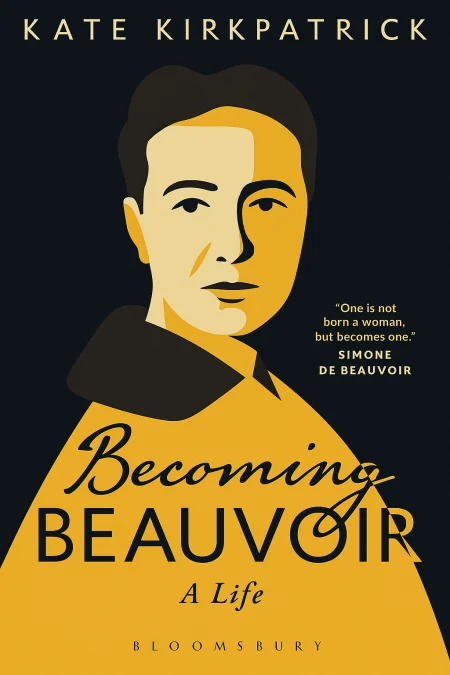
Becoming Beauvoir
A Life
Book Edition Details
Summary
In the shadowed corridors of intellectual history, Simone de Beauvoir emerges not just as a philosopher and feminist luminary, but as an enigmatic figure whose personal life continues to captivate. "Becoming Beauvoir" peels back the layers of her public persona, revealing a complex tapestry woven from unpublished diaries and letters, including heartfelt missives to her elusive soulmate, Claude Lanzmann. Through Kate Kirkpatrick's deft narrative, readers are invited to ponder the contradictions and secrets of a woman who reshaped gender discourse yet meticulously curated her own myth. What compelled her to obscure her ties with Sartre or downplay her philosophical prowess? As these private writings come to light, we edge closer to understanding the authentic Beauvoir—unraveling a mystery that defies easy resolution, igniting curiosity anew in her legacy.
Introduction
In the smoky cafés of 1940s Paris, a young woman sat writing furiously, her pen racing across pages that would eventually challenge the very foundations of how society viewed women. Simone de Beauvoir was crafting what would become one of the most revolutionary texts of the twentieth century, though she could hardly have imagined the global impact her words would have. Born into a world where women were expected to be dutiful daughters, wives, and mothers, Beauvoir dared to ask the fundamental question: what does it mean to be a woman in a world designed by and for men? Her life spanned nearly the entire twentieth century, from 1908 to 1986, witnessing two world wars, the rise of existentialism, and the birth of modern feminism. Yet Beauvoir was far more than just a feminist icon. She was a brilliant philosopher who developed her own ethical framework, a pioneering novelist who explored the complexities of human relationships, and a fearless intellectual who refused to accept the limitations society placed on her gender. Through her journey, readers will discover how a dutiful daughter transformed into a revolutionary thinker, how she navigated the tension between personal freedom and social responsibility, and how her philosophical insights continue to illuminate the path toward authentic living. Her story reveals not just the making of a feminist philosopher, but the evolution of a woman who dared to live entirely on her own terms.
From Dutiful Daughter to Philosophical Rebel
Simone de Beauvoir's early years were marked by the suffocating expectations of bourgeois French society in the early 1900s. Born into a family where propriety reigned supreme, young Simone was raised to be the perfect Catholic daughter—well-educated enough to be an interesting conversationalist, but never so accomplished as to threaten masculine authority. Her mother, Françoise, embodied the ideal of feminine devotion, sacrificing her own desires for her family's needs, while her father, Georges, represented the intellectual world that seemed forever closed to women. The family's financial decline following World War I created a crucial turning point in Simone's development. As their comfortable bourgeois lifestyle crumbled, she witnessed her mother's increasing bitterness and her father's growing resentment. This domestic drama became her first lesson in the costs of traditional gender roles. She watched her brilliant mother waste away in domestic servitude while her charming but irresponsible father blamed everyone but himself for their circumstances. The young Simone began to question why women were expected to sacrifice everything while men were forgiven their failures. Her rebellion began quietly, in the pages of books. Literature became her escape route from the predetermined path of marriage and motherhood. Through characters like Jo March in Little Women, she discovered that there were other ways for a woman to live. She devoured philosophy texts, finding in abstract thought a realm where her gender seemed irrelevant. Her parents had encouraged her education as an ornament to her femininity, never imagining it would become the weapon she used to dismantle their expectations. The final break came when Simone announced her intention to study philosophy at the Sorbonne. Her parents were horrified—philosophy was not a suitable subject for a respectable young woman. But their financial circumstances had made marriage without a dowry impossible, forcing them to accept that their daughter would need to work. In choosing philosophy over the safer path of literature or teaching, Simone was not just selecting a career; she was declaring her independence from everything her family represented. This decision would set the stage for a life lived in defiance of conventional expectations.
Existential Partnership and Literary Emergence
At the Sorbonne in the late 1920s, Beauvoir discovered both her intellectual calling and the complex relationship that would define much of her adult life. Her encounter with Jean-Paul Sartre was not the romantic coup de foudre of legend, but rather the meeting of two ambitious minds seeking to understand freedom, authenticity, and the human condition. When they met in 1929, both were brilliant philosophy students preparing for the highly competitive agrégation exam, and both were determined to live lives of radical freedom. Their famous pact was born from shared philosophical convictions rather than romantic compromise. Both rejected the bourgeois institution of marriage as a betrayal of individual freedom, preferring what they called essential love supplemented by contingent affairs. This arrangement was revolutionary for its time, representing a conscious attempt to create a new model of relationship based on intellectual equality and mutual respect for autonomy. Beauvoir saw in Sartre not just a lover, but the incomparable friend of her thought—someone who could match her intellectual intensity and share her commitment to philosophical inquiry. However, the reality of their relationship was far more complex than their theoretical framework suggested. While Sartre pursued numerous affairs with younger women, often former students, Beauvoir found herself navigating the gap between philosophical ideals and emotional reality. She experienced jealousy, loneliness, and doubt, even as she maintained her commitment to their unconventional arrangement. Her student diaries reveal a woman torn between multiple loves and struggling to reconcile her desire for independence with her need for connection. During this period, Beauvoir was developing her own philosophical voice, though it would take years for her to receive recognition for her original contributions. Her early insights into the nature of human relationships, the tension between freedom and situation, and the ethics of interpersonal responsibility would later form the foundation of her mature philosophy. She was not simply absorbing Sartre's ideas, but engaging in a genuine intellectual dialogue that shaped both their thinking. Her philosophical education was teaching her to question everything, including the very relationship that had introduced her to the life of the mind.
Revolutionary Vision: The Second Sex and Feminist Awakening
In 1949, Beauvoir published the work that would define her legacy and ignite a revolution in how the world understood women's lives. What began as a personal reflection on her own experience as a woman evolved into a comprehensive analysis of women's oppression throughout history and across cultures. Her famous declaration that one is not born, but rather becomes, a woman challenged centuries of assumptions about feminine nature and destiny, recognizing that femininity is not a biological destiny but a social construction imposed upon women from birth. Beauvoir's analysis went far beyond documenting women's oppression; she sought to understand its psychological and philosophical dimensions. She explored how women had been taught to see themselves through men's eyes, to value themselves only insofar as they were desired or needed by men. This process of internalization, she argued, was what made women complicit in their own subordination. Breaking free required not just legal and political changes, but a fundamental transformation in consciousness—women needed to learn to see themselves as subjects of their own lives rather than objects in someone else's story. The publication created an immediate scandal that revealed the depth of society's investment in maintaining traditional gender roles. Critics attacked Beauvoir personally, questioning her femininity, her relationships, and her right to speak for women. The Catholic Church placed the book on its Index of Forbidden Books, while communist critics dismissed it as bourgeois individualism. The intensity of the reaction only confirmed her thesis: society was deeply threatened by any challenge to the myths about women that served male interests. Yet beneath the scandal, the work was performing the patient labor of consciousness-raising that would eventually transform millions of lives. Beauvoir had given women a new language for understanding their experiences, showing them that their dissatisfaction was not personal failure but the result of systematic oppression. The book became a foundational text for the women's liberation movement that would emerge in the 1960s, inspiring countless women to question the limitations that society had placed on their lives and to demand the right to define themselves. She had not merely described women's condition; she had shown them the philosophical foundation for their liberation.
Living Philosophy: Activism and Authentic Aging
As Beauvoir entered her later years, she increasingly put her philosophical beliefs into practice through political activism and social engagement. The 1960s and 1970s saw her become deeply involved in the women's liberation movement in France, lending her considerable intellectual prestige to causes ranging from abortion rights to workplace equality. She signed the famous Manifesto of the 343, publicly declaring that she had had an abortion when the procedure was illegal in France, risking prosecution to advance women's reproductive freedom. Her later work continued to apply existentialist analysis to marginalized groups, most notably in her examination of aging and society's treatment of the elderly. She argued that just as women were made other by patriarchal society, the aged were marginalized and dehumanized by a culture obsessed with youth and productivity. Her analysis revealed aging not as a purely biological process but as a social and political phenomenon shaped by economic systems and cultural values. This work demonstrated her commitment to extending philosophical inquiry beyond academic circles to address real human suffering. The final decades of her life were marked by both triumph and loss. While she achieved international recognition as a pioneering feminist thinker and received numerous honors, she also faced the decline and death of Sartre, whose deteriorating health in the 1970s required increasing care and attention. Their relationship, which had sustained both of them for nearly fifty years, remained central to her identity even as she developed other important friendships and intellectual partnerships with younger feminists and activists. Beauvoir's approach to her own aging embodied her philosophical commitment to authenticity and clear-sighted analysis. She refused to retreat into comfortable illusions about growing older, instead maintaining her engagement with contemporary issues and her support for younger generations of activists. Her apartment became a meeting place for feminist thinkers from around the world, and she used her celebrity status to amplify voices that might otherwise have gone unheard. Even as her physical strength waned, she continued writing, thinking, and fighting for the principles that had guided her entire adult life: freedom, authenticity, and the fundamental dignity of all human beings.
Summary
Simone de Beauvoir's extraordinary life demonstrates that the most profound revolutions often begin with a single person's refusal to accept the world as it is presented to them. Her journey from dutiful daughter to pioneering feminist philosopher illustrates how individual awakening can become a force for universal liberation, showing that thinking clearly about our condition is the first step toward changing it. Through her fearless examination of women's lives, her innovative approach to philosophy, and her unwavering commitment to human freedom, she proved that intellectual work gains its highest meaning when it serves not merely personal advancement but the liberation of others who face similar struggles. Her legacy offers essential wisdom for anyone seeking to live authentically in a complex world. First, that genuine freedom requires not just the absence of external constraints but the courage to examine and challenge the internal limitations we have been taught to accept as natural or inevitable. Second, that the examined life is not a luxury for the privileged few but a necessity for anyone who refuses to be diminished by circumstances beyond their control. Beauvoir's example continues to inspire all who believe that human beings are capable of transcending the limitations imposed by tradition, convention, and fear, reminding us that each generation must fight anew for the right to define itself and that the struggle for authentic existence is both deeply personal and fundamentally political.
Related Books
Download PDF & EPUB
To save this Black List summary for later, download the free PDF and EPUB. You can print it out, or read offline at your convenience.
By Kate Kirkpatrick
