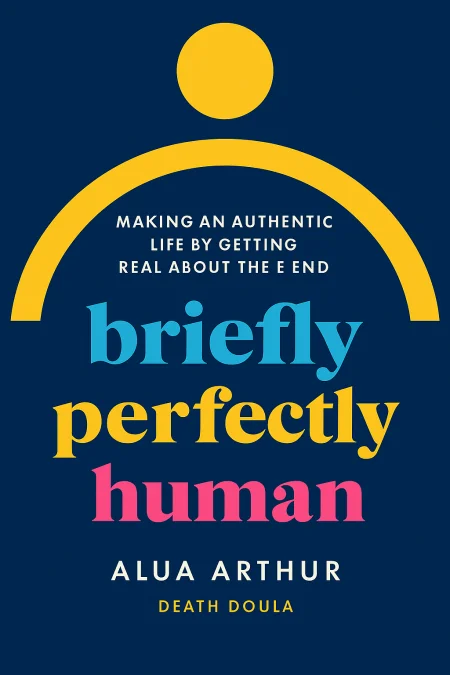
Briefly Perfectly Human
Making an Authentic Life by Getting Real about the End
Book Edition Details
Summary
In the tender dance between life and its inevitable end, Alua Arthur emerges as a beacon of empathy and wisdom. "Briefly Perfectly Human" invites readers to reimagine their relationship with mortality through the eyes of America’s most celebrated death doula. Alua’s journey, shaped by personal loss and profound encounters, uncovers the hidden vitality in acknowledging our own impermanence. Her stories, woven with humor and heartfelt honesty, guide us to the core of what it means to truly live—fully and fearlessly. As she bears witness to the raw beauty of final moments, Alua’s message is clear: by embracing death, we unlock the potential to transform our lives, nurturing deeper connections and unprecedented growth. This memoir isn’t just a book; it’s a call to awaken to life’s fleeting magic with courage and compassion.
Introduction
In the sterile corridors of a Los Angeles courthouse, a young lawyer shuffled through endless paperwork, her spirit slowly dying with each bureaucratic procedure. Alua Arthur seemed to have it all—a prestigious law degree, meaningful work serving low-income communities, and the approval of her immigrant parents who had sacrificed everything for their daughter's success. Yet beneath her professional exterior, a profound emptiness was consuming her from within. This is the story of a woman who discovered that sometimes we must lose ourselves completely to find our true calling, and that our deepest wounds can become our greatest sources of healing for others. Through Arthur's transformation from a depressed attorney to a pioneering death doula, we witness the power of embracing our mortality to fully embrace our lives. Her journey reveals how confronting death can teach us to live authentically, how serving others in their final moments can illuminate our own purpose, and how the courage to abandon a life that looks good on paper can lead to work that feeds the soul. This is ultimately a testament to the radical act of choosing authenticity over expectation, and finding meaning in the places society teaches us to fear most.
Crisis and Awakening: Depression to Cuban Revelation
By her mid-thirties, Alua Arthur had constructed what appeared to be an enviable life. Born in Ghana and raised across multiple continents due to her father's missionary work, she had overcome the challenges of being a perpetual outsider to become a successful Legal Aid attorney in Los Angeles. Her part-time schedule afforded her freedom to travel internationally, pursue photography, and maintain an active social life. Yet beneath this carefully curated exterior, Arthur was drowning in a depression so profound that getting dressed each morning felt like an insurmountable task. The breaking point came when Arthur was reassigned to what she privately dubbed "The Dungeon"—a windowless basement office in the Inglewood courthouse where she supervised volunteers in sterile isolation. The fluorescent lights and concrete walls became a physical manifestation of her internal prison. Each morning brought tears before her alarm even sounded, and evenings dissolved into wine-soaked solitude on her couch. The woman who had once found joy in debate and advocacy now could barely remember how to engage with the world around her. It was during this nadir that Arthur made what seemed like another impulsive escape—a trip to Cuba, ostensibly to outrun her depression through travel, as she had done so many times before. But this journey would prove different. On a crowded bus between Cuban cities, she encountered Jessica, a German traveler with uterine cancer who was touring the world before her disease might claim her life. Their conversation about mortality—frank, curious, and unafraid—awakened something dormant in Arthur's spirit. As Jessica spoke openly about her approaching death, Arthur experienced a startling revelation. For the first time in years, she felt fully present, her natural empathy and curiosity flowing freely. She realized that she had been living as though she were immortal, postponing authentic engagement with life itself. The conversation forced her to confront a fundamental question: if she died tomorrow, would she be satisfied with the life she had lived? The answer was a resounding no, but it came with an unexpected gift—the recognition that she still had time to change that answer.
Finding Purpose: From Law to Death Work
Returning from Cuba, Arthur could no longer pretend that her legal career was sustainable. The medical leave she took for depression became a period of profound self-examination, supported by friends who literally left meal schedules to ensure her survival. During psychedelic-assisted therapy sessions, the carefully constructed walls of her professional identity crumbled, revealing the hollow shell she had become in pursuit of others' expectations rather than her own calling. The transition from lawyer to death doula was neither immediate nor linear. Arthur's first encounter with death work came through caring for her brother-in-law Peter during his battle with lymphoma. As she navigated the bewildering maze of medical decisions, family dynamics, and bureaucratic necessities surrounding his death, she discovered her natural gifts as a companion to the dying. Her legal skills proved useful for practical matters, but her true talent lay in creating space for difficult conversations and honoring the full humanity of those facing their mortality. Arthur's formal training as a death doula provided structure for what had been intuitive responses to Peter's needs. She learned to distinguish between empathy and compassion, recognizing that trying to fix others' pain often prevented her from truly serving them. The work demanded that she confront her own relationships with death, privilege, and the complex realities of how people actually die in America. She discovered that her years of feeling like an outsider—as a Black woman, an immigrant's daughter, a perpetual seeker—had uniquely prepared her for accompanying others through their own transitions. Building her practice required confronting the death-phobic nature of American culture, where even hospice workers sometimes struggled to accept her role. Arthur learned to articulate the value of her work not through abstractions but through the tangible relief she could provide to families drowning in practical and emotional chaos. Each client taught her something new about the courage required to face mortality with grace and the profound intimacy possible when pretense falls away.
Building a Practice: Lessons from the Dying
Arthur's early clients became her greatest teachers in the art of death companionship. She learned from Ken, who wanted to die wearing blue nail polish despite family disapproval, that honoring authentic identity becomes even more crucial at life's end. Nancy, the elderly woman with dementia whose racism emerged as her condition progressed, taught Arthur about setting boundaries while still maintaining compassion for the full complexity of human nature. Summer, the twenty-six-year-old with terminal breast cancer, demonstrated how someone can embrace death with remarkable grace while still grieving all they would miss. Each client presented unique challenges that stretched Arthur's skills and understanding. She navigated family dynamics complicated by decades of secrets, supported individuals whose religious beliefs differed radically from her own, and learned to hold space for the messy realities of human mortality. The work required her to master practical skills—understanding medical processes, legal requirements, and family systems—while never losing sight of the profound spiritual and emotional dimensions of death. Arthur discovered that her role often involved helping families distinguish between their need to do something and their need to be present with their dying loved one. She learned to guide difficult conversations about end-of-life preferences, help create meaningful rituals, and support the practical work of wrapping up a human life. Perhaps most importantly, she developed the ability to sit comfortably with questions that have no answers, offering companionship in the face of life's greatest mystery. The diversity of her clients' deaths taught Arthur that there is no single way to die well. Some deaths were peaceful and surrounded by love, others were complicated by family conflict or medical crises. She learned to honor each person's unique journey while helping them identify what mattered most in their final chapters. The work demanded constant growth in cultural competency, medical knowledge, and emotional resilience.
Embracing Mortality: Living Authentically Through Death
Through years of accompanying others toward death, Arthur underwent her own profound transformation. The depression that had once threatened to destroy her became a source of deep empathy for others facing their own dark nights of the soul. Her restless nature, which had seemed like a character flaw in her legal career, proved perfectly suited to work that demanded presence with the unknown and comfort with impermanence. Arthur learned that embracing mortality paradoxically made life more vibrant rather than more frightening. When she truly accepted that her time was limited and unpredictable, every choice became more intentional. She began to measure decisions not by external approval but by how they would feel when viewed from her deathbed. This perspective liberated her from many of the social expectations that had previously constrained her, allowing her to dress boldly, speak truthfully, and love fully. The work also taught Arthur about the profound interconnectedness of human experience. Each person she accompanied to death left traces of their essence that continued to influence her long after their bodies had died. She began to see death not as an ending but as a transformation, with the love and wisdom shared between people creating an eternal continuity that transcended individual mortality. Arthur's vision of her own death became a North Star guiding her living. She imagined dying outdoors, surrounded by flowers and the sounds of nature, having used every ounce of her gifts and lived without apology. This vision informed daily choices, from the jewelry she wore to the risks she was willing to take in service of authenticity. Death had become not her enemy but her advisor, constantly reminding her to choose presence over postponement, truth over convenience, and love over fear.
Summary
Alua Arthur's journey from legal despair to death doula exemplifies the transformative power of aligning our work with our deepest values and gifts. Her story demonstrates that sometimes our greatest crisis becomes the doorway to our most meaningful contribution, and that serving others in their most vulnerable moments can heal our own deepest wounds. Arthur's willingness to abandon professional security in favor of authentic purpose offers a powerful reminder that true success cannot be measured by external achievements alone but must include the internal satisfaction of living in harmony with our values. Her work challenges us to consider how awareness of our mortality might inform our daily choices, encouraging us to live with greater intentionality and courage. For anyone feeling trapped by others' expectations or struggling to find meaning in conventional success, Arthur's transformation suggests that our supposed weaknesses—sensitivity, restlessness, emotional depth—might actually be our greatest strengths when applied to work that truly serves the world.
Related Books
Download PDF & EPUB
To save this Black List summary for later, download the free PDF and EPUB. You can print it out, or read offline at your convenience.
By Alua Arthur
