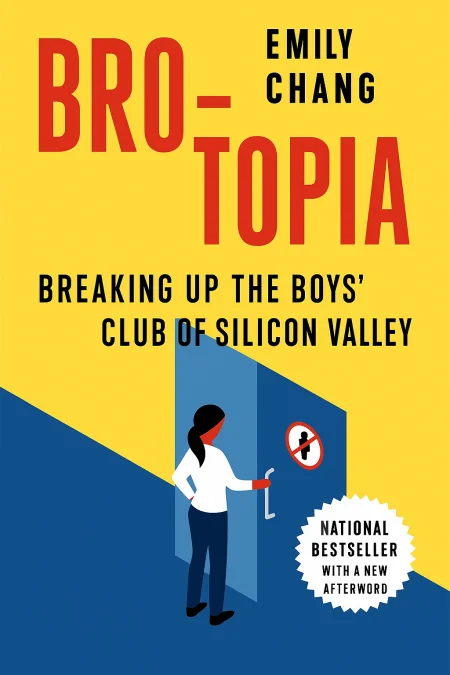
Brotopia
Breaking Up the Boys’ Club of Silicon Valley
Book Edition Details
Summary
In the shadow of Silicon Valley's glittering tech empires lies a stark reality—an industry marred by a "Brotopia" where women are sidelined in a boys' club masquerading as a meritocracy. Through the incisive lens of Bloomberg journalist Emily Chang, this gripping exposé unravels the deeply ingrained sexism that permeates the tech world, despite its high-minded slogans of progress and innovation. Chang pulls back the curtain on exclusive boardrooms and notorious venture capital firms, spotlighting the courageous women who dare to challenge the status quo. From high-profile lawsuits to the audacious voices of trailblazers like Susan Fowler and Brianna Wu, "Brotopia" shines a light on the battle to shatter the Silicon Ceiling. The book is a clarion call for change, revealing the urgent need to dismantle a toxic culture and usher in a more equitable tech landscape.
Introduction
Silicon Valley presents itself as the ultimate meritocracy, where brilliant ideas triumph regardless of their creators' backgrounds and innovation flows freely from diverse minds. Yet this progressive facade conceals a troubling reality: the technology industry has systematically excluded women from participating in the greatest wealth creation in human history. This exclusion represents neither natural selection nor market forces at work, but rather the deliberate construction of cultural norms, institutional practices, and power structures that consistently favor men while marginalizing women. The evidence reveals a stark contradiction between Silicon Valley's egalitarian rhetoric and its exclusionary practices. Women earned nearly 40 percent of computer science degrees in 1984, yet today that figure has plummeted to just 22 percent. Female entrepreneurs receive merely 2 percent of venture capital funding, while women hold only 7 percent of partner positions at top venture capital firms. These statistics reflect not isolated incidents of bias but systematic patterns that have transformed what was once a female-dominated field into one of the most gender-segregated industries in the modern economy. The consequences extend far beyond individual careers or corporate diversity metrics. As technology increasingly shapes every aspect of human existence, from the products we use daily to the algorithms governing our digital interactions, the absence of women's perspectives in technological development represents a fundamental threat to innovation itself. The industry's homogeneous leadership has produced health applications that track alcohol consumption but ignore menstruation, virtual assistants unable to respond appropriately to reports of sexual assault, and social media platforms that amplify harassment disproportionately targeting women. Understanding this exclusion requires examining how cultural stereotypes, institutional biases, and power dynamics have combined to create an ecosystem that systematically advantages men while creating insurmountable barriers for women. Through careful analysis of historical transformations, hiring practices, investment patterns, and workplace cultures, a clear picture emerges of how Silicon Valley constructed and maintains its own version of systematic exclusion, revealing the mechanisms through which seemingly progressive industries can perpetuate deeply regressive outcomes.
The Historical Construction of Male-Dominated Tech Culture
The transformation of computer programming from a female-dominated profession to a male preserve represents one of the most dramatic occupational reversals in modern history. During the 1940s and 1950s, women pioneered the field of software development, programming the first computers and creating fundamental concepts that underpin modern technology. Grace Hopper invented the compiler, six women programmed the revolutionary ENIAC computer, and Margaret Hamilton led the software team that guided the Apollo missions to the moon. Programming was considered detail-oriented clerical work, similar to operating telephone switchboards or performing mathematical calculations, tasks traditionally assigned to women. This early female dominance reflected practical considerations rather than progressive ideology. Employers viewed programming as requiring patience, precision, and meticulous attention to detail, qualities they associated with women's work. The term "programmer" itself carried relatively low status precisely because of its association with female labor. As late as 1967, Cosmopolitan magazine encouraged women to pursue computer programming as a lucrative career path, describing women as naturally suited to the work. The systematic exclusion of women began during the mid-1960s when the computing industry recognized its growing importance and economic potential. Companies desperate to identify qualified programmers commissioned psychologists William Cannon and Dallis Perry to develop personality assessments for screening candidates. These tests, based on surveys of existing programmers who were predominantly male, concluded that successful programmers shared crucial characteristics: they disliked interpersonal interaction and preferred working in isolation. This personality profile became the foundation for hiring practices that would reshape the industry for decades. The implementation of these biased selection criteria created a self-reinforcing cycle of exclusion. By screening for antisocial traits more commonly exhibited by men and establishing stereotypes that equated programming excellence with social awkwardness, the industry systematically filtered out women who failed to conform to this narrow archetype. The cultural reinforcement of the "antisocial genius" stereotype through popular media in the 1980s, combined with marketing strategies that positioned home computers as toys for boys rather than tools for families, completed the transformation. What had once been women's work became definitively coded as masculine territory, creating institutional barriers that persist today.
Venture Capital's Role in Perpetuating Gender Exclusion
The venture capital industry functions as Silicon Valley's ultimate gatekeeper, wielding concentrated power to determine which entrepreneurs receive funding and which innovations gain the resources necessary for global impact. This gatekeeping role makes the demographics of venture capital partnerships crucial for understanding broader patterns of exclusion throughout the technology ecosystem. The statistics reveal a stark reality: women account for merely 7 percent of partners at leading venture capital firms, while companies founded by women receive only 2 percent of total venture funding, despite research demonstrating that women-led companies often deliver superior financial returns. The exclusion operates through interconnected mechanisms that compound over time, creating seemingly insurmountable barriers for female entrepreneurs. Venture capitalists overwhelmingly invest in entrepreneurs who remind them of previous successes, leading to pattern matching that favors young, white, male founders from elite universities. The PayPal network exemplifies this dynamic perfectly, as a tight-knit group of male Stanford graduates went on to found or fund many of Silicon Valley's most valuable companies. Their extraordinary success created a template that subsequent investors have repeatedly attempted to replicate, establishing narrow definitions of what successful entrepreneurs look like. This pattern matching extends beyond demographics to encompass the types of businesses that receive funding consideration. Male investors, who dominate decision-making roles, naturally gravitate toward ideas and markets they understand intuitively and find personally compelling. Female entrepreneurs frequently find themselves pitching businesses focused on female consumers to rooms filled with men who may not recognize market opportunities or connect emotionally with product visions. The result is systematic undervaluation of women-focused businesses and corresponding overvaluation of products and services designed primarily for male users. The power dynamics inherent in fundraising create additional vulnerabilities for women seeking capital. The relationship between investor and entrepreneur involves significant dependency, as entrepreneurs require not only financial resources but also access to networks, expertise, and ongoing support that investors provide. This dependency, combined with overwhelming male dominance among investors, has created conditions where sexual harassment and inappropriate behavior can flourish with minimal consequences. Multiple high-profile cases have revealed how venture capitalists have exploited their positions of power to pursue sexual relationships with female entrepreneurs, knowing that speaking out could destroy a woman's chances of raising capital not just from that firm but throughout the broader industry.
Sexual Harassment and Workplace Hostility Toward Women
The technology industry's harassment problem extends far beyond isolated incidents to encompass pervasive cultural patterns that systematically undermine women's ability to succeed professionally. Research reveals that 60 percent of women in Silicon Valley have experienced unwanted sexual advances, with the vast majority of incidents involving supervisors or colleagues in positions of power. These statistics represent not merely individual violations but systematic patterns reflecting deeper structural problems within industry culture and organizational practices. Harassment operates across multiple dimensions, from overt sexual propositions to subtler forms of discrimination that accumulate over time to create hostile work environments. Women report being consistently interrupted during meetings, having their technical contributions questioned more frequently than male colleagues, and seeing their ideas attributed to men who repeat them. They are disproportionately asked to perform administrative tasks like note-taking or event planning that are never requested of male peers. This phenomenon of "death by a thousand cuts" creates exhausting additional emotional labor that women must navigate daily while attempting to perform their actual job responsibilities. The industry's pervasive drinking culture exacerbates these problems by creating environments where normal professional boundaries become blurred or disappear entirely. Many technology companies provide alcohol on-site as a workplace perk, and after-hours socializing frequently involves heavy drinking in settings where women may be vastly outnumbered by male colleagues. Women face impossible choices: participate in these alcohol-centered social events and risk being sexualized or harassed, or abstain and miss crucial networking opportunities that determine career advancement and professional relationship building. Organizational responses to harassment complaints often reveal fundamental biases toward protecting male employees over female victims. Human resources departments frequently minimize complaints, suggest that harassment was likely an innocent misunderstanding, or recommend that women simply transfer to different teams rather than addressing underlying behavioral problems. The widespread use of non-disclosure agreements and mandatory arbitration clauses in employment contracts further silences victims and prevents patterns of abuse from becoming visible to other employees or external observers. The Susan Fowler case at Uber illustrates these dynamics perfectly, as her documented experiences of harassment and retaliation were dismissed by human resources representatives who suggested she was "the common theme" in all complaints she filed, demonstrating how reporting harassment often becomes a career-limiting decision for women while perpetrators face minimal consequences.
The Intersection of Power, Sex, and Professional Marginalization
Silicon Valley's sexual culture reveals fundamental power imbalances and their consequences for women's professional advancement in stark detail. The emergence of drug-fueled sex parties among technology elites represents more than personal lifestyle choices; it reflects broader dynamics where professional and sexual relationships become dangerously intertwined, creating additional barriers for women seeking success in the industry. These gatherings, attended by prominent venture capitalists, successful entrepreneurs, and technology executives, operate on principles that systematically disadvantage women while serving male fantasies of sexual access and control. These exclusive events typically feature gender ratios heavily skewed toward women, with male attendees leveraging their wealth and professional status to create environments serving their sexual desires. The parties operate under the premise that participants are progressive and open-minded, disrupting traditional social norms just as they disrupt industries through technological innovation. However, actual dynamics reveal deeply traditional power structures where wealthy men gain sexual access to women through economic and professional influence, using the language of liberation to mask fundamentally exploitative relationships. The professional consequences of this culture fall disproportionately on women, creating double binds that compromise their ability to compete on equal terms. Female entrepreneurs who participate in these social networks risk being perceived as sexual objects rather than serious business leaders, while those who refuse participation may find themselves excluded from networking opportunities and relationship building that determine access to funding and career advancement. The culture effectively entangles women's professional success with their willingness to navigate sexual situations involving potential investors, mentors, and business partners. The rationalization of exploitative behavior through progressive rhetoric masks its fundamentally harmful nature. When powerful men claim they are exploring new paradigms of human relationships or challenging conventional social boundaries, they obscure the reality that these "experiments" primarily serve male desires while placing women in vulnerable positions. The frequent use of drugs like MDMA at these gatherings further compromises participants' ability to provide meaningful consent and make clear-headed decisions about professional relationships. The broader implications extend beyond individual incidents to shape Silicon Valley's entire culture, creating systemic barriers that prevent women from competing professionally when advancement becomes tied to sexual availability or tolerance for inappropriate behavior.
Summary
The exclusion of women from Silicon Valley represents a carefully constructed system of cultural, institutional, and economic barriers that transformed what was once a female-dominated field into one of the most gender-segregated industries in the modern economy. This transformation occurred not through natural selection or merit-based competition, but through deliberate choices about hiring practices, cultural values, and power structures that consistently favored men while marginalizing women. The systematic nature of this exclusion reveals how seemingly progressive industries can perpetuate deeply regressive outcomes through biased selection criteria, pattern matching in investment decisions, tolerance for harassment, and the intertwining of professional advancement with sexual dynamics. The consequences extend far beyond individual careers to affect the fundamental nature of technological development, as products and platforms designed primarily by men reflect masculine perspectives while failing to serve the needs and experiences of half the population. Understanding these mechanisms of exclusion is essential not only for addressing current inequalities but for ensuring that the technologies shaping human civilization reflect the full spectrum of human experience, creativity, and potential rather than the narrow worldview of a homogeneous elite.
Related Books
Download PDF & EPUB
To save this Black List summary for later, download the free PDF and EPUB. You can print it out, or read offline at your convenience.
By Emily Chang
