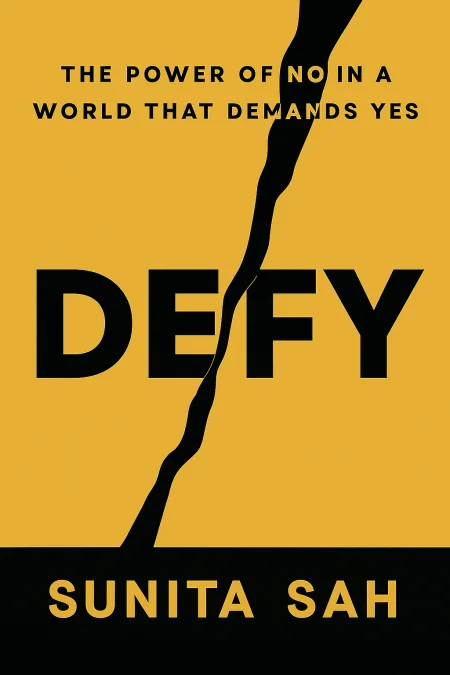
Defy
The Power of No in a World That Demands Yes
Book Edition Details
Summary
In the silent dance of compliance, where even whispers of dissent fade into the background, lies a powerful truth waiting to be unearthed. "Defy" by Dr. Sunita Sah shatters the facade of obedience, exposing the hidden forces that compel us to nod in agreement when our hearts scream "no." Through riveting case studies, from boardrooms steeped in corruption to the quiet submission in everyday life, this book unveils the intricate web of societal pressures that bind us. Dr. Sah's pioneering research redefines defiance not as a rebellious outburst, but as a vital catalyst for change. With her "five stages of defiance," she arms readers with the courage and strategies to reclaim their voice and align their actions with their deepest values. In a world that often rewards silence, "Defy" is your essential guide to speaking up and shaping the narrative of your own life.
Introduction
The tension between obedience and moral courage represents one of humanity's most persistent psychological challenges. Despite widespread belief in individual autonomy and ethical decision-making, research consistently reveals that ordinary people routinely abandon their deepest values when confronted by authority figures or social pressure. This pattern extends far beyond laboratory experiments into hospitals where nurses hesitate to question harmful orders, corporate environments where employees remain silent about unethical practices, and everyday situations where individuals comply with requests that violate their moral compass. The phenomenon of automatic compliance operates through sophisticated psychological mechanisms that bypass conscious decision-making entirely. Social belonging needs, threat-detection systems, and neurological reward pathways combine to create powerful forces that prioritize conformity over individual judgment. Yet this troubling reality need not represent an immutable aspect of human nature. By examining the cognitive and emotional processes that drive both compliance and resistance, specific strategies emerge for recognizing when values are under threat and developing practical tools for authentic response. The journey from unconscious obedience to conscious choice requires understanding both internal forces that compel compliance and external conditions that enable principled resistance. Through careful analysis of successful acts of moral courage, patterns reveal defiance as a learnable skill rather than an innate personality trait, offering hope for individuals seeking to align their actions with their deepest convictions regardless of social pressure.
The Compliance Trap: How Authority Undermines Moral Agency
Compliance represents humanity's default behavioral setting, shaped by evolutionary necessity and reinforced through systematic conditioning from earliest childhood. Parents, teachers, and social institutions create powerful associations between obedience and survival, acceptance, and reward, while framing defiance as moral failure. This conditioning operates at neurological levels, establishing dopamine pathways that reward conformity and weaken neural connections associated with resistance, creating automatic responses that bypass conscious moral evaluation. The psychological architecture extends beyond simple reward mechanisms to exploit fundamental human needs for social belonging. When faced with authority figures or group pressure, the brain's threat-detection systems activate, prioritizing social safety over moral consistency. This explains why otherwise principled individuals can participate in harmful actions when embedded within hierarchical structures, as the fear of exclusion triggers anxiety responses that override individual judgment and ethical reasoning. However, compliance and defiance exist on a spectrum rather than as binary opposites, with many individuals experiencing internal tension when asked to act against their values. This discomfort manifests as physical symptoms, emotional distress, or cognitive dissonance, signaling the presence of moral conflict and representing the foundation for potential resistance. Rather than viewing such tension as weakness, it should be recognized as evidence of intact moral sensibilities and the starting point for principled action. The transition from automatic compliance to conscious defiance follows predictable stages: initial tension, acknowledgment of discomfort, vocalization of concerns, threats of non-compliance, and finally direct action. Understanding this progression allows individuals to recognize their position within the process and make deliberate choices about whether and how to proceed, transforming defiance from an unpredictable emotional reaction into a strategic decision based on careful consideration of values and circumstances.
The Defiance Framework: Values, Assessment, and Strategic Resistance
Authentic defiance requires deep self-knowledge that extends beyond surface preferences to identify core values that transcend situational pressures and social expectations. Values differ fundamentally from beliefs, goals, or preferences, representing enduring principles that guide behavior across contexts and provide the emotional foundation necessary to withstand inevitable pushback. The challenge lies not in identifying admirable values but in honestly examining whether current actions align with stated principles and understanding the specific circumstances under which compromise becomes unacceptable. Environmental assessment involves evaluating two critical dimensions: personal safety and potential impact of resistance. Safety encompasses physical, emotional, financial, and social considerations, while impact analysis determines whether defiance can create meaningful change or merely symbolic gesture. These assessments must be realistic rather than perfectionist, recognizing that complete safety never exists and that even small acts of resistance can generate significant consequences through cultural ripple effects and gradual norm shifts. The responsibility dimension transforms abstract principles into urgent imperatives for action, serving as defiance's most powerful motivator. When individuals feel accountable for others' welfare, usual barriers to resistance often crumble, as demonstrated by parents defending children, professionals protecting clients, and citizens safeguarding communities. This phenomenon suggests that expanding our sense of responsibility beyond immediate self-interest can unlock greater capacity for principled action and overcome the psychological mechanisms that enable moral abdication. Strategic thinking involves recognizing that cultural transformation often begins with individual acts of resistance that gradually shift organizational norms and expectations. Small wins accumulate over time, creating momentum for larger changes, while even early stages of defiance such as asking clarifying questions can plant seeds of doubt that eventually blossom into systemic reform. The framework emphasizes finding situations where the safety-to-impact ratio justifies the risks, viewing resistance as an ongoing commitment rather than occasional dramatic gestures.
True vs. False Defiance: Distinguishing Authentic Moral Courage
False defiance appears rebellious while actually reflecting external influences rather than authentic values, manifesting in adolescent rebellion, crowd behavior, and performative opposition that represents reactive compliance with different authority figures. This type of resistance shifts based on audience and social dynamics, lacking the internal consistency and moral foundation necessary for sustained principled action. The January 6th Capitol riots exemplify this phenomenon, where many participants later expressed confusion about their actions, suggesting compliance with crowd dynamics rather than genuine conviction. True defiance stems from what researchers term moral conviction - beliefs so central to identity that compromising them would fundamentally alter who we are. These convictions provide the psychological resources necessary to maintain resistance across different contexts and withstand sustained pressure from authority figures or social groups. Authentic moral courage demonstrates consistency over time, remaining compelling even when immediate emotional drivers have subsided and social support has diminished. The distinction becomes particularly crucial in group settings where social dynamics can amplify both authentic and inauthentic forms of resistance. Crowd psychology research reveals how individuals can be swept along by collective emotions, participating in actions they would never consider undertaking alone. This phenomenon affects both compliance and defiance, making individual moral clarity essential for distinguishing between genuine conviction and temporary emotional contagion. Power hierarchies fundamentally shape who can defy and under what circumstances, with marginalized groups facing disproportionate consequences for identical behaviors that earn privileged individuals praise or admiration. This dynamic creates complex calculations where the same action carries vastly different risks depending on the actor's social position, highlighting the need for systemic changes that protect everyone's right to principled dissent while recognizing the unequal distribution of both opportunity and consequence in acts of moral courage.
Building Sustainable Moral Courage: Skills and Community Support
Developing capacity for principled resistance involves both practical skill-building and psychological preparation that strengthens resilience over time. Practical capabilities include learning to recognize early warning signs of moral compromise, developing scripts for difficult conversations, and building networks of support that provide guidance and encouragement during challenging situations. These skills improve through deliberate practice in low-stakes situations, building confidence and competence for higher-stakes encounters when they inevitably arise. Psychological preparation involves what researchers call moral imagination - the ability to envision ourselves acting courageously before facing actual tests of character. Behavioral rehearsal studies suggest that mentally practicing difficult scenarios significantly increases the likelihood of following through when real situations arise, helping overcome the paralysis that often accompanies high-stakes moral decisions. This preparation process helps individuals understand that meaningful defiance rarely requires superhuman bravery but emerges from ordinary people making necessary choices in everyday circumstances. Conscious compliance offers a strategic alternative when defiance carries excessive risks or limited potential for impact, involving deliberately choosing compliance while maintaining awareness of values and the temporary nature of the decision. Unlike automatic obedience, this approach preserves moral agency and prepares individuals for future opportunities to act authentically. However, the strategy requires careful monitoring to prevent gradual erosion of values and increasing tolerance for unacceptable situations. Community support and role models play crucial roles in sustaining moral courage over time, providing both practical wisdom and emotional encouragement from others who have navigated similar challenges. Learning from experienced practitioners offers insights into effective strategies while demonstrating that principled resistance can be both impactful and sustainable. This ongoing learning process continues throughout life as new situations present fresh opportunities to refine understanding and strengthen resolve for future tests of character and conviction.
Summary
The capacity for principled defiance emerges not from extraordinary personality traits but from the systematic cultivation of self-awareness, environmental assessment skills, and strategic thinking about when and how to act on deeply held values. By understanding the psychological mechanisms that drive automatic compliance, individuals can recognize moments when their authentic selves are under threat and respond with conscious choice rather than conditioned obedience. This transformation from passive compliance to active moral agency represents both personal liberation and contribution to broader social change, as each act of principled resistance creates possibilities for others to follow and demonstrates that living authentically requires not superhuman strength but patient development of awareness, skills, and unwavering commitment to one's deepest principles.
Related Books
Download PDF & EPUB
To save this Black List summary for later, download the free PDF and EPUB. You can print it out, or read offline at your convenience.
By Sunita Sah
