
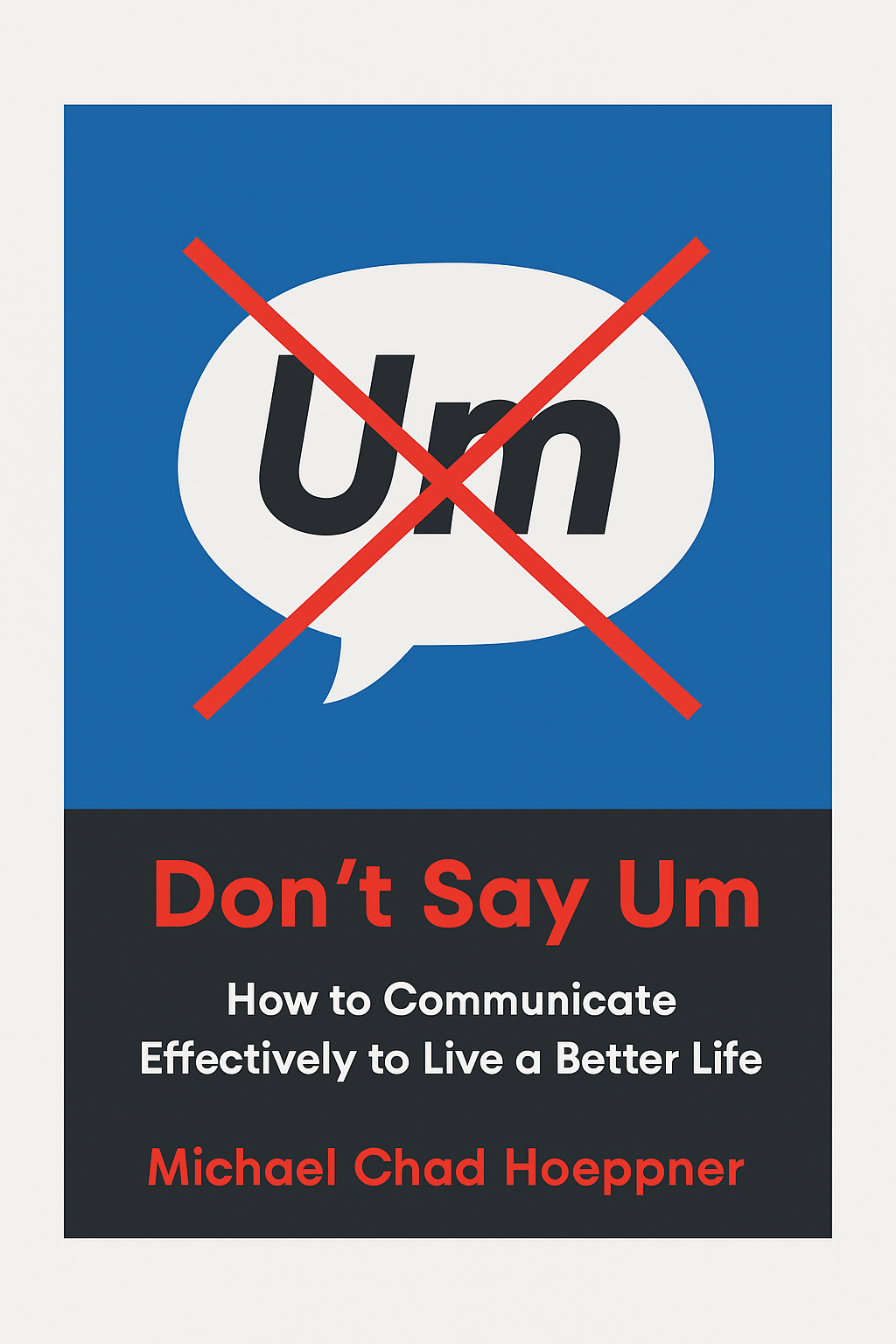
Don't Say Um
How to Communicate Effectively to Live a Better Life
Book Edition Details
Summary
In a world where every word spoken can tip the scales of success, Michael Chad Hoeppner emerges as the maestro of eloquence with "Don't Say Um." This transformative guide challenges the age-old adage that content is king, instead placing the crown on delivery. With a rich history of coaching the crème de la crème—from presidential hopefuls to corporate titans—Hoeppner distills his expertise into actionable exercises designed to fortify your verbal prowess. Imagine shedding the anxiety that binds your voice and stepping into a realm where communication flows with clarity and confidence. Whether you're addressing a boardroom or sharing a joke at a dinner party, this book offers the keys to unlock your full potential. It's not about imagining your audience in their underwear; it's about mastering the art of speech itself. Embrace this blueprint for speaking with ease and discover how powerful your words can truly become.
Introduction
Every day, you face moments where your ability to communicate clearly determines your success. Whether you're presenting to colleagues, interviewing for your dream job, or simply trying to be heard in a meeting, the stakes feel impossibly high. Yet despite knowing what you want to say, something happens when you open your mouth. The words don't flow as smoothly as they did in your head. Your voice wavers, your hands feel awkward, and those dreaded filler words creep in. You're not alone in this struggle, and more importantly, you're not stuck with it. The solution isn't about thinking differently about communication, it's about using your body differently. Your voice, gestures, posture, and breath work together as a sophisticated instrument, and like any instrument, it can be trained, refined, and mastered. When you learn to engage your physical self in communication, everything changes. You stop fighting against your nerves and start working with your natural abilities. You discover that confidence isn't something you need to feel, it's something you can embody through specific, learnable actions.
Master Your Physical Communication Instrument
Your body is your communication instrument, and like any instrument, it requires proper technique to produce beautiful music. Think of yourself as a clarinet where air flows over your vocal cords to create vibration, then gets amplified through all the resonant chambers of your body. When professional musicians want to improve their sound, they don't just think about playing better, they practice physical exercises that train their embouchure, breathing, and finger positioning. Jim, a marketing executive, discovered this truth in an unexpected way. Despite being brilliant at his job, he struggled with presentations. His voice would become thin and shaky, his shoulders would hunch, and he'd speak so quietly that clients had trouble hearing him. Rather than working on his confidence or content, his coach handed him a slice of wine cork and asked him to place it between his teeth while speaking. The cork forced Jim to open his mouth wider, use his lips more decisively, and breathe more deeply to be understood. Within minutes, something remarkable happened. As Jim worked to speak clearly past the cork, his posture naturally straightened to give his lungs more room. His voice became fuller and more resonant. His shoulders relaxed as his breathing deepened. When he removed the cork and continued speaking, he maintained that same powerful presence. The physical adjustment had unlocked a cascade of improvements throughout his entire communication instrument. To master your own physical instrument, start with this simple awareness exercise. Notice how you're sitting or standing right now. Without changing anything, take a mental snapshot of your posture, breathing, and physical tension. Now imagine your head as a helium balloon gently lifting toward the ceiling while your feet grow roots into the ground. Feel your spine lengthen and your breath deepen. This isn't about forcing rigid posture, it's about allowing your body to achieve its natural, powerful alignment. Practice speaking in this aligned position daily. Read aloud for five minutes while maintaining this physical awareness. Your instrument will begin to remember this optimal configuration, making it available to you in high-stakes moments when you need it most.
Build Unshakeable Confidence Through Action
True confidence in communication doesn't come from feeling calm or self-assured. It comes from knowing you can perform effectively regardless of how you're feeling in the moment. This revelation transforms everything because it shifts your focus from trying to control your internal state to mastering external actions that consistently produce results. Consider the story of Nancy, a former American football cornerback who had mastered the art of physical presence on the field. As a cornerback, he could anticipate an opponent's moves, maintain perfect balance while running at full speed, and position his body with split-second precision. Yet when he stepped in front of an audience to speak, he would twist his legs into an unstable pretzel-like stance that made him look ready to topple over at the slightest breeze. His coach asked him to demonstrate his defensive stance from football. Instantly, Nancy dropped into a balanced, alert position, feet planted firmly but ready to move in any direction. His entire presence radiated capability and readiness. Then they compared this to his speaking stance, captured in a video still. The contrast was startling. In football, Nancy embodied physical confidence through proper technique. In speaking, he had abandoned everything he knew about using his body effectively. The breakthrough came when Nancy learned to apply his athletic wisdom to communication. Just as he wouldn't dream of playing football off-balance, he began approaching speaking with the same commitment to physical preparation. He practiced standing with both feet grounded, weight evenly distributed, ready to move when needed but stable when still. Build your confidence through these concrete actions. First, identify one physical aspect of communication you can control completely, such as keeping your feet planted when standing or maintaining steady eye contact with one person at a time. Practice this single element until it becomes automatic. Then add another element, like using deliberate gestures or speaking at the top of your breath. Each mastered element becomes a building block of embodied confidence that supports you regardless of how nervous or uncertain you might feel.
Navigate Nerves and Embrace Your Voice
Your relationship with nervousness determines whether it becomes your greatest obstacle or your secret weapon. The key isn't eliminating nerves, which is impossible through thought suppression, but learning to channel that energy into enhanced performance. When you stop fighting your nervous system and start working with it, you discover that anxiety contains tremendous power that can fuel exceptional communication. A world-class singer experienced this transformation during her Carnegie Hall debut. As she waited in the wings, her knees were literally knocking with terror. Instead of trying to calm down or think positive thoughts, she focused on one simple physical task. She committed to using her lips and tongue to enunciate every single consonant with crystal clarity. This wasn't even challenging for her under normal circumstances, but it gave her racing mind something concrete and achievable to focus on. As she walked to the microphone and began singing, something magical happened. The precise enunciation required deeper breathing, which naturally calmed her nervous system. The clearer diction helped her connect with the audience, which boosted her confidence. Within a few measures, she was fully present and enjoying the performance she had worked her entire career to give. Her nerves hadn't disappeared, but they had been transformed from a destructive force into fuel for artistic excellence. You can harness this same principle by choosing your own point of physical focus. Select something concrete and measurable, like feeling your ribs expand when you breathe, maintaining steady eye contact with individuals in your audience, or placing your feet firmly on the ground. Practice this focus intensively in low-stakes situations until it becomes second nature. When nerves arise in important moments, pour all your attention into executing this physical skill perfectly. Your nervous energy will be redirected from internal chaos into external excellence. Remember, you don't need to feel confident to communicate powerfully. You simply need to act confidently through your body, and the feeling will follow.
Create Your Daily Communication Regimen
Excellence in communication, like excellence in any physical skill, requires consistent daily practice. Just as athletes maintain their edge through regular training and musicians keep their instruments responsive through daily scales, your communication instrument needs ongoing attention to perform at its peak when it matters most. The most effective approach is to build your practice into existing routines rather than creating entirely new time commitments. Many successful communicators use their morning routine as a foundation. After brushing your teeth, use the toothbrush handle as a speaking impediment, practicing clear enunciation for three minutes. During your commute, practice tongue twisters or record yourself speaking on various topics. These micro-practices compound over time into significant improvements. Your regimen should include three elements. Physical warm-ups prepare your instrument, just as stretching prepares an athlete. Spend five minutes moving your face, jaw, and tongue through their full range of motion. Practice breathing exercises that engage your diaphragm and expand your vocal capacity. Technical skill building focuses on specific areas where you want to improve, whether that's reducing filler words, improving eye contact, or developing vocal variety. Real-world application is where the magic happens. Choose low-stakes opportunities to practice your developing skills. Order your coffee with extra attention to clear enunciation. Make that customer service call an exercise in maintaining steady vocal pace. Turn routine conversations into chances to practice whatever element you're working on. Set reminders on your phone or place sticky notes in strategic locations to cue your practice throughout the day. Track your progress by recording yourself weekly and noting specific improvements. Celebrate small wins, like successfully completing a phone call without saying "um" or maintaining good posture throughout a meeting. These victories build momentum and reinforce your commitment to continued growth.
Summary
Your communication challenges aren't character flaws to overcome through positive thinking or willpower. They're simply the result of not knowing how to use your remarkable physical instrument effectively. When you understand that "your voice is your body" and begin treating communication as the embodied skill it truly is, everything shifts. You stop trying to think your way to better speaking and start training your way to excellence. You discover that the tools for powerful communication have been with you all along, waiting to be awakened through proper technique and practice. Most importantly, you realize that great communicators aren't born, they're made through the patient development of kinesthetic skills that support them in any situation. Start today by choosing one physical element to focus on, whether it's breathing more deeply, standing taller, or speaking more slowly. Commit to practicing this single element for just five minutes each day. Your future self will thank you for beginning this journey, and everyone who hears you speak will benefit from the more powerful, authentic communicator you're becoming.
Related Books
Download PDF & EPUB
To save this Black List summary for later, download the free PDF and EPUB. You can print it out, or read offline at your convenience.
By Michael Chad Hoeppner
