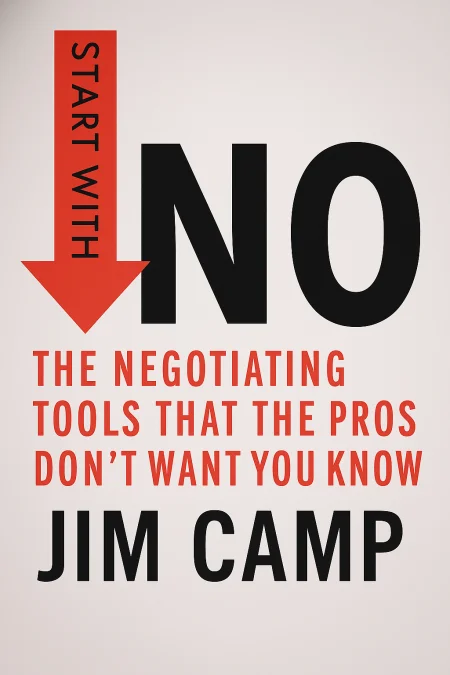
Start with No
The Negotiating Tools That the Pros Don't Want You to Know
byJim Camp
Book Edition Details
Summary
Negotiation is a battlefield, and "Start with No" is your strategic playbook for emerging victorious. Defying the feel-good facade of win-win scenarios, this guide flips the script, teaching you to harness the power of "no" for superior deals. Forget the allure of immediate agreement; the real art lies in understanding the emotional undercurrents that shape discussions and mastering the elements you can control. Through vivid anecdotes and practical insights, discover how elite negotiators maintain their edge—eschewing haste, wielding neediness to their advantage, and ensuring every communication has a purpose. Transform every negotiation into a calculated triumph, armed with a method that redefines success on your terms.
Introduction
The conventional wisdom of "win-win" negotiation has dominated business culture for decades, promising mutual prosperity and sustainable relationships. Yet this seemingly benevolent approach may be fundamentally flawed, creating vulnerability rather than strength in critical business dealings. The promise of shared success often masks a more troubling reality: one party's systematic exploitation of the other's desire to appear reasonable and cooperative. Traditional negotiation training emphasizes compromise, relationship-building, and the pursuit of mutually beneficial outcomes. However, these very principles can become weapons in the hands of skilled adversaries who understand that the most dangerous opponent is one who desperately wants to be liked and fears saying no. The corporate world is filled with predatory negotiation strategies specifically designed to exploit win-win mentality, turning good intentions into competitive disadvantages. This analysis challenges readers to reconsider their fundamental assumptions about negotiation success. Rather than focusing on outcomes beyond our control, effective negotiation requires mastering specific behaviors and decision-making processes that maintain leverage while creating genuine value. The journey ahead demands intellectual courage to abandon comfortable illusions and embrace a more rigorous, systematic approach to human interaction in high-stakes situations.
Rejecting Win-Win: Why Traditional Negotiation Fails
The win-win paradigm represents one of the most seductive and dangerous concepts in modern business practice. While it promises equitable outcomes and sustainable relationships, it systematically weakens negotiators by encouraging premature compromise and emotional decision-making. The very desire to appear reasonable and collaborative creates vulnerability that sophisticated opponents routinely exploit. Corporate purchasing departments have developed entire methodologies specifically designed to defeat win-win negotiators. Programs like PICOS (Program for the Improvement and Cost Optimization of Suppliers) use collaborative rhetoric to mask aggressive cost-reduction strategies. These approaches succeed precisely because they prey upon the win-win negotiator's need to be helpful, reasonable, and accommodating. The language of partnership and mutual benefit becomes a sophisticated manipulation tool. The fundamental flaw in win-win thinking lies in its implicit invitation to compromise before understanding what compromise is necessary or even appropriate. This premature concession-making stems from emotion-based rather than decision-based negotiating. When negotiators operate from feelings of obligation to help their counterparts succeed, they lose sight of their own legitimate interests and valid requirements. True negotiation effectiveness requires abandoning the comfortable mythology of win-win in favor of a more disciplined approach. Success comes not from ensuring everyone feels good about the outcome, but from making sound decisions based on clear vision, valid mission, and systematic behavior. The goal is not harmony, but competence, respect, and results that can withstand the test of time and scrutiny.
The Camp System: Decision-Based Negotiation Fundamentals
Effective negotiation begins with understanding that all decisions are fundamentally emotional, made first in the gut and later rationalized by the mind. This recognition forms the cornerstone of decision-based negotiating, which acknowledges emotional reality while providing systematic tools to move beyond emotional chaos toward sound judgment. The key lies not in suppressing emotions, but in channeling them through disciplined processes. The foundation of this systematic approach rests on several interconnected principles. Neediness represents the greatest weakness any negotiator can display, signaling vulnerability to predatory tactics and compromising decision-making capacity. The concept of being "not okay" provides strategic advantage by allowing adversaries to feel superior and comfortable, thereby lowering their defenses and encouraging open communication. Mission and purpose must be established before any negotiation begins, set specifically in the adversary's world rather than one's own. This outward focus ensures that all tactical decisions serve legitimate strategic objectives while maintaining clarity about what constitutes success. Without this foundational element, negotiators inevitably drift into reactive mode, responding to circumstances rather than directing them. The systematic approach demands rigorous attention to behavioral goals rather than outcome goals. Negotiators can control their preparation, questions, responses, and decision-making processes, but cannot directly control their counterpart's choices or the final results. This distinction between controllable means and uncontrollable ends provides the philosophical framework for maintaining effectiveness under pressure while avoiding the emotional volatility that characterizes most failed negotiations.
Advanced Tools: Questions, Agendas, and Emotional Control
The most powerful tool available to any negotiator is the properly constructed interrogative-led question. Unlike verb-led questions that invite yes, no, or maybe responses, interrogative-led questions beginning with who, what, when, where, why, how, and which create expansive dialogue and reveal critical information. These questions move negotiations into the adversary's world, where all meaningful decisions ultimately occur. Effective questioning technique extends beyond mere information gathering to encompass strategic relationship management. The reverse, which answers questions with questions, maintains control while gathering intelligence. Nurturing language creates psychological safety that encourages honest communication. The connector transforms adversarial statements into opportunities for deeper understanding. These behavioral tools work in concert to create productive dialogue while avoiding defensive reactions. Agenda development and management represent perhaps the most overlooked aspects of negotiation preparation. Every interaction, including brief phone calls and email exchanges, requires explicit agenda negotiation covering problems, baggage, wants, and next steps. This systematic approach prevents misunderstandings, maintains forward momentum, and ensures all parties understand their commitments and expectations. Budget management across three dimensions—time and energy, money, and emotion—provides crucial leverage awareness throughout extended negotiations. Understanding both parties' investment levels enables tactical decisions about when to advance, when to pause, and when to withdraw. The emotional budget carries particular weight, as high emotional investment often leads to poor decision-making and unnecessary compromise. Systematic budget tracking prevents the common mistake of continuing negotiations beyond their viable point.
Building Success: Self-Esteem and Long-Term Effectiveness
The correlation between self-image and negotiation performance cannot be overstated. Individuals consistently perform to the level of their self-concept, making high self-esteem an absolute requirement for sustained success. This internal strength provides the confidence necessary to face overwhelming odds, make difficult decisions, and maintain discipline under pressure. Without genuine self-respect, negotiators inevitably compromise their principles when challenged. Self-esteem enables the paradoxical combination of personal confidence with public humility that characterizes effective negotiators. The ability to allow adversaries to feel superior while maintaining internal strength requires secure self-knowledge and emotional maturity. This balance proves particularly crucial when facing intimidation tactics or when walking away from apparently attractive but fundamentally flawed agreements becomes necessary. The concept of paying forward provides the most reliable method for building and maintaining high self-esteem. Contributing to others' success, supporting community initiatives, and helping those in need creates a positive feedback loop that reinforces personal worth and capability. This practice extends into business relationships, where fair dealing and ethical behavior ultimately serve both immediate tactical needs and long-term strategic interests. Long-term success in negotiation requires viewing each interaction as part of an ongoing relationship rather than an isolated transaction. This perspective demands consistent behavior, reliable follow-through, and genuine concern for creating sustainable value. The negotiator who builds a reputation for competence, fairness, and effectiveness discovers that each successive negotiation begins from a position of enhanced credibility and respect.
Summary
The systematic rejection of win-win mythology in favor of disciplined, decision-based negotiation represents a fundamental shift from emotional reactivity to strategic competence. This transformation requires both intellectual courage to abandon comfortable assumptions and practical commitment to developing new behavioral patterns. The ultimate insight transcends tactical technique to embrace a comprehensive approach to human interaction based on respect, competence, and systematic preparation rather than manipulation or accommodation. Readers seeking to master complex interpersonal dynamics and achieve consistently superior results in high-stakes situations will find this analytical framework invaluable for both professional advancement and personal development.
Related Books
Download PDF & EPUB
To save this Black List summary for later, download the free PDF and EPUB. You can print it out, or read offline at your convenience.
By Jim Camp
