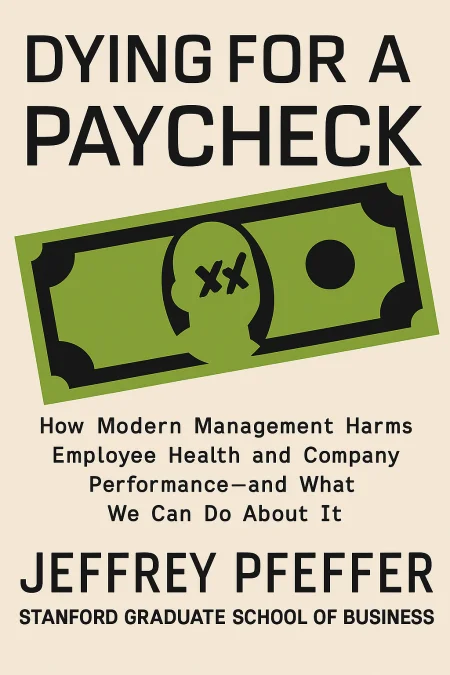
Dying for a Paycheck
How Modern Management Harms Employee Health and Company Performance—and What We Can Do About It
Book Edition Details
Summary
A relentless, modern-day battle rages not on traditional battlefields but within the sterile walls of our workplaces. In "Dying for a Paycheck," Jeffrey Pfeffer reveals a grim truth: the daily grind is not just exhausting but lethal, taking a toll that rivals the hazards of smoking. With a tapestry of global anecdotes and piercing statistics, Pfeffer dismantles the illusion of productivity that masks the destruction of human health. He takes aim at the unyielding demands of today’s corporate culture—where long hours and job insecurity aren't just stressful but downright deadly. This book is both a wake-up call and a roadmap, urging a shift toward workplaces that value human life as fiercely as the planet's. It's a manifesto for change, challenging readers to reclaim their well-being and urging leaders to prioritize people over profits.
Introduction
Modern workplaces present a paradox that few dare to examine: while physical safety regulations have dramatically reduced industrial accidents, the psychological and social environment of work has become increasingly toxic, literally killing employees through stress-related diseases. This systematic examination reveals how management decisions create workplace conditions that generate measurable health consequences, from cardiovascular disease to premature death. The evidence demonstrates that approximately 120,000 Americans die annually from workplace-induced stress, making toxic management practices the fifth leading cause of death in the United States. The analysis employs epidemiological research methods to quantify the health impacts of specific workplace exposures, comparing their effects to known carcinogens like secondhand smoke. Through meta-analysis of over 200 studies and comprehensive cost-benefit calculations, the investigation reveals that harmful workplace practices impose nearly $200 billion in annual healthcare costs while paradoxically reducing organizational performance. This exploration challenges readers to recognize workplace toxicity as a public health crisis requiring the same urgency applied to environmental pollution, while demonstrating that creating healthy work environments benefits both employees and employers economically.
The Hidden Health Crisis: How Modern Workplaces Kill Employees
The transformation of workplace hazards from visible physical dangers to invisible psychological toxicity represents a fundamental shift in occupational health risks. While regulatory agencies successfully reduced workplace fatalities by 65 percent between 1970 and 2015, stress-related health problems have proliferated unchecked. Unlike industrial accidents that trigger immediate regulatory response, workplace-induced psychological stress operates through chronic exposure, creating cumulative health damage that manifests as heart disease, depression, substance abuse, and premature mortality. Toxic workplace practices function as environmental hazards comparable to air pollution or contaminated water supplies. Management decisions regarding layoffs, work hours, job control, and social support create measurable physiological responses in employees. Chronic stress elevates cortisol levels, weakens immune systems, and triggers inflammatory responses that lead directly to cardiovascular disease, diabetes, and other chronic conditions. The workplace becomes a vector for disease transmission, not through pathogens but through organizational policies that systematically undermine human health. The scope of this hidden epidemic extends across all sectors and educational levels. High-technology companies with generous perks still impose crushing work demands and job insecurity. Healthcare organizations, ostensibly dedicated to healing, create work environments that drive their own employees to substance abuse and mental health crises. Professional service firms normalize 80-hour work weeks as badges of honor while their lawyers and consultants develop addiction problems and family dysfunction. The pervasiveness of workplace toxicity reveals that this is not merely a problem of poorly managed companies but a systemic crisis requiring comprehensive intervention.
The Evidence: 120,000 Annual Deaths from Workplace Stress
Rigorous epidemiological analysis reveals the quantifiable mortality impact of toxic workplace practices through examination of ten specific workplace exposures: unemployment, lack of health insurance, shift work, long work hours, job insecurity, work-family conflict, low job control, high job demands, inadequate social support, and workplace unfairness. Meta-analysis of 200 studies involving millions of subjects demonstrates that these workplace conditions produce health effects comparable to or exceeding those of secondhand smoke exposure, a recognized carcinogen subject to extensive regulation. The methodology employed statistical modeling to avoid double-counting health effects while calculating the aggregate mortality burden. Unemployment contributes approximately 35,000 excess deaths annually, while lack of health insurance accounts for 50,000 deaths. Job insecurity adds 29,000 deaths, and insufficient job control contributes 17,000 more. These figures represent conservative estimates based on peer-reviewed research employing sophisticated controls for confounding variables such as age, gender, socioeconomic status, and individual health behaviors. Comparison with other advanced economies provides crucial context for understanding the preventability of these deaths. When the United States is contrasted with 27 European nations that have similar economic development but different labor policies, approximately 60,000 of the 120,000 workplace-attributable deaths appear potentially preventable. Countries with stronger social safety nets, universal healthcare, mandatory paid leave, and regulations limiting excessive work hours achieve substantially better population health outcomes while maintaining economic competitiveness. The mortality calculations focus exclusively on direct health effects experienced by individual workers, without considering spillover effects on families or communities. This conservative approach likely underestimates the true human cost of toxic workplaces, as stress and economic insecurity ripple through households and social networks, affecting spouses, children, and extended social connections.
The False Trade-off: Why Healthy Workplaces Are More Profitable
The conventional assumption that employee wellbeing must be sacrificed for organizational performance represents a fundamental misunderstanding of the relationship between workplace health and economic outcomes. Comprehensive analysis demonstrates that companies implementing health-promoting workplace practices consistently outperform competitors on measures of productivity, profitability, innovation, and employee retention. The false trade-off between employee welfare and business success perpetuates harmful practices that damage both human lives and organizational effectiveness. Healthy workplace practices generate measurable economic returns through multiple mechanisms. Reduced healthcare costs represent the most obvious benefit, as companies with lower-stress work environments experience decreased medical claims, workers' compensation expenses, and disability costs. Beyond direct cost savings, healthy workplaces demonstrate superior performance through enhanced employee engagement, reduced absenteeism, lower turnover rates, and increased discretionary effort. Organizations that provide job control, social support, and reasonable work-life balance attract and retain higher-quality talent while fostering innovation and creativity. Case studies of exemplary employers illustrate the practical application of health-promoting practices. Companies like Southwest Airlines have never implemented layoffs while consistently outperforming competitors through economic downturns. SAS Institute maintains industry-leading employee retention through comprehensive wellbeing programs that include on-site healthcare, reasonable work hours, and strong social support systems. Barry-Wehmiller has achieved 16 percent annual earnings growth while explicitly prioritizing employee fulfillment and community building. The persistence of toxic workplace practices despite their demonstrated ineffectiveness reflects institutional inertia, short-term thinking, and the externalization of health costs onto society. Companies that implement layoffs, excessive work hours, and job insecurity often experience immediate cost reductions while the negative consequences manifest in healthcare systems, families, and communities. This misalignment of costs and benefits creates perverse incentives that perpetuate harmful practices even when they damage long-term organizational performance.
Building Human Sustainability: A Blueprint for Change
Transforming toxic workplaces requires systematic intervention at multiple levels, beginning with measurement and accountability mechanisms that make workplace health effects visible. Just as environmental pollution monitoring enabled regulatory intervention and corporate responsibility, systematic measurement of workplace wellbeing indicators can drive organizational change. Companies must track employee health metrics, stress levels, and work-life balance measures with the same rigor applied to financial performance indicators. Policy interventions should capture the externalized costs of toxic workplace practices through mechanisms similar to environmental regulations or workers' compensation systems. Companies that create health-damaging work environments should bear the full costs of resulting healthcare expenses, disability claims, and social services utilization. This internalization of costs would create economic incentives for implementing health-promoting practices while reducing the burden on public health systems. Organizational leaders must recognize that employee health represents a fundamental business imperative rather than a peripheral concern. Creating healthy workplaces requires deliberate design of job roles that provide autonomy and control, development of supportive social environments that foster collaboration and mutual assistance, and implementation of policies that enable sustainable work-life integration. These changes demand leadership commitment to long-term employee wellbeing over short-term cost minimization. Individual employees also bear responsibility for making informed workplace choices that prioritize health and sustainability. Workers must evaluate potential employers based on their track record of employee treatment, including work hour expectations, layoff history, healthcare benefits, and organizational culture. By preferentially choosing employers that demonstrate genuine commitment to employee wellbeing, workers can create market pressure for healthier workplace practices while protecting their own long-term health and family welfare.
Summary
The systematic analysis of workplace toxicity reveals that management decisions literally determine whether employees live or die, making organizational leaders responsible for a public health crisis that kills 120,000 Americans annually while imposing $200 billion in healthcare costs. This investigation demonstrates that healthy workplace practices consistently outperform toxic alternatives on both human and financial metrics, exploding the myth that employee wellbeing must be sacrificed for organizational success. The evidence demands immediate action to measure workplace health effects, hold companies accountable for the social costs they create, and prioritize human sustainability with the same urgency applied to environmental protection. Readers seeking to understand how seemingly mundane management decisions create life-and-death consequences, and how evidence-based workplace design can simultaneously improve human welfare and organizational performance, will find this analysis both disturbing and ultimately hopeful.
Related Books
Download PDF & EPUB
To save this Black List summary for later, download the free PDF and EPUB. You can print it out, or read offline at your convenience.
By Jeffrey Pfeffer
