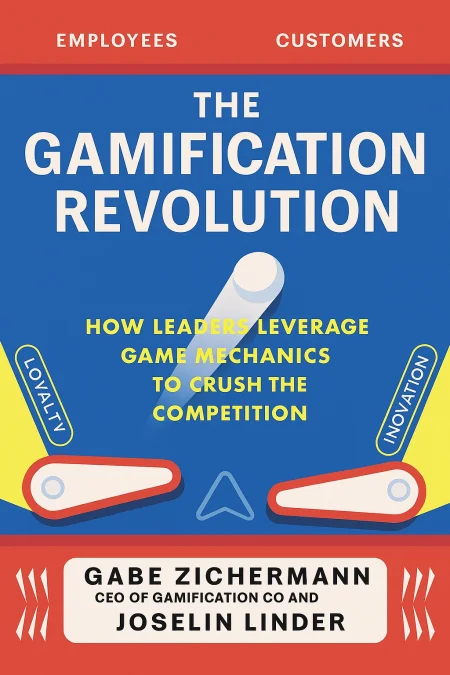
The Gamification Revolution
How Leaders Leverage Game Mechanics to Crush the Competition
byGabe Zichermann, Joselin Linder
Book Edition Details
Summary
In a world where traditional business strategies are as outdated as dial-up internet, "The Gamification Revolution" emerges as the dynamic playbook for thriving in the digital age. Imagine transforming mundane business processes into exhilarating games that captivate both employees and customers alike. Gabe Zichermann, a trailblazer in game-based innovation, alongside Joselin Linder, draws back the curtain on how game mechanics can revolutionize your approach to growth and engagement. This book isn't just about adding a points system; it’s a paradigm shift that promises to redefine competitive advantage. For those ready to unleash the power of play, this isn’t merely a guide—it's your ticket to the forefront of industry innovation.
Introduction
In today's hyper-connected world, capturing and maintaining human attention has become the ultimate business challenge. Traditional methods of engaging employees and customers are failing at an unprecedented rate, with organizations struggling to cut through the endless noise of digital distraction. Yet there's a powerful solution hiding in plain sight, one that taps into our fundamental human drives for achievement, recognition, and meaningful progress. The principles and mechanics that make games irresistibly engaging offer a revolutionary approach to transforming how we motivate teams, delight customers, and drive organizational success. By understanding and applying these game-based strategies, leaders can create experiences that people genuinely want to participate in, turning mundane tasks into compelling challenges and passive consumers into active advocates. This isn't about adding superficial rewards to broken systems, but about redesigning human interactions to align with how our minds naturally seek engagement, mastery, and connection.
Build Winning Corporate Strategy with Games
At its core, gamification represents a fundamental shift in how we approach business strategy, moving from command-and-control models to engagement-centered designs that harness intrinsic human motivations. This approach recognizes that sustainable competitive advantage comes not from forcing behavior, but from creating systems where desired actions feel natural, rewarding, and aligned with people's deeper psychological needs. The transformation at eBay perfectly illustrates this strategic power. When the company faced declining user engagement and mounting competitive pressure in the mid-2000s, traditional approaches to problem-solving proved inadequate. Instead of simply cutting costs or launching marketing campaigns, eBay's leadership team made a crucial decision to orient their entire organization around user-centric design principles borrowed directly from successful game companies. They restructured teams to mirror the collaborative, iterative approaches used by game developers, empowering cross-functional groups to rapidly prototype and test solutions. This strategic pivot yielded remarkable results. By 2012, eBay had engineered what most analysts thought impossible, posting record earnings and rekindling growth in their core marketplace business. The company's reputation system, originally designed using game mechanics to create trust between buyers and sellers, became a model for online commerce platforms worldwide. Users began to see their feedback scores and transaction histories not as administrative requirements, but as achievements that enhanced their status and capabilities within the marketplace ecosystem. The key insight driving eBay's success was understanding that engagement must precede revenue, not follow it. By making the user experience inherently rewarding through game-like mechanics such as reputation building, achievement recognition, and progressive skill development, they created a self-reinforcing cycle of participation. Users stayed longer, transacted more frequently, and became advocates for the platform because the experience itself had become enjoyable and meaningful. Organizations seeking similar transformations should begin by identifying their core engagement challenges, then systematically applying game design principles to address them. This means creating clear progression paths, providing immediate feedback on actions, enabling social recognition, and ensuring that every interaction contributes to a larger sense of purpose and advancement.
Supercharge Team Performance and Innovation
The most profound applications of gamification emerge when organizations recognize that their employees are also customers of the company experience, deserving the same thoughtful design attention typically reserved for external audiences. This perspective shift unlocks tremendous potential for performance improvement, as it addresses the fundamental disconnect between how people naturally seek motivation and how traditional workplace systems deliver it. Target's checkout transformation exemplifies this principle in action. Facing persistent problems with slow transaction times and customer complaints about long lines, the company could have implemented punitive measures or simply hired more cashiers. Instead, they introduced a elegantly simple game mechanic that displayed a letter on each cashier's screen after scanning an item. G meant the scan was fast enough, R meant it was too slow, with a running percentage score showing overall performance. What happened next surprised everyone involved. Not only did checkout speeds increase dramatically, but employee satisfaction actually improved. Cashiers reported that the previously monotonous work had become engaging and even fun. The game element gave them a sense of agency and control over their performance, transforming a repetitive task into an opportunity for skill development and personal achievement. The system provided the three essential elements of engagement that drive human motivation: immediate feedback on actions, a clear sense of progress toward mastery, and the social recognition that comes from visible accomplishment. The success spread throughout Target's operations as managers recognized the broader principle at work. When people understand how their individual actions contribute to larger goals, receive regular feedback on their progress, and feel genuine agency in their work, performance improvements follow naturally. The game mechanics didn't manipulate behavior through external pressure, but rather revealed the intrinsic satisfaction that comes from doing good work and seeing measurable results. Teams seeking similar transformations should focus on designing systems that make progress visible, achievements meaningful, and collaboration rewarding. This means establishing clear metrics that connect individual contributions to team success, creating opportunities for skill development and recognition, and ensuring that the work experience itself becomes a source of satisfaction rather than merely a means to external rewards.
Create Unbreakable Customer Engagement
The challenge of cutting through consumer noise has intensified dramatically as attention spans fragment across multiple devices and platforms, making traditional marketing approaches increasingly ineffective. Successful customer engagement now requires creating experiences so compelling that people actively choose to participate, share, and return, transforming passive consumers into active community members who drive organic growth through their enthusiasm. Foursquare's evolution from the failed Dodgeball app demonstrates the transformative power of well-designed engagement systems. The original Dodgeball concept was sound, allowing users to notify friends of their locations to facilitate spontaneous meetups. However, the app failed because checking in felt like work with no intrinsic reward. Users quickly abandoned the behavior once novelty wore off, leaving the system without the critical mass needed for value creation. The Foursquare redesign changed everything by adding game mechanics that made checking in inherently rewarding. Users could now earn badges for different types of visits, compete for mayorships at frequently visited locations, and track their exploration of new places. These elements transformed location sharing from a utility into an achievement system where every check-in contributed to personal progress and social status. The surprise and delight factor was crucial, as users never knew exactly when they might unlock a new badge or achievement, creating positive anticipation around routine activities. The results were spectacular. Foursquare achieved over 2 billion check-ins within a few years, with users averaging 3 million check-ins daily across 11 countries. More importantly, the engagement created real business value as venues began offering rewards to mayors and active users, creating a virtuous cycle where game participation generated tangible benefits. The social sharing aspect amplified growth as users broadcast their achievements across other platforms, introducing friends to the experience through authentic peer recommendations rather than traditional advertising. Organizations building customer engagement systems should focus on creating experiences where participation feels like achievement rather than obligation. This requires understanding what motivates your specific audience, designing clear progression paths that acknowledge growing expertise, and ensuring that social sharing enhances rather than interrupts the core experience. The goal is building communities where customers become advocates because the experience itself has become part of their identity and social connections.
Summary
The transformation of human engagement through game-based design represents more than a tactical shift, it's a fundamental recognition that sustainable success requires aligning organizational systems with how people naturally seek meaning, progress, and connection. As one industry leader observed, "Without employee and customer engagement, the best laid strategies and tactics are doomed to fail." This insight captures the essential truth that no amount of strategic brilliance can compensate for disengaged stakeholders who feel disconnected from the experience you're trying to create. The most successful organizations of the coming decade will be those that embrace this reality early, systematically applying game design principles to create experiences where desired behaviors feel natural, rewarding, and aligned with human psychological needs. Start by identifying one area where engagement challenges are limiting your success, then design a simple system that provides clear progress indicators, meaningful achievements, and social recognition. The revolution isn't coming, it's here, and your response will determine whether you lead the transformation or struggle to catch up with those who recognized its power first.
Related Books
Download PDF & EPUB
To save this Black List summary for later, download the free PDF and EPUB. You can print it out, or read offline at your convenience.
By Gabe Zichermann
