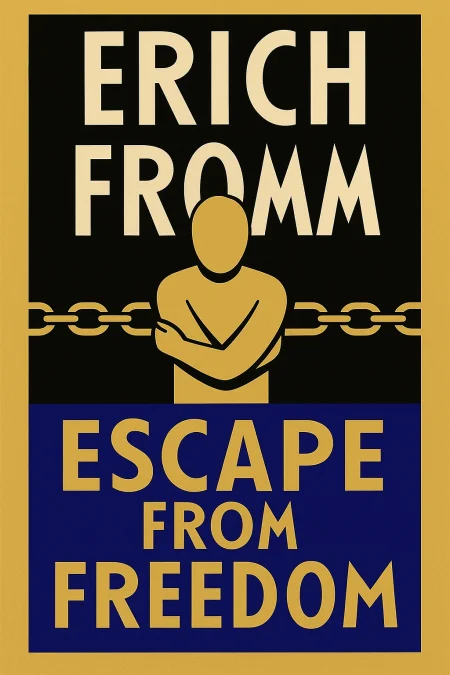
Escape from Freedom
Dig Deep into Democracy and Dictatorship
Book Edition Details
Summary
In the shadow of liberty's promise lies a haunting paradox: the very freedom that promises to uplift can also suffocate. Erich Fromm's "Escape from Freedom" stands as a profound exploration into this tension. Set against the backdrop of a world teetering between liberation and repression, Fromm delves into the psychological undercurrents that drive societies to relinquish their hard-won autonomy for the cold comfort of authoritarian rule. With the keen eye of a psychoanalyst, he dissects the collective anxiety and alienation birthed by unchecked freedom, revealing a civilization all too eager to trade its soul for security. This seminal work challenges readers to confront the hidden chains of modern existence, provoking an unsettling reflection on the costs of true independence.
Introduction
Modern democratic societies face a profound paradox that strikes at the heart of human nature itself. While individuals have achieved unprecedented liberation from traditional bonds of medieval society, they simultaneously experience an overwhelming sense of isolation, powerlessness, and anxiety. This psychological contradiction reveals itself in humanity's tendency to escape from the very freedom that previous generations fought so hard to achieve, often by surrendering to new forms of authoritarianism or by losing themselves in mindless conformity. The analysis presented here employs a unique psychoanalytic lens combined with socioeconomic examination to understand how freedom became both humanity's greatest achievement and its most terrifying burden. Through careful examination of historical periods, particularly the Reformation and the rise of Nazism, this exploration demonstrates how character structures develop in response to changing social conditions, and how these psychological formations in turn shape political movements and cultural phenomena. The investigation challenges conventional assumptions about individual autonomy and reveals the complex interplay between personal psychology and social forces that determines whether freedom leads to genuine self-realization or to desperate escape into submission.
The Paradox of Modern Freedom: Isolation and the Burden of Choice
Modern freedom operates as a double-edged sword that simultaneously liberates and imprisons the human spirit. The breakdown of medieval social structures granted individuals unprecedented autonomy from traditional authorities, yet this very liberation stripped away the security and sense of belonging that characterized pre-modern existence. Medieval society, despite its limitations, provided each person with an unquestionable place in a structured whole where life possessed inherent meaning and direction. The process of individuation that accompanies modern freedom creates a fundamental psychological dilemma. As individuals emerge from primary bonds that once connected them organically to their social world, they gain the capacity for independent thought and action but lose the protective framework that previously shielded them from existential anxiety. This growing awareness of separateness brings with it an acute consciousness of personal insignificance when measured against the vast, impersonal forces that govern modern life. The burden of choice that defines modern existence becomes particularly acute when individuals lack the inner strength to exercise genuine autonomy. Freedom transforms from an opportunity for self-realization into a source of overwhelming anxiety when people find themselves responsible for decisions they feel unprepared to make. The weight of this responsibility, combined with the absence of traditional guideposts, creates a psychological vacuum that demands resolution through either authentic self-development or escape into new forms of dependence. This psychological tension manifests most clearly in periods of rapid social transformation, where established authorities lose credibility while new forms of security remain elusive. The resulting sense of powerlessness drives individuals to seek refuge in ideologies or movements that promise to restore meaning and belonging, even at the cost of surrendering the very freedom that makes genuine human fulfillment possible.
Mechanisms of Escape: Authoritarianism, Destructiveness, and Conformity
When the burden of freedom becomes unbearable, individuals resort to specific psychological mechanisms that provide relief from isolation and anxiety while simultaneously undermining authentic selfhood. These escape mechanisms represent unconscious strategies for managing the terror of standing alone in an uncertain world, yet they ultimately perpetuate the very conditions they seek to remedy. Authoritarianism emerges as perhaps the most significant escape mechanism, characterized by simultaneous sadistic and masochistic tendencies that allow individuals to dominate others while submitting to superior powers. This psychological orientation seeks security through symbiotic relationships where personal identity dissolves into identification with authority figures or institutions. The authoritarian character finds satisfaction both in exercising power over those perceived as weak and in surrendering autonomy to forces deemed overwhelmingly strong, creating a hierarchy of domination that extends throughout society. Destructiveness represents another pathway of escape, offering temporary relief from powerlessness through the elimination of threatening external objects. Rather than seeking connection or submission, destructive impulses aim to simplify an overwhelming world by removing its most challenging aspects. This mechanism operates on the principle that destroying what cannot be controlled provides a form of mastery, albeit one that leaves the individual ultimately more isolated and fearful. Automaton conformity provides the most widespread escape mechanism in democratic societies, where individuals adopt patterns of thinking, feeling, and behaving that match social expectations while losing touch with their authentic impulses and desires. This form of escape maintains the illusion of freedom while actually representing a subtle form of self-negation, where spontaneous activity gives way to mechanical responses determined by external pressures rather than inner conviction.
The Psychology of Nazism: Character Structure and Social Appeal
The rise of Nazism demonstrates how specific socioeconomic conditions interact with particular character structures to produce mass movements that appeal to deep psychological needs while serving destructive political ends. The Nazi ideology found its most receptive audience among the lower middle class, whose traditional economic security and social status had been undermined by the development of monopolistic capitalism and the aftermath of World War I. The psychological foundation of Nazi appeal rested on its ability to address the authoritarian character structure that had developed among threatened segments of German society. This character type, shaped by economic insecurity and social displacement, exhibited the classic combination of submissiveness toward authority and aggression toward those perceived as inferior or different. The Nazi movement provided both a powerful leader figure for identification and acceptable targets for the expression of accumulated resentment and destructiveness. Hitler's own personality exemplified the authoritarian character in its most extreme form, combining grandiose fantasies of power with deep-seated feelings of inadequacy and resentment. His ideological pronouncements revealed the essential features of the authoritarian worldview: worship of strength, contempt for weakness, belief in natural hierarchies, and the conviction that life consists fundamentally of struggle between dominant and submissive forces. These themes resonated powerfully with individuals whose own experience had taught them to expect either domination or submission in human relationships. The success of Nazi propaganda lay not merely in its manipulation of economic grievances or nationalistic sentiments, but in its sophisticated appeal to unconscious psychological needs that had been intensified by social and economic disruption. The movement offered its followers both the security of belonging to a powerful collective and the satisfaction of participating in the domination of designated enemies, providing psychological compensation for the powerlessness and isolation that characterized their actual social position.
Democracy and Spontaneity: Toward Positive Freedom and Individual Realization
Genuine freedom requires moving beyond the mere absence of external constraints toward the positive realization of human potentialities through spontaneous activity and authentic self-expression. This positive freedom emerges when individuals develop sufficient inner strength to maintain their independence while simultaneously connecting meaningfully with others and with the world around them. Spontaneous activity represents the essence of positive freedom, distinguished from both compulsive behavior driven by anxiety and automatic responses shaped by external expectations. True spontaneity requires integration of the total personality, including emotional, intellectual, and sensuous capacities, in creative expressions that affirm individual uniqueness while contributing to collective human welfare. This form of activity generates genuine security because it flows from inner strength rather than dependence on external support or approval. The realization of positive freedom demands fundamental changes in social and economic structures that currently undermine individual autonomy while claiming to support it. Contemporary democratic societies often perpetuate subtle forms of manipulation and conformity that prevent genuine self-development, creating the illusion of freedom while actually fostering dependence on anonymous authorities like public opinion, advertising, and bureaucratic institutions. Authentic democracy must go beyond formal political rights to encompass economic and social conditions that enable all individuals to develop their capacities for independent thought, genuine feeling, and creative work. This requires not only material security but also educational approaches that encourage critical thinking, cultural patterns that value individual uniqueness, and economic arrangements that treat human beings as ends in themselves rather than merely as means to external purposes. Only through such comprehensive transformation can freedom fulfill its promise of human liberation rather than continuing to function as a source of anxiety and escape.
Summary
The central insight emerging from this analysis reveals that freedom becomes genuinely liberating only when individuals develop the inner strength to embrace both independence and meaningful connection with others, transforming the terror of isolation into the joy of authentic self-expression. The psychological mechanisms that drive people to escape from freedom ultimately fail to provide lasting security because they require the sacrifice of the very selfhood that makes genuine satisfaction possible. Understanding these dynamics proves essential for creating social conditions that support positive freedom rather than merely offering choices between different forms of submission or conformity.
Related Books
Download PDF & EPUB
To save this Black List summary for later, download the free PDF and EPUB. You can print it out, or read offline at your convenience.
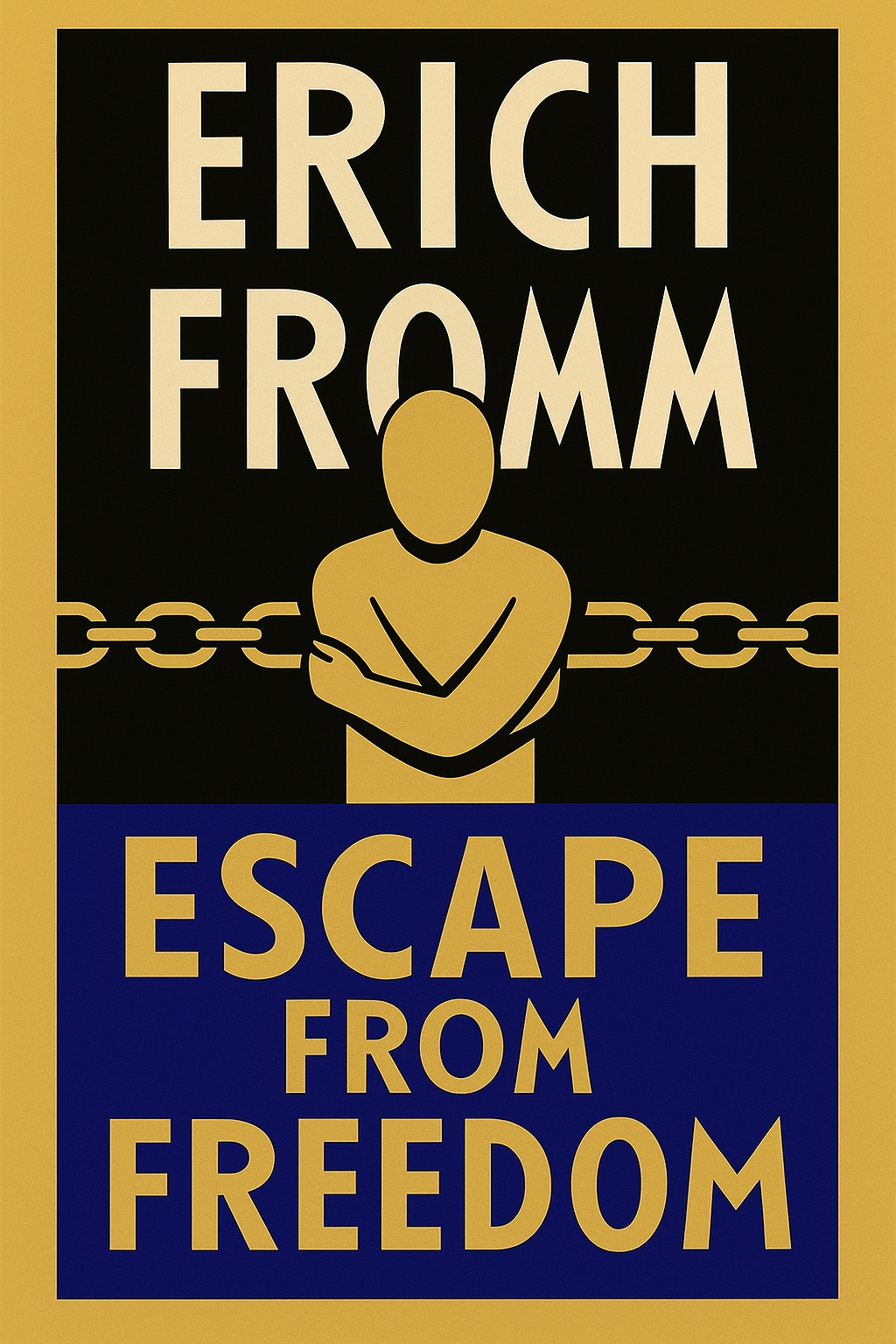
By Erich Fromm
