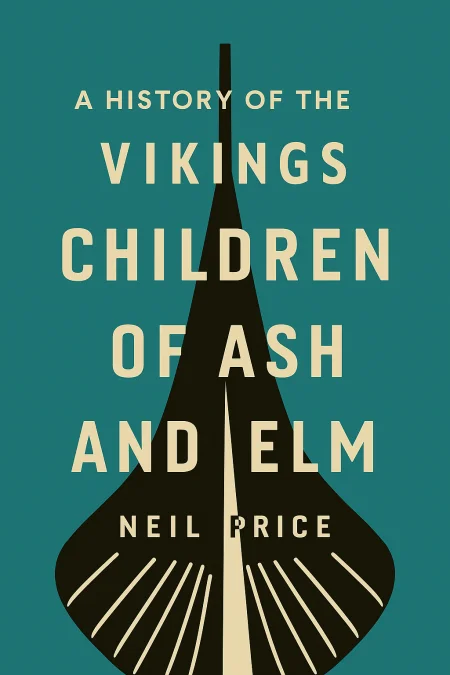
Children of Ash and Elm
A History of the Vikings
Book Edition Details
Summary
In a world where tales of conquest and discovery are often told by those left in their wake, "Children of Ash and Elm" reclaims the Viking narrative with exhilarating authenticity. Journey back to the heart of the Viking Age, from the bold escapades of Björn Ironside, who dared to challenge the might of Rome, to the extraordinary travels of Gudrid Thorbjarnardóttir, the era's most intrepid woman. Unveiling a civilization that thrived on daring exploration and fierce independence, Neil Price paints a vivid portrait of a people whose legacy extends from the icy North Atlantic to the windswept Asian steppe. This book promises not just history, but a visceral connection to the Vikings’ rich tapestry of art, politics, and mythology. Dive into the unvarnished truths of a world long shrouded in myth and misinterpretation, and meet the real Vikings, unfiltered and unbowed.
Introduction
In the flickering firelight of a great hall somewhere in eighth-century Scandinavia, a warrior-king raises his drinking horn to toast his assembled band of followers. Outside, the winter wind howls across a landscape still recovering from centuries of crisis, while inside, plans take shape for voyages that will carry these northern peoples to the edges of the known world. This scene captures the essence of one of history's most remarkable transformations, as the descendants of scattered tribal chieftains evolved into the architects of medieval Europe's political and commercial networks. The Viking Age reveals how environmental catastrophe can become the catalyst for extraordinary innovation and expansion. These three centuries demonstrate that history's most dynamic periods often emerge from the margins rather than established centers of power, as societies forced to adapt or perish develop new forms of organization that prove superior to existing models. We witness the birth of global trade networks, the development of democratic institutions, and the creation of cultural syntheses that would influence European civilization for centuries to come. This exploration appeals to anyone fascinated by the interplay between crisis and opportunity, the dynamics of cultural transformation, or the question of how warrior societies evolve into stable kingdoms. The Viking experience illuminates fundamental patterns of historical change that remain relevant today, offering insights into how societies navigate periods of rapid transformation while maintaining their essential character and values.
Crisis and Emergence: Forging a Warrior Society (500-793)
The foundations of the Viking Age were laid in catastrophe. During the sixth century, massive volcanic eruptions created what climatologists now call the Late Antique Little Ice Age, plunging Scandinavia into decades of crop failures and social collapse. Archaeological evidence reveals abandoned farmsteads, empty graveyards, and the retreat of cultivated land back to wilderness. Population estimates suggest that up to half of the region's inhabitants perished during these dark decades, creating a demographic and social vacuum that would reshape Northern European civilization. From this devastation emerged entirely new forms of leadership and social organization. The old tribal chieftains, whose authority rested on kinship and tradition, gave way to what scholars aptly term "violent chancers" - warlords who built power through military success and personal charisma rather than inherited status. These emerging elites constructed massive halls where they feasted with their warrior bands, creating bonds of loyalty that transcended traditional clan structures. The archaeological record shows the sudden appearance of spectacular weapon burials and monumental architecture that proclaimed the arrival of a new aristocratic order. The transformation extended beyond politics to encompass technology, economics, and culture. The development of advanced shipbuilding techniques, particularly the revolutionary addition of sails around 700 CE, gave these warrior elites unprecedented mobility. New trade networks emerged that connected the remote forests of northern Scandinavia with the luxury markets of Europe and beyond, creating the wealth necessary to sustain increasingly elaborate courts and larger military followings. The old gods themselves were reimagined, with Odin evolving from a wise magician into a war deity who gathered the battle-slain to his hall. Most significantly, the crisis fostered a culture of adaptation and opportunism that would prove crucial to Viking success. Communities that survived the sixth-century collapse were those that could quickly reorganize, exploit new opportunities, and maintain flexible responses to changing circumstances. These survival strategies, refined over two centuries of gradual recovery, created the social and technological foundations that would enable Scandinavian expansion across the medieval world. By 793, the stage was set for an explosion of activity that would reshape European civilization.
The Great Expansion: Raiders to Global Network Builders (793-950)
The attack on Lindisfarne monastery in 793 sent shockwaves through the Christian world, but it represented merely the opening movement of a carefully orchestrated expansion that would transform medieval Europe. These were not random acts of piracy but sophisticated military and commercial ventures that combined traditional warrior values with innovative approaches to warfare, trade, and political organization. The Vikings possessed crucial technological advantages in shipbuilding and navigation that allowed them to strike where enemies least expected, using rivers and coastal waters as highways to the heart of established kingdoms. The expansion took multiple forms simultaneously, revealing the remarkable adaptability that characterized Viking culture. In the west, Norwegian and Danish fleets established permanent bases in Ireland, Scotland, and northern England, creating hybrid Norse-Celtic societies that blended Scandinavian legal traditions with local customs and knowledge. The famous "Great Army" that conquered much of England in the 860s demonstrated how Viking military organization had evolved from seasonal raiding parties into professional military corporations capable of sustained conquest and territorial administration. Meanwhile, Swedish adventurers pushed eastward along the river systems of Russia and Ukraine, establishing the trade networks and political structures that would become the foundation of the medieval Russian state. These eastern Vikings, known as the Rus, created a chain of trading posts stretching from the Baltic to the Black Sea, connecting Scandinavia to the silver mines of Central Asia and the luxury markets of Byzantium. Archaeological evidence suggests that over 125 million Arab silver coins flowed into northern Europe during this period, representing an unprecedented transfer of wealth that funded further expansion. Central to this success was the Vikings' revolutionary understanding that violence and commerce were not opposites but complementary aspects of the same system. Viking merchants followed in the wake of Viking warriors, establishing trading relationships that often proved more durable than political conquests. The development of urban centers like Dublin, York, and Kiev demonstrated their ability to create new forms of political organization that could integrate diverse populations under flexible governance structures. By 950, the Vikings had created the medieval world's most extensive commercial and cultural network, stretching from Greenland to Constantinople and beyond.
Kingdom Formation: From Pagan Warlords to Christian Monarchs (950-1100)
The tenth and eleventh centuries witnessed the most profound transformation of the Viking world as scattered raiding bands and trading networks consolidated into recognizable medieval kingdoms. This evolution was driven by both external pressures, as established European powers developed more effective defenses against Viking attacks, and internal dynamics, as successful war leaders sought to legitimize their rule through traditional monarchical institutions. The conversion to Christianity played a crucial role in this process, providing both ideological justification for centralized authority and diplomatic integration with the broader European community. The transformation varied dramatically across different regions, reflecting the continued adaptability that had made Viking expansion possible. In Denmark, kings like Harald Bluetooth used Christian conversion as a tool of state-building, constructing impressive circular fortresses and establishing administrative systems that prefigured modern bureaucracy. Norway's unification under rulers like Olaf Tryggvason involved more violent suppression of traditional religious practices, creating tensions between old and new that would persist for generations. Sweden remained pagan longest, with the great temple at Uppsala continuing to function well into the eleventh century even as Christian influences gradually penetrated the kingdom. Perhaps most remarkably, this period saw the establishment of entirely new societies in previously uninhabited territories. The settlement of Iceland created Europe's first republic, where traditional Viking legal and political institutions could develop without the constraints of established monarchical authority. The Icelandic Althing, founded around 930, represented a sophisticated experiment in democratic governance that preserved and codified the legal traditions developed during the expansion period. From Iceland, further expeditions reached Greenland and eventually North America, pushing the boundaries of the known world to their absolute limits. The consolidation was not merely political but cultural and economic as well. The establishment of permanent kingdoms required new forms of wealth generation beyond raiding and tribute collection, leading to agricultural intensification, urban development, and the creation of more complex craft industries. The great trading centers evolved into true cities with specialized populations and international connections. By 1100, the Scandinavian world had been fundamentally restructured around principles of Christian kingship, territorial sovereignty, and commercial development that would define Northern European civilization for centuries to come. The age of the Vikings was ending, but their legacy was just beginning to unfold.
Summary
The Viking Age reveals how environmental crisis, technological innovation, and cultural adaptation can combine to reshape entire civilizations in ways that echo across centuries. The transformation of Scandinavian societies from isolated northern communities devastated by climate catastrophe into the architects of medieval Europe's political and economic order demonstrates that historical change often emerges from the margins rather than established centers of power. The Vikings succeeded not through superior numbers or resources, but through their remarkable ability to adapt traditional institutions to new circumstances while maintaining cultural coherence across vast geographical distances. The Viking experience offers profound lessons for understanding how societies navigate periods of rapid change and uncertainty. Their emphasis on collective decision-making through thing assemblies, combined with strong executive leadership, created governance systems that balanced democratic participation with effective action. Their approach to cultural integration, which preserved local customs while establishing overarching political frameworks, provides insights into managing diversity within unified structures. Most importantly, their transformation from raiders to state-builders demonstrates how societies can channel disruptive energies into constructive institution-building when faced with existential challenges. For contemporary readers, the Viking Age illuminates the deep historical roots of democratic governance, international commerce, and cultural exchange that continue to shape our world. Their story reminds us that periods of apparent chaos and destruction often contain the seeds of remarkable innovation and renewal, and that the most enduring changes frequently emerge from societies willing to abandon traditional constraints in pursuit of new possibilities. The Vikings' legacy suggests that successful adaptation requires maintaining core values while remaining flexible about methods and structures, a lesson particularly relevant in our own age of rapid global transformation.
Related Books
Download PDF & EPUB
To save this Black List summary for later, download the free PDF and EPUB. You can print it out, or read offline at your convenience.
By Neil Price
