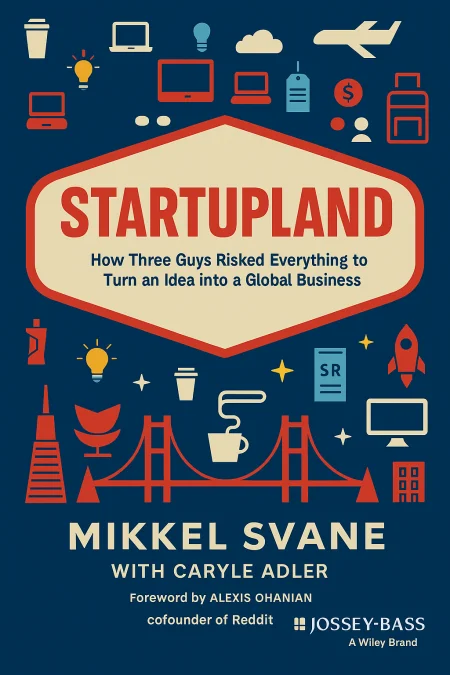
Startupland
How Three Guys Risked Everything to Turn an Idea into a Global Business
Book Edition Details
Summary
Toss aside everything you thought you knew about the startup universe. In "Startupland," Mikkel Svane shatters the Silicon Valley mythos with the audacious tale of Zendesk's birth—a saga penned not in glossy Californian boardrooms but in a humble Copenhagen loft. Three friends, weary of the corporate grind, dared to chase the dream across continents, defying conventions and facing financial ruin. Svane's narrative is a tapestry of candid humor and hard truths, revealing the gritty reality behind the glamor. His insights challenge the clichés, advocating for resilience, unconventional ideas, and community spirit over mere profit. This is more than a business book; it's a manifesto for every bold soul yearning to carve their unique path in a world obsessed with the next big thing. With Svane's heartfelt guidance, "Startupland" becomes your roadmap to inspiration and entrepreneurial triumph.
Introduction
In 2007, three Danish friends working from a cramped loft in Copenhagen had a radical idea: customer service software didn't have to be terrible. While established companies charged tens of thousands of dollars for clunky, complex systems that frustrated both businesses and their customers, Mikkel Svane, Morten Primdahl, and Alexander Aghassipour envisioned something different. They dreamed of beautifully simple software that people would actually love to use, delivered over the internet at a fraction of the traditional cost. What started as weekend sketches in Alex's kitchen would become one of the most successful Software-as-a-Service companies of the modern era. Zendesk's journey from Danish startup to billion-dollar public company offers a masterclass in entrepreneurial perseverance, the power of democratizing technology, and the art of building genuine customer relationships. Their story reveals how three unlikely founders navigated cultural barriers, funding crises, and intense competition to revolutionize an entire industry. Through their experiences, we discover the unglamorous realities behind Silicon Valley success stories, the critical importance of timing and location in startup ventures, and the delicate balance between maintaining authentic company culture while scaling globally.
The Danish Dreamers: Building in a Loft
Copenhagen in 2005 was hardly the epicenter of the startup world. With Denmark's small private sector and virtually no venture capital ecosystem, the three founders found themselves working in a peculiar environment. Alex's fifth-floor loft became their headquarters, complete with a semi-functional kitchen, a desk made from an old door on sawhorses, and views of a gay S&M bar across the street. The romantic notion of startup life quickly gave way to cramped quarters, shared kitchen chairs, and the intimate reality of spending eight hours a day in someone's bachelor pad. The founding dynamic was both their strength and their challenge. Mikkel brought domain expertise from his consulting work at Materna, where he had witnessed firsthand the failures of traditional enterprise software. Morten contributed engineering brilliance and an obsession with perfection that would prove crucial for building scalable infrastructure. Alex provided the design sensibility and user experience thinking that would differentiate their product in a market dominated by ugly, complicated systems. Yet their different personalities created constant tension: Alex's night-owl tendencies clashed with Mikkel's family schedule, while Morten's sensitivity to Copenhagen's brutal winters sometimes led to periods of withdrawal from the project. Financial pressure mounted relentlessly during their eighteen months of development. Mikkel maxed out credit cards and secretly took a $50,000 personal line of credit to fund operations, all while supporting a growing family. The trio survived on consulting gigs, but these side projects often pulled them away from Zendesk for weeks at a time. There were moments when the whole venture nearly collapsed, with each founder receiving tempting job offers that could have solved their immediate financial problems. Their persistence during this period wasn't driven by confidence in success, but rather by a shared fear of lifelong regret if they didn't pursue their vision. The product they built during those lean months would prove revolutionary, though they couldn't have known it at the time. Their beautifully simple help desk system, designed for the new generation of internet businesses, represented a fundamental shift from the enterprise software model. Instead of lengthy sales cycles and expensive implementations, customers could sign up online, try the product immediately, and begin using it within minutes. This democratization of customer service software would eventually transform an entire industry.
Crossing the Atlantic: America Calls
The first glimpse of American startup culture came through a TechCrunch August Capital party in 2009, where Mikkel experienced something extraordinary. Strangers approached him throughout the evening, recognizing Zendesk and praising the product. For someone accustomed to Copenhagen's modest startup scene, this validation from Silicon Valley insiders was intoxicating. The density of customers, competitors, and potential partners in San Francisco made it clear that building a global software company from Denmark would be nearly impossible. The move to America began awkwardly in Boston, driven by their Series A investor Charles River Ventures. The transition revealed how much the founders still had to learn about American business culture. Their first employee onboarding was a disaster when Amanda, a professional marketing hire from Google, showed up for her first day without a computer because no one had thought to provide one. These growing pains extended to hiring practices, where the founders initially took every candidate's self-promotion at face value, not yet understanding the cultural differences in how Americans presented their qualifications. Boston's brutal winter and the founders' cramped temporary housing situation made for a challenging adjustment period. Mikkel's family struggled in their four-thousand-square-foot loft with no air conditioning during an unusually hot summer, while Mie dealt with computer crashes that destroyed months of thesis work. The isolation from their support networks in Denmark, combined with the stress of learning American business practices, created moments of genuine despair. Simple tasks like unlocking a bathroom door became overwhelming symbols of their displacement. Yet Boston provided crucial lessons in American startup methodology. Working with their first professional CFO, Rick Rigoli, the founders learned about proper accounting systems, investor relations, and the metrics that would define their success. Rick's patient guidance through cap tables, revenue models, and board presentations gave them the foundation they would need for future growth. The experience taught them that building a company required more than just building a great product, it demanded mastering an entirely new set of business disciplines they had never encountered in Denmark.
Silicon Valley Growth: Scaling and Struggles
The move to San Francisco in 2009 marked Zendesk's true entry into the global startup ecosystem. Settling into the SoMa district at 410 Townsend Street, they found themselves surrounded by companies like Twitter, Airbnb, and Dropbox that would define the next wave of internet businesses. This proximity wasn't coincidental; Silicon Valley's concentration of talent, customers, and capital created a feedback loop that accelerated every aspect of their growth. Within months, their customer base exploded from hundreds to thousands as venture-backed startups adopted Zendesk as their customer service platform. Scaling brought unforeseen technical challenges that nearly broke the company. When Twitter appeared on Oprah and experienced explosive growth, Zendesk's infrastructure couldn't handle the sudden demand. Morten worked around the clock to keep the system running, implementing creative solutions like solid-state drives well before they became industry standard. A critical database bug that crashed servers one by one brought them within hours of complete system failure. These trial-by-fire experiences taught them lessons about reliability and performance that would serve them well as they attracted larger enterprise customers. The cultural shift from Denmark to Silicon Valley required significant personal adaptation. The competitive intensity and aggressive marketing tactics of rival companies initially shocked the founders, who had approached business with Scandinavian modesty and cooperation. Learning to navigate investor relationships, public relations, and the constant pressure for growth metrics forced them to develop new skills while trying to maintain their authentic company culture. The famous "pricing fiasco" of 2010 became a watershed moment when customer backlash taught them that relationships, not just products, defined their success. Building the team became an exercise in balancing rapid hiring needs with cultural fit. Their unconventional hiring practices, including Michael Hansen's walking interviews and profanity tests, reflected their determination to find people who could thrive in a chaotic startup environment. They learned to hire for attitude over experience, prioritizing candidates who were travelers, athletes capable of wearing multiple hats, and individuals who could maintain authenticity under pressure. These hiring decisions would prove crucial as the company grew from dozens to hundreds of employees.
Going Public: From Startup to IPO
The journey to becoming a publicly traded company culminated in May 2014 with Zendesk's listing on the New York Stock Exchange under the symbol ZEN. The timing seemed impossible, coming during a broader market correction that had devastated other SaaS companies and forced competitors like Box to delay their own public offerings. While advisors questioned their decision to proceed, Mikkel's determination to move forward reflected the same stubborn persistence that had sustained them through earlier crises. The IPO roadshow provided a masterclass in American business theater. Two weeks of cross-country flights on private jets, pitching to institutional investors in cities from Baltimore to Kansas City, required a completely different set of skills than building software. Despite battling a cold caught from his baby daughter and the pressure of performing the same presentation dozens of times, Mikkel discovered that investors ultimately wanted to believe in the people behind the business, not just the financial metrics. The pricing decision reflected their philosophy of building long-term relationships over short-term gains. Settling on nine dollars per share, well within their projected range, prioritized giving new investors upside potential rather than maximizing immediate proceeds. This approach, reminiscent of their early customer-first philosophy, demonstrated how their core values had survived the transition from Danish startup to American public company. The IPO represented not an endpoint but a new beginning. The stock's immediate 49 percent jump on the first day validated their business model and provided capital for continued expansion. More importantly, it created wealth for employees who had joined them throughout their journey, fulfilling the promise that taking startup risks could lead to life-changing rewards. The ceremony at the New York Stock Exchange, with forty employees flown in from around the world, symbolized how far they had traveled from Alex's cramped Copenhagen loft.
Summary
Zendesk's remarkable journey from Danish loft to billion-dollar public company demonstrates that revolutionary businesses often emerge from the most overlooked opportunities. By choosing to tackle the seemingly boring world of customer service software, three friends discovered that making mundane processes beautiful and accessible could transform entire industries. Their success stemmed not from groundbreaking technology, but from recognizing that relationships, whether with customers, employees, or investors, form the foundation of any lasting business. The challenges they faced—from financial crisis to cultural adaptation to scaling struggles—became the very experiences that prepared them for sustained success. For aspiring entrepreneurs, their story offers a crucial lesson: persistence through uncertainty, combined with an obsession for solving real problems, can overcome almost any obstacle. Their willingness to leave comfort behind and bet everything on their vision serves as inspiration for anyone seeking to build something meaningful in our interconnected world.
Related Books
Download PDF & EPUB
To save this Black List summary for later, download the free PDF and EPUB. You can print it out, or read offline at your convenience.
By Mikkel Svane
