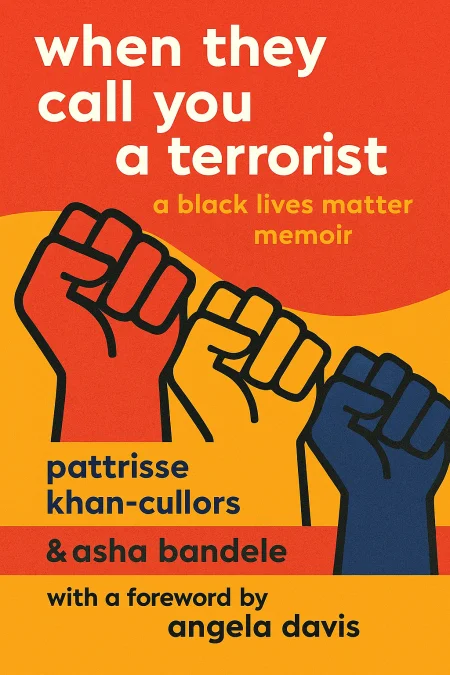
When They Call You a Terrorist
A Black Lives Matter Memoir
byAngela Y. Davis, Patrisse Khan-Cullors, Asha Bandele
Book Edition Details
Summary
In a nation that promises liberty and justice, one woman's journey uncovers the harrowing reality of racial inequality. Raised amidst the grit and grind of Los Angeles, Patrisse Khan-Cullors witnessed the systemic oppression of Black Americans firsthand. Her memoir, "When They Call You a Terrorist," is an unflinching exploration of survival and defiance against a backdrop of relentless prejudice. With the brutal acquittal of Trayvon Martin's killer as her catalyst, Patrisse—alongside Alicia Garza and Opal Tometi—ignited a movement that demands accountability and justice. Branded as a threat yet fueled by love and resilience, she redefines power in the face of adversity, transforming personal anguish into a clarion call for change. This gripping narrative not only chronicles the birth of Black Lives Matter but also stands as a testament to the enduring fight for human rights, capturing a world where the struggle for equality is more urgent than ever.
Introduction
In the summer of 2013, when a Florida jury acquitted the man who killed seventeen-year-old Trayvon Martin, Patrisse Khan-Cullors sat in a small motel room in Northern California, overwhelmed by grief and rage. That night, she would help birth three words that would reshape American consciousness: Black Lives Matter. But this moment of national awakening emerged from a lifetime of personal struggle against systems designed to criminalize Black existence. Khan-Cullors' journey from a working-class girl in Van Nuys, California, to a co-founder of one of the most influential social justice movements of the twenty-first century reveals the profound connection between individual trauma and collective resistance. Her story illuminates how personal pain can become the catalyst for transformative social change, demonstrating that the most powerful movements often arise from the most vulnerable communities. Through Khan-Cullors' eyes, we witness the devastating impact of mass incarceration on Black families, the resilience required to survive state violence, and the revolutionary power of declaring one's own humanity in the face of systematic dehumanization. Her memoir offers readers an intimate understanding of how grassroots organizing works, the spiritual dimensions of social justice work, and the courage required to speak truth to power when that truth threatens to destroy you.
Growing Up Under Siege: Family, Poverty, and Police Violence
Patrisse Khan-Cullors was born into a world where poverty and police surveillance formed the twin pillars of daily existence. Raised by her mother Cherice in Van Nuys, California, she learned early that being Black in America meant living under constant threat. Her neighborhood was designated a war zone in the drug war, where children playing in alleyways could be swept up by police at any moment. When she was nine years old, she watched officers throw her brothers Paul and Monte against a wall, searching their bodies in a ritual humiliation that would mark them as targets for life. The Khan-Cullors family embodied the contradictions of American poverty. Cherice worked multiple jobs—telemarketing, reception, domestic support—yet could barely afford to feed her children. When their refrigerator broke, the family went without one for nearly a year, surviving on school breakfast and lunch programs that traced their lineage to the Black Panthers' revolutionary community care initiatives. The absence of basic resources stood in stark contrast to the abundance of surveillance and punishment that surrounded them daily. Police presence in their community functioned not as protection but as occupation. Helicopters circled overhead like mechanical vultures, and squad cars prowled the streets with predatory persistence. For young Black men like Monte, this meant inevitable cycling through juvenile detention centers that served as training grounds for longer prison sentences. The so-called gang injunctions were so broadly written that wearing matching t-shirts or riding the bus with friends could result in arrest, creating a pipeline that funneled children from playgrounds to prison yards. This early immersion in state violence would shape Khan-Cullors' understanding that individual struggles were always connected to larger systems of oppression. Her family's hunger was not a personal failing but a policy choice. The police harassment wasn't random but systematic. These lessons in structural analysis, learned in childhood through lived experience, would later inform her approach to movement building and her insistence that personal healing and political liberation are inseparable endeavors.
Finding Voice and Community: Education, Identity, and Early Activism
At Cleveland High School, a social justice-focused arts magnet program, Khan-Cullors discovered that her experiences were not unique or shameful but part of a larger pattern of systemic oppression that could be named, analyzed, and resisted. The school's curriculum introduced her to writers like Audre Lorde, bell hooks, and Emma Goldman, whose words gave language to feelings she had carried since childhood. For the first time, she encountered adults who encouraged critical thinking about power structures rather than demanding silent acceptance of injustice. This educational awakening coincided with her personal coming-out journey as a queer woman. At sixteen, she found herself navigating multiple marginalizations while building chosen family with friends who shared her commitment to both personal authenticity and social change. The intersection of her racial, sexual, and class identities made her acutely aware of how different forms of oppression compound and reinforce each other. This understanding would later become central to Black Lives Matter's commitment to centering the most marginalized voices within Black communities. Her first taste of organizing came through the Labor Community Strategy Center, where she learned to connect her family's individual struggles to broader patterns of economic and racial injustice. Working on campaigns for public transit justice and against the school-to-prison pipeline, she discovered that ordinary people could challenge seemingly insurmountable systems through collective action. These early organizing experiences taught her that movements are built through relationships, sustained through mutual care, and strengthened by refusing to abandon the most vulnerable members of the community. The transition from high school to community organizing was marked by housing instability and financial precarity, experiences that deepened her analysis of how capitalism intersects with racism to create conditions of perpetual crisis for working-class Black families. Yet these challenges also reinforced her commitment to building alternative models of support and resistance. Through chosen family networks and intentional community building, she began practicing the kind of world she wanted to create—one where people's humanity was recognized regardless of their economic productivity or social status.
The Birth of Black Lives Matter: From Tragedy to Movement
The acquittal of Trayvon Martin's killer in July 2013 represented more than a single miscarriage of justice; it crystallized decades of accumulated grief and rage over the systematic devaluation of Black life. When Khan-Cullors read Alicia Garza's Facebook post declaring that Black lives matter, she responded with a hashtag that would become a rallying cry for millions. But the creation of Black Lives Matter was not spontaneous—it emerged from years of organizing experience, theoretical development, and spiritual preparation for exactly this kind of cultural intervention. The three women who founded Black Lives Matter—Khan-Cullors, Garza, and Opal Tometi—brought complementary skills and perspectives to the work of translating hashtag activism into sustained movement building. Their approach was intentionally decentralized, encouraging local chapters to develop analysis and tactics appropriate to their specific contexts while maintaining connection to broader principles. This model reflected hard-won lessons about how movements can maintain revolutionary vision while adapting to diverse conditions and communities. From its inception, Black Lives Matter insisted on an expansive definition of Blackness that centered women, queer and trans people, immigrants, and others whose experiences were often marginalized within traditional civil rights organizing. This commitment to intersectionality was not merely theoretical but practical, recognizing that the people most vulnerable to state violence often possess the clearest analysis of how systems of oppression function and can be disrupted. The movement's rapid growth revealed both the hunger for this kind of political intervention and the risks that come with challenging entrenched power structures. As chapters formed across the country and internationally, Khan-Cullors and her co-founders navigated the complex dynamics of media attention, organizational development, and personal security. They learned to balance the need for strategic visibility with the importance of protecting organizers from backlash, developing practices of collective care that would sustain them through years of intense struggle.
Fighting for Justice: Building Power and Creating Change
The militarized response to protests in Ferguson, Missouri, following Michael Brown's murder in 2014 marked a turning point in public consciousness about police violence and the lengths to which authorities would go to suppress dissent. Khan-Cullors helped organize Freedom Rides that brought hundreds of activists to support local organizers who had been protesting for weeks under conditions of virtual martial law. The images of tanks rolling through suburban streets and tear gas deployed against peaceful protesters made visible the kind of state violence that had long been routine in Black communities. The Ferguson uprising demonstrated Black Lives Matter's ability to connect local struggles to national conversations while maintaining focus on the leadership of those most directly affected. Rather than imposing outside agendas, the network provided resources and solidarity while following the direction of local organizers who understood their specific conditions. This approach reflected lessons learned from previous generations of activists about the importance of supporting grassroots leadership rather than creating celebrity figureheads. As the movement expanded, Khan-Cullors continued her local organizing work in Los Angeles, founding Dignity and Power Now to challenge the Los Angeles County Sheriff's Department's history of systematic torture in county jails. The campaign successfully established the first civilian oversight board in the department's history, demonstrating how sustained organizing could win concrete victories even against seemingly insurmountable opposition. These local campaigns provided laboratories for developing tactics and analysis that could be shared across the broader network. The election of Donald Trump in 2016 intensified both the urgency and the risks of the work, as federal authorities signaled their intention to criminalize protest and target movement leaders. Several Ferguson organizers were found dead under suspicious circumstances, reminding everyone involved that speaking truth to power carried potentially fatal consequences. Yet Khan-Cullors and her comrades refused to be intimidated, instead deepening their commitment to building sustainable movements that could outlast any individual administration or threat.
Summary
Patrisse Khan-Cullors' journey from a surveilled child in Van Nuys to a co-founder of Black Lives Matter illustrates how individual trauma can be transformed into collective liberation when channeled through organized resistance and community care. Her story demonstrates that the most powerful social movements emerge not from abstract ideology but from the lived experiences of those most harmed by existing systems, and that sustainable change requires both fierce opposition to injustice and intentional practices of healing and mutual support. Khan-Cullors shows us that declaring one's humanity in the face of systematic dehumanization is itself a revolutionary act, one that creates space for others to do the same. Her memoir offers crucial lessons for anyone seeking to understand how ordinary people become extraordinary agents of social transformation, and how movements can maintain hope and vision even under conditions of extreme repression. This work speaks especially to young people of color who may feel isolated in their struggles, showing them that their experiences matter and that collective action can create the kind of world their humanity deserves.
Related Books
Download PDF & EPUB
To save this Black List summary for later, download the free PDF and EPUB. You can print it out, or read offline at your convenience.
By Angela Y. Davis
