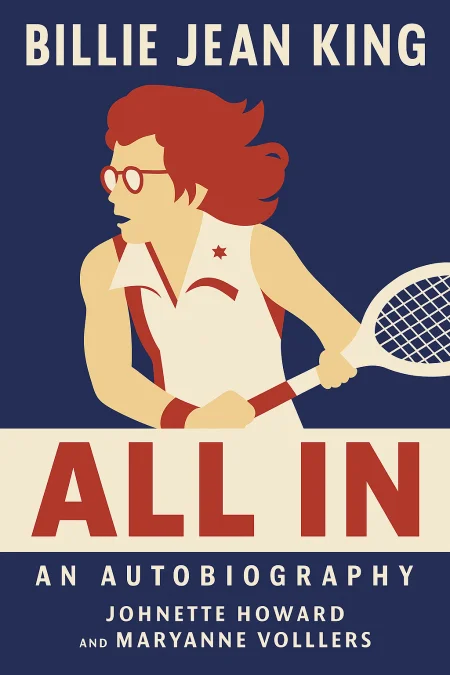
All In
An Autobiography
byBillie Jean King, Maryanne Vollers, Johnette Howard
Book Edition Details
Summary
A trailblazer on and off the court, Billie Jean King reshaped the boundaries of sports and society with her racket and her resolve. In "All In," King chronicles her audacious journey from a seven-year-old with big dreams to a legendary athlete and fearless advocate for equality. Her astonishing tally of 39 grand-slam titles and her unforgettable victory over Bobby Riggs in the Battle of the Sexes marked not just athletic triumphs but seismic shifts in cultural landscapes. Through riveting narratives, King reveals the fierce battles she waged against entrenched sexism, the tumultuous backdrop of the 1960s civil rights and women's movements, and her personal battles with identity and acceptance. At 51, she boldly embraced her true self, declaring "I am gay," and continued her relentless push for justice and inclusivity. This is the compelling saga of a champion whose legacy reaches far beyond tennis, into the heart of social change.
Introduction
On September 20, 1973, in front of 30,472 spectators at the Houston Astrodome and an estimated 90 million television viewers worldwide, a 29-year-old tennis champion stepped onto the court carrying the hopes and dreams of women everywhere. Billie Jean King wasn't just playing tennis that night against Bobby Riggs in the infamous "Battle of the Sexes"—she was fighting for the fundamental principle that women deserved equal respect, equal opportunities, and equal pay. Her straight-sets victory became one of the most watched sporting events in history and a defining moment in the struggle for gender equality. But King's revolution began long before that historic match. Born in 1943 in working-class Long Beach, California, she discovered tennis at age ten on public courts, wielding a racket she bought with money earned from odd jobs. In an era when women athletes were expected to be gracious in defeat and grateful for any opportunity, King dared to demand more. She challenged the tennis establishment's shameful treatment of female players, who received prize money eight times smaller than men's despite playing before packed stadiums. When the sport's power brokers refused to listen, she led a rebellion that would transform not just tennis, but all of women's professional sports. Through King's extraordinary journey, we witness the birth of modern women's athletics, the courage required to challenge entrenched systems of discrimination, and the profound truth that progress demands both individual bravery and collective action. Her story reveals how one person's refusal to accept the status quo can ignite a movement that changes the world.
From Public Courts to Tennis Greatness
Billie Jean Moffitt's path to tennis greatness began on the public courts of Long Beach, where her father Bill, a firefighter, and mother Betty, a homemaker, instilled in her the radical belief that she could be anything she wanted to be. This was revolutionary thinking for a girl in 1950s America. When ten-year-old Billie Jean announced after her first tennis lesson that she would become the world's number one player, her mother simply said, "Okay, dear"—words that would echo through a lifetime of boundary-breaking achievements. The early signs of King's fighting spirit emerged quickly. At her first sanctioned tournament, the imperious Perry T. Jones, known as "the Czar" of Southern California tennis, yanked her from a group photograph because she wore white shorts instead of a skirt. Rather than being humiliated, young Billie Jean felt anger—and determination. "Don't worry, Mom," she told her mortified mother. "I'll show him someday." This incident crystallized her understanding that tennis, despite its genteel facade, was a battlefield where women had to fight for every scrap of respect. Under the guidance of coach Clyde Walker on Long Beach's public courts, King developed not just her aggressive serve-and-volley style, but also her philosophy that tennis could be a platform for social change. At twelve, watching the all-white crowds at the Los Angeles Tennis Club, she had an epiphany that would guide her life: she would use tennis to fight for equal rights and opportunities for everyone, ensuring no one felt scorned or left out. This wasn't mere childhood idealism—it was a mission statement. King's breakthrough came in 1966 when she captured her first Wimbledon singles title, defeating Maria Bueno in three sets. Standing on Centre Court, holding the Venus Rosewater Dish, she knew her name would be engraved forever alongside tennis legends. But more importantly, she understood that being number one gave her a platform. The girl from Long Beach had reached the pinnacle of her sport, and now the real work could begin.
Leading the Revolution in Women's Sports
By the early 1970s, King had evolved from tennis champion to reluctant revolutionary. The catalyst came in 1970 when promoter Jack Kramer announced prize money for his Pacific Southwest Championships that epitomized the sport's gender discrimination: $65,000 for men versus $7,500 for women. When King and eight other players signed symbolic $1 contracts to compete in a rival tournament in Houston, they weren't just protesting unfair pay—they were declaring independence from a system that treated women as second-class citizens. The "Original 9," as they became known, faced threats of suspension and career destruction from tennis authorities who preferred women to remain grateful and quiet. But King understood that progress required risk. "What do we have to lose?" she challenged her fellow players. "We have nothing to lose!" Their rebellion birthed the Virginia Slims tour, the first professional women's tennis circuit, transforming women's tennis from a sideshow into a legitimate business. King's genius lay not just in her ability to win matches, but in her vision of what women's tennis could become. Working with publisher Gladys Heldman and Philip Morris executive Joe Cullman, King helped create something unprecedented: a women's professional sports circuit controlled by women. They established minimum prize money standards, negotiated television coverage, and most importantly, proved that fans would pay to watch women compete at the highest level. The numbers tell the story of King's revolutionary impact. When she began her career, women's prize money was a fraction of men's, and opportunities were scarce. By the time she retired, the women's tour was a global enterprise offering millions in prize money. Players like Chris Evert and Martina Navratilova, who joined the tour as teenagers, would earn over $30 million combined—wealth unimaginable for previous generations of female athletes. King had transformed women's tennis from charity case to big business, creating a template that other women's sports would follow.
The Battle of the Sexes and Cultural Impact
The Battle of the Sexes match against Bobby Riggs emerged from this context of struggle. Riggs, the 1939 Wimbledon champion turned hustler and showman, had defeated Margaret Court earlier in 1973, claiming it proved men's superiority over women. When he challenged King, she initially declined, but the stakes became too important to ignore. This wasn't about tennis—it was about whether women deserved respect as athletes and equals in society. King approached the match with meticulous preparation, understanding that millions of women were counting on her. She studied Riggs's game, maintained her fitness while he seemed to coast on publicity, and prepared mentally for the pressure. When she entered the Astrodome carried on a golden litter by muscular men dressed as ancient slaves—a theatrical response to Riggs's own showmanship—she was ready. Her systematic 6-4, 6-3, 6-3 victory wasn't just a tennis match; it was a statement that reverberated far beyond sports. The cultural impact of King's victory cannot be overstated. The match was watched by an estimated 90 million people worldwide, making it one of the most-viewed tennis matches in history. Her triumph transcended sports, becoming a defining moment for the women's liberation movement. It proved that women could perform under ultimate pressure and demonstrated the commercial viability of women's athletics. The victory shattered stereotypes about female athletes and showed that skill, preparation, and mental toughness transcended gender. Beyond the immediate triumph, King leveraged her victory to advance broader social causes. She used her elevated platform to advocate for Title IX legislation, support political candidates who championed women's rights, and establish the Women's Sports Foundation. The Battle of the Sexes became a launching pad for systemic change, proving that individual moments of courage could catalyze movements that benefit millions. King understood that her victory belonged not just to her, but to every woman who had been told she wasn't strong enough, smart enough, or tough enough to compete at the highest level.
Living Authentically and Building Lasting Legacy
King's activism extended far beyond tennis courts into the broader fight for human rights and equality. She was among the first prominent athletes to support the civil rights movement, LGBTQ+ rights, and women's liberation, understanding that all forms of discrimination were interconnected. When she was outed as gay in 1981, losing lucrative endorsement deals overnight, she chose authenticity over financial security, becoming one of the first major athletes to live openly as a lesbian. Her personal journey toward authenticity proved as challenging as any professional battle she faced. The pressure of maintaining multiple identities—champion athlete, business entrepreneur, social activist, and private person—took a severe toll on King's mental and physical health. Yet she refused to let internal struggles derail her public mission. Even when facing blackmail and the threat of career destruction, she chose truth over safety, demonstrating the same courage that had driven her tennis career and social activism. Her influence on Title IX, the landmark 1972 law mandating equal opportunities for women in education and athletics, cannot be overstated. King's high-profile battles for equal treatment in tennis provided crucial momentum for the legislation, while her success proved that women's sports could be both competitive and commercially viable. The explosion of women's collegiate athletics that followed Title IX's passage owed much to the foundation King had built in professional tennis. Even in her eighties, King continues advocating for equality, working with the Billie Jean King Leadership Initiative to promote inclusive workplaces and supporting young athletes through her foundation. Her Los Angeles tennis center serves as a beacon of accessibility, welcoming players regardless of background or ability. The girl who once dreamed of changing the world through tennis succeeded beyond her wildest imagination, proving that individual courage combined with collective action can indeed transform society.
Summary
Billie Jean King's life demonstrates that true champions are measured not just by their victories, but by their willingness to fight for others who cannot fight for themselves. Her journey from the public courts of Long Beach to the pinnacle of tennis greatness, and ultimately to becoming one of America's most important civil rights leaders, reveals the transformative power of refusing to accept limitations imposed by others. King understood that breaking barriers requires both the courage to stand alone when necessary and the wisdom to build coalitions that create lasting change. Her legacy offers two profound lessons for anyone seeking to make a difference: first, that progress demands we risk what we have to gain what we believe is right, and second, that individual excellence means nothing unless it opens doors for others to follow. King's revolution in tennis became a template for challenging discrimination in all its forms, proving that sports can be a powerful force for social justice. For anyone who has ever been told they don't belong, who has faced discrimination or been underestimated because of who they are, King's story provides both inspiration and a roadmap for creating the change they wish to see in the world.
Related Books
Download PDF & EPUB
To save this Black List summary for later, download the free PDF and EPUB. You can print it out, or read offline at your convenience.

By Billie Jean King
