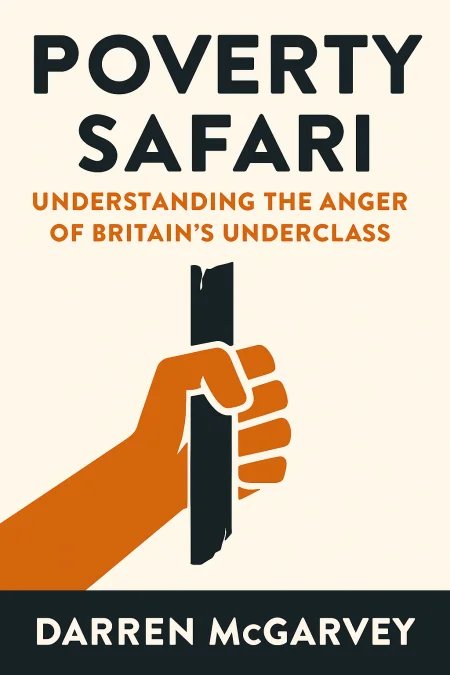
Poverty Safari
Understanding the Anger of Britain’s Underclass
Book Edition Details
Summary
Step into the raw, unvarnished reality of Britain's forgotten corners with Darren McGarvey as your guide. In "Poverty Safari," McGarvey, a voice forged in the fires of Glasgow's toughest streets, strips away the misconceptions that both the left and right cling to about poverty. This isn't a tale told from a safe distance; it's a full-throated, boots-on-the-ground exploration of the relentless struggle and quiet resilience found in society's shadows. With searing honesty and a lyrical edge, McGarvey challenges us to confront the uncomfortable truths about economic hardship and what we can do to rewrite the narrative. This is more than a book—it's a wake-up call.
Introduction
This work presents a radical challenge to conventional narratives about poverty, arguing that the poverty industry itself has become complicit in perpetuating the very problems it claims to solve. Rather than accepting comfortable assumptions about systemic oppression or individual responsibility, this exploration demands a more complex understanding of how social deprivation operates at the intersection of personal agency and structural inequality. The analysis cuts through political orthodoxies from both left and right, suggesting that meaningful change requires honest self-examination alongside social critique. Through unflinching personal testimony combined with sharp social observation, the investigation reveals how stress, trauma, and false beliefs create cycles of dysfunction that transcend simple explanations. Readers encounter a framework that refuses to separate individual transformation from collective action, instead positioning personal responsibility as a radical political act. The journey moves beyond traditional poverty discourse toward a more nuanced understanding of how communities might genuinely transform themselves when external solutions prove inadequate.
The Reality of Poverty: Beyond Economic Deprivation
Poverty functions as a gravitational field comprising multiple forces that shape human experience far beyond mere financial hardship. This comprehensive understanding reveals how social, emotional, physiological, political, and cultural pressures combine to create conditions that determine life trajectories from birth. The analysis demonstrates how stress operates as the connective tissue between seemingly disparate social problems, driving behaviors that appear self-defeating but actually represent logical responses to overwhelming circumstances. The exploration of high-rise housing failures, community displacement, and cultural erasure illustrates how well-intentioned interventions can devastate communities when designed without genuine consultation. These case studies reveal the profound disconnect between policymakers and residents, showing how decisions made in boardrooms translate into lived experiences of powerlessness and exclusion. The documentation of community resistance movements demonstrates that people possess sophisticated political consciousness even when dismissed as apathetic or ignorant. Physical environments emerge as crucial determinants of social outcomes, with architectural choices reflecting and reinforcing class hierarchies. The contrast between affluent areas with mature trees and preserved heritage versus demolished tower blocks reveals how space itself becomes a marker of social worth. These material conditions interact with psychological stress to create feedback loops that trap families across generations. The framework challenges binary thinking about individual versus structural causes, instead revealing how personal choices occur within constrained circumstances while acknowledging that agency exists even under oppressive conditions. This nuanced understanding provides groundwork for interventions that address both systemic inequality and individual empowerment without falling into simplistic victim-blaming or deterministic fatalism.
Class, Culture, and the Politics of Representation
Cultural exclusion operates through subtle mechanisms that render working-class experiences invisible or distorted within mainstream discourse. The analysis exposes how middle-class dominance in media, arts, and politics creates representation gaps that leave entire communities feeling politically homeless. This cultural hegemony manifests not through deliberate conspiracy but through the natural tendency of socially mobile individuals to assume their perspectives and concerns reflect universal truths. The examination of news coverage, arts funding, and political priorities reveals systematic bias toward concerns that resonate with affluent audiences while marginalizing issues affecting deprived communities. The contrast between extensive coverage of an art school fire versus minimal attention to benefit changes affecting thousands demonstrates how cultural capital translates into political influence. These disparities create legitimate grievances that demagogues exploit when mainstream politics fails to address them. Identity politics emerges as a double-edged phenomenon that both advances inclusion and reinforces exclusion. While expanding representation for some marginalized groups, intersectional frameworks often overlook class dynamics or reduce complex social positions to simple privilege hierarchies. The analysis reveals how university-educated activists can inadvertently replicate the patronizing dynamics they claim to oppose, speaking over the communities they purport to represent. Language itself becomes a battlefield where jargon functions as both barrier and weapon. Technical terminology that appears neutral actually signals membership in educated elites, creating insider-outsider dynamics that mirror broader social divisions. The tension between accessible communication and analytical precision reflects deeper questions about who gets to define problems and propose solutions. These cultural dynamics help explain why populist movements gain traction even when their policies may harm their supporters' material interests.
Personal Responsibility Within Systemic Inequality
The false dichotomy between individual responsibility and structural analysis dissolves under rigorous examination, revealing how both perspectives contain essential truths that become distorted when treated as mutually exclusive. Acknowledging personal agency within constrained circumstances offers pathways to empowerment without ignoring legitimate grievances about systemic barriers. This integration challenges both conservative narratives that ignore structural inequality and progressive frameworks that can inadvertently encourage helplessness. Addiction, mental health struggles, and self-destructive behaviors emerge as complex phenomena that resist simple explanations. The detailed examination of how trauma creates hypervigilance, which then drives stress-relief behaviors that become compulsive, demonstrates the intricate relationships between childhood experiences and adult outcomes. These patterns operate beneath conscious awareness, making personal transformation require both individual commitment and supportive environments. The recovery process illuminates how false beliefs and victim narratives can become self-fulfilling prophecies that perpetuate suffering. Breaking these cycles requires painful honesty about one's own contributions to negative outcomes without minimizing genuine harm from external sources. This balance proves especially challenging within political movements that organize around shared grievances, where self-criticism can be interpreted as betrayal of collective solidarity. The analysis extends beyond individual psychology to examine how communities can foster either resilience or dysfunction through their cultural norms and expectations. Examples of successful grassroots organizing demonstrate that meaningful change occurs when people combine structural critique with personal accountability. These models suggest that the most radical political act involves taking responsibility for aspects of life within one's control while continuing to challenge systems that limit those choices.
Toward Genuine Change: Individual and Collective Action
Revolutionary fantasies and electoral politics both prove inadequate for addressing poverty's deep roots, necessitating more pragmatic approaches that work within existing systems while building alternative structures. The recognition that fundamental social transformation requires generational timescales paradoxically liberates immediate action by removing pressure for perfect solutions. This realism enables focus on achievable improvements rather than waiting for comprehensive system change. Community organizing succeeds when it combines resistance to harmful policies with internal capacity building that addresses the psychological and social damage created by deprivation. Successful examples demonstrate how local leaders can simultaneously challenge external authorities and help neighbors develop skills, confidence, and mutual support networks. This dual approach acknowledges that oppressive systems create internalized problems that require healing alongside political struggle. The integration of stress reduction, emotional literacy, and practical life skills into political organizing represents an evolution beyond traditional left-wing approaches. Rather than viewing self-improvement as bourgeois distraction from structural issues, this framework treats personal development as essential foundation for sustained collective action. Communities cannot effectively challenge power when their members lack basic tools for managing their own lives and relationships. The emergence of new political formations that transcend traditional left-right divisions suggests possibilities for coalitions based on shared human needs rather than ideological purity. These movements prioritize results over rhetoric, embracing complexity rather than seeking simple villains to blame. They recognize that meaningful change requires contributions from across the political spectrum while maintaining clear commitments to reducing suffering and expanding opportunity for the most vulnerable.
Summary
The central insight emerging from this comprehensive analysis reveals that genuine social transformation requires simultaneous personal and collective evolution, with neither sufficient alone to address poverty's complex roots. The framework demonstrates how individual agency and structural oppression interact in ways that demand sophisticated responses transcending traditional political categories. This approach offers hope precisely because it refuses false comfort, acknowledging the long-term nature of meaningful change while identifying immediate opportunities for improvement. The work serves readers seeking to move beyond ideological certainty toward more effective engagement with social problems, providing tools for sustained effort rather than revolutionary fantasies. The ultimate contribution lies not in providing easy answers but in modeling the intellectual honesty and practical wisdom necessary for communities to transform themselves when external solutions remain inadequate.
Related Books
Download PDF & EPUB
To save this Black List summary for later, download the free PDF and EPUB. You can print it out, or read offline at your convenience.
By Darren McGarvey
