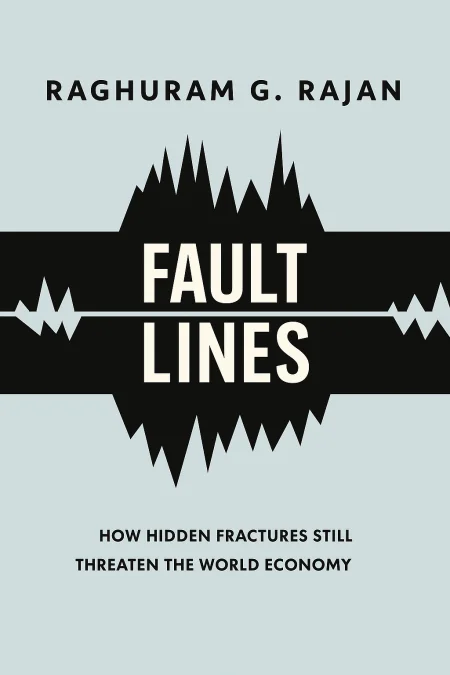
Fault Lines
How Hidden Fractures Still Threaten The World Economy
Book Edition Details
Summary
In "Fault Lines," Raghuram Rajan expertly dismantles the facade of a stable global economy, revealing the hidden cracks that almost shattered it in 2008. Rather than pinning the collapse solely on reckless bankers, Rajan unravels a tapestry of systemic vulnerabilities—flaws deeply embedded in our financial fabric. He paints a vivid picture of a world teetering on the edge, fueled by America’s consumption and inequity, and strained by international pressures. As Rajan navigates this precarious landscape, he challenges us to confront the dangerous incentives and social disparities threatening our economic future. With a sharp eye for detail, Rajan not only diagnoses the ailments but also prescribes the tough choices necessary to avert future crises. "Fault Lines" is a compelling call to action, urging us to rethink and reshape the systems that bind us all.
Introduction
In the summer of 2005, at an exclusive gathering of the world's most powerful central bankers in Jackson Hole, Wyoming, a lone economist stood before his peers with a warning that would prove prophetic. While others celebrated the "Great Moderation" and the apparent taming of economic volatility, this voice spoke of hidden dangers lurking beneath the surface of prosperity. His concerns were dismissed as pessimistic musings, yet within three years, the global economy would teeter on the brink of collapse. The 2008 financial crisis was not merely the result of greedy bankers or regulatory failure. Instead, it emerged from deep structural imbalances that had been building for decades across the global economy. These fault lines ran through domestic politics, international trade relationships, and the fundamental architecture of different financial systems around the world. Like geological fault lines that remain invisible until an earthquake strikes, these economic fractures accumulated stress over time until they finally ruptured with devastating consequences. This analysis reveals how seemingly unrelated developments across different countries and decades converged to create the perfect storm. It shows how rising inequality in America intersected with export-driven growth strategies in Asia, how jobless recoveries met inadequate safety nets, and how sophisticated financial instruments masked rather than managed risk. For policymakers, economists, and anyone seeking to understand how modern economies can go so spectacularly wrong, this exploration offers crucial insights into the hidden connections that shape our interconnected world.
Rising Inequality and Credit Expansion (1980s-2000s)
The roots of the financial crisis can be traced back to a fundamental shift in American society that began in the 1980s. As technological progress accelerated and globalization reshaped the economy, the United States found itself grappling with a growing divide between the educated elite and the struggling middle class. Between 1976 and 2007, the top one percent of households saw their share of total income nearly triple, capturing 58 cents of every dollar of real income growth during this period. This wasn't simply a story of the rich getting richer while everyone else stagnated. The real tragedy lay in America's failure to adapt its educational system to meet the demands of a rapidly changing economy. While previous generations had successfully transitioned from agriculture to manufacturing through massive investments in primary and secondary education, the country struggled to produce enough college-educated workers for the information age. The result was a growing premium for skilled workers and declining prospects for those without higher education. Politicians recognized the brewing social tensions but found themselves constrained by the difficulty of educational reform and the polarization of Congress. Direct redistribution proved politically impossible, but there was another path that seemed to offer immediate relief without the pain of higher taxes or controversial spending programs. Credit expansion, particularly in housing, became the politically expedient solution to rising inequality. As one observer noted, "it is not income that matters but consumption," and easy credit allowed middle-class families to maintain their standard of living even as their wages stagnated. The push for expanded homeownership gained momentum through both Democratic and Republican administrations. Government-sponsored enterprises like Fannie Mae and Freddie Mac became the vehicles for this ambitious social engineering, with mandates to purchase increasing percentages of loans to low-income borrowers. What began as a well-intentioned effort to expand opportunity would ultimately become a dangerous distortion of credit markets, setting the stage for the housing bubble that would bring down the global financial system.
Export-Led Growth and Global Imbalances
While America grappled with rising inequality, a different drama was unfolding across the Pacific. Countries like Japan, South Korea, and later China had discovered a powerful formula for rapid economic development: export-led growth combined with managed capitalism. This strategy, born from the ashes of World War II and refined through decades of practice, involved governments actively nurturing domestic industries while suppressing household consumption to generate the savings needed for massive investment. The approach worked brilliantly in its early stages. By protecting infant industries from foreign competition while simultaneously forcing them to prove their mettle in export markets, these countries created world-class manufacturers like Toyota, Samsung, and Canon. The discipline of international competition prevented the inefficiencies that typically plague government-directed investment, while export revenues provided the foreign exchange needed to import advanced technology and equipment. Within a few decades, countries that had been devastated by war or trapped in poverty joined the ranks of the world's wealthy nations. However, success bred its own problems. As these export-oriented economies grew larger and richer, they found themselves unable to generate sufficient domestic demand to absorb their own production. The very policies that had enabled their rise now constrained their ability to grow through internal consumption. Meanwhile, their export sectors had become so efficient and competitive that they generated persistent trade surpluses, flooding global markets with goods that someone, somewhere, had to buy. The situation became particularly acute after the Asian financial crisis of 1997-98, when many developing countries abandoned their role as net importers and instead began accumulating massive foreign exchange reserves as insurance against future crises. China's entry into this dynamic was especially significant, as its combination of export-oriented policies and demographic pressures created an economy where household consumption represented an unusually small share of total output. The result was a world increasingly divided between countries that produced more than they consumed and countries that consumed more than they produced, with the United States increasingly bearing the burden of being the "consumer of last resort" for the global economy.
Easy Money and Asset Bubbles (2001-2007)
The convergence of America's political pressures and the world's savings glut created the perfect conditions for a dangerous experiment in monetary policy. Following the dot-com crash and the recession of 2001, the Federal Reserve found itself confronting a new and troubling phenomenon: a jobless recovery where economic output rebounded quickly but employment lagged far behind. With America's weak social safety net providing little cushion for the unemployed, political pressure mounted on policymakers to do whatever it took to restore job growth. Fed Chairman Alan Greenspan responded by slashing interest rates to levels not seen since the Great Depression, bringing the federal funds rate down to just one percent by 2003. The central bank's actions were guided by fears of deflation and a mandate to restore full employment, but the consequences extended far beyond the intended targets. Low interest rates didn't just encourage business investment; they unleashed a torrent of speculation in housing and other assets as investors searched desperately for higher yields in a world awash with cheap money. The Fed's approach was shaped by what became known as the "Greenspan Put" - an implicit promise that while the central bank wouldn't intervene to prevent asset bubbles from forming, it would aggressively cut rates and provide liquidity if those bubbles burst. This asymmetric policy created powerful incentives for risk-taking throughout the financial system. Banks and investors understood that they could capture the upside of speculative bets while having their downside losses cushioned by Federal Reserve intervention. Meanwhile, the global savings glut intensified these distortions. Foreign central banks, particularly in Asia, found themselves accumulating massive dollar reserves as they intervened to prevent their currencies from appreciating against the weakening dollar. These reserves had to be invested somewhere, and much of the money flowed into U.S. government bonds and agency securities, further depressing long-term interest rates and encouraging the search for yield. The result was a feedback loop where easy monetary policy pushed money overseas, only to have it return as foreign investment in increasingly risky American securities. By the mid-2000s, the stage was set for a spectacular collapse as housing prices soared to unsustainable levels and financial institutions loaded up on complex securities they barely understood.
Financial System Collapse and Reform Imperatives
The final act of this drama played out in the sophisticated trading floors and boardrooms of Wall Street, where the world's most advanced financial institutions managed to convert their informational advantages into instruments of self-destruction. The key to understanding this paradox lies in recognizing how the modern financial system's emphasis on short-term performance created powerful incentives to take on "tail risks" - low-probability events that could cause catastrophic losses but were unlikely to occur in any given year. Banks and investment firms found themselves under intense pressure to generate "alpha" - returns that exceeded risk-adjusted benchmarks - in an increasingly competitive environment. For many institutions, the solution was to write insurance against rare but devastating events, collecting steady premiums while the risks remained hidden. This strategy worked brilliantly for years, generating enormous profits and bonuses while the underlying dangers accumulated. Firms like AIG sold credit default swaps on mortgage-backed securities, essentially betting that widespread housing defaults would never occur. The breakdown of traditional risk management reflected deeper structural problems within financial institutions. Risk managers were often subordinated to revenue-generating units, paid less than traders, and marginalized when their warnings conflicted with profitable activities. Meanwhile, the originate-to-distribute model of mortgage lending severed the traditional connection between lenders and borrowers, replacing careful underwriting with mechanical credit scoring that could be easily gamed. The result was a steady deterioration in lending standards even as the volume of mortgage origination exploded. Perhaps most perniciously, the expectation of government bailouts distorted incentives throughout the system. Banks understood that the systemic nature of their risk-taking made them too important to fail, while the Federal Reserve's history of intervention during previous crises created moral hazard on an unprecedented scale. When the crisis finally struck in 2007-2008, the authorities found themselves with little choice but to validate these expectations, bailing out creditors and propping up asset prices in ways that preserved many of the distortions that had caused the crisis in the first place. The challenge for reformers is to break this cycle of boom, bust, and bailout without destroying the beneficial aspects of financial innovation and risk-taking that drive economic growth.
Summary
The 2008 financial crisis emerged from the intersection of three fundamental fault lines that had been building pressure for decades. The first ran through American domestic politics, where rising inequality created irresistible pressure for credit expansion as a substitute for more difficult reforms to education and redistribution. The second stretched across the global economy, where export-dependent countries generated persistent surpluses that had to be absorbed by nations willing to run deficits and accumulate debt. The third cut through the heart of the international financial system, where sophisticated financial engineering created dangerous instabilities and moral hazard. These fault lines intersected in the American housing market, where government mandates, foreign capital, and financial innovation combined to create a bubble of unprecedented proportions. The crisis that followed was not simply the result of greed or regulatory failure, but the inevitable consequence of deeper structural imbalances that remain largely unaddressed today. The massive government interventions that prevented a complete collapse have, in many ways, reinforced the expectations and incentives that created the crisis in the first place. The path forward requires confronting these underlying imbalances rather than simply treating their symptoms. America must address its educational failures and strengthen its social safety net to reduce the political pressure for credit-fueled consumption. Export-dependent countries must develop their domestic markets and financial systems to reduce their reliance on foreign demand. And the global financial system must be reformed to eliminate the subsidies to risk-taking that make periodic crises inevitable. Without such fundamental changes, the world economy will likely lurch from bubble to bubble, with each crisis potentially more severe than the last.
Related Books
Download PDF & EPUB
To save this Black List summary for later, download the free PDF and EPUB. You can print it out, or read offline at your convenience.
By Raghuram G. Rajan
