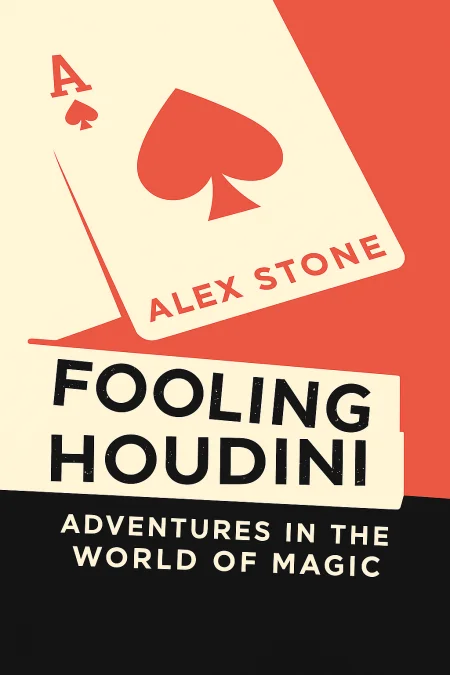
Fooling Houdini
Adventures in the World of Magic
Book Edition Details
Summary
In the heart of New York's vibrant underground, where the aroma of coffee mingles with whispered secrets, Alex Stone—a PhD candidate at Columbia and a magician in the making—begins his audacious ascent into the world of professional illusion. "Fooling Houdini" unfolds like a masterful trick itself, revealing a tapestry of enigmatic personalities: from blind card savants to shadowy street hustlers and glitzy Vegas performers. As Stone navigates this dazzling realm, he seeks answers that transcend mere sleight of hand, delving into the mysteries of human perception and deception. With wit and wonder, this debut bestseller illuminates the intricate dance between science and sorcery, promising readers a front-row seat to the magic show of the mind.
Introduction
Picture a physicist standing before thousands of spectators, his hands trembling as he attempts to perform a simple card trick at the World Championships of Magic in Stockholm. The audience begins to heckle, judges shake their heads in disapproval, and within moments, a red light signals his elimination from the competition. This moment of profound humiliation becomes the catalyst for an extraordinary journey into the hidden world of professional magic, where ancient secrets meet cutting-edge science, and where the pursuit of wonder reveals profound truths about perception, memory, and the very nature of reality. What begins as a quest for redemption evolves into something far more significant: an exploration of how magic serves as a unique lens through which to understand the human mind. Through intensive training with underground masters, encounters with legendary card cheats, and collaborations with neuroscientists, we discover that magic is far more than entertainment. It's a sophisticated art form that exploits the deepest quirks of human psychology, revealing startling truths about how our brains construct reality from incomplete information. This journey through magic's hidden corridors promises to transform your understanding of perception itself. You'll discover why our minds are so easily fooled, how ancient techniques continue to baffle modern scientists, and what these revelations mean for navigating a world filled with deception. More than just tricks and techniques, this exploration reveals magic as a profound metaphor for the mysteries that surround us daily, inviting us to see wonder in the ordinary and to question the nature of what we think we know.
From Olympics Failure to Underground Masters
The aftermath of Stockholm felt like exile from a world that had briefly welcomed me. My magic props gathered dust in a forgotten corner, while the memory of that red light haunted my sleep. The humiliation was complete, but sometimes our greatest failures become doorways to deeper understanding. After months of avoiding the magic community, I found myself drawn back to Tannen's Magic Store on a quiet Saturday afternoon, where the familiar sight of cards dancing through skilled fingers reminded me why I had fallen in love with this art form in the first place. It was there that I first heard whispers about Wesley James, a grizzled master who held court at a grimy pizzeria near Herald Square. Wes was described in almost mythical terms by those who knew him, a direct student of the legendary Dai Vernon and keeper of secrets that had been passed down through generations of underground magicians. Unlike the tournament performers who sought glory on stage, Wes represented something deeper: the pure transmission of knowledge from master to student, unadorned by spotlight or applause. When I finally worked up the courage to approach him at Rustico II, his initial assessment was brutally honest yet strangely encouraging. Under Wes's tutelage, I discovered that true magic exists not in the tricks themselves, but in the relationship between teacher and student, in the careful preservation of knowledge that might otherwise be lost. His weathered hands could make coins dance with movements so subtle they seemed like acts of telekinesis, yet he demanded that I master the fundamentals with monastic dedication. "Magic is a subset of theater," he would growl between drags of his menthol cigarettes, "and as such it has all the same responsibilities." Through months of Saturday afternoon sessions, surrounded by the aroma of stale pizza and the quiet intensity of serious study, I began to understand that my Olympic failure had been necessary, stripping away my illusions so that I could rebuild my understanding from the ground up. The underground world that Wes introduced me to operated by different rules than the competition circuit. Here, the measure of a magician wasn't the trophies they had won, but the depth of their knowledge and their commitment to the art's ancient traditions. These weren't performers seeking fame, but scholars and artists dedicated to preserving something precious and mysterious. In this hidden community, I found not just better techniques, but a new way of thinking about magic as a lens through which to understand the deepest mysteries of human perception and the beautiful complexity of minds that can be fooled, yet somehow enriched by the experience.
The Psychology of Misdirection and Memory
The laboratory at the New School felt like a different kind of magic theater, where Dr. Arien Mack was conducting experiments that revealed the startling limitations of human perception. As I sat with my head braced against an apparatus, watching crosses flash on a computer screen, I was participating in research that would fundamentally change my understanding of how magic works. The test seemed simple: determine whether the horizontal or vertical line was longer. Yet when Dr. Mack asked if I had seen anything else during the trials, I was certain nothing had appeared. Only later did I learn that images had flashed repeatedly before my eyes, invisible to my conscious mind because my attention was focused elsewhere. This phenomenon, which Dr. Mack termed "inattentional blindness," explained something profound about the human condition. We believe we see everything before us, yet our conscious awareness captures only a tiny fraction of the sensory information our brains receive. During magic performances, misdirection doesn't work by making things invisible to our eyes, but by overwhelming our limited attention, creating blind spots in our awareness. The implications extend far beyond entertainment: drivers talking on phones become functionally blind to motorcycles, witnesses to crimes remember events that never occurred, and our memories constantly reshape themselves based on suggestion and expectation. The watch-stealing experiment we designed together pushed these principles to their limits. Even when volunteers could feel me manipulating the clasp on their wrist, their conscious minds remained unaware that their timepiece was being removed. In one memorable trial, a watch alarm began beeping as I unbuckled the strap, yet the wearer remained completely oblivious to both the sound and the theft. These results weren't just amusing parlor tricks; they revealed fundamental truths about the constructed nature of our reality and the profound gaps in our awareness that skilled practitioners have learned to exploit. Our research bridged the ancient art of deception with cutting-edge neuroscience, revealing magic as an intuitive science of the mind. For centuries, magicians have developed techniques that exploit specific quirks of human psychology, creating effects that seem impossible precisely because they target the blind spots in our perception. This convergence of art and science suggested something beautiful: that wonder and understanding need not be enemies, but can dance together in revealing the magnificent complexity of consciousness itself.
Mathematics, Mentalism, and the Perfect Shuffle
The revelation came not from a dusty grimoire or secret manuscript, but from a mathematics classroom at Columbia University, where Professor David Bayer was demonstrating something that seemed impossible. After allowing me to shuffle a deck of cards three times, he somehow located the card I had selected and buried in the middle of the pack. This wasn't sleight of hand or psychological manipulation, but mathematical precision at work. The secret lay in understanding that shuffling, despite our intuitions, doesn't randomize cards as thoroughly as we imagine. Working with legendary mathematician Persi Diaconis, Bayer had discovered that it takes seven shuffles to truly randomize a deck of cards, far more than the three or four typically used in casinos. Their research revealed shuffling as a phase transition, where order suddenly collapses into chaos around the seventh shuffle, like water freezing at exactly zero degrees. This insight had revolutionized casino security and revealed deep connections between card manipulation and fundamental principles of physics, from entropy to information theory. The mathematical principles underlying these discoveries opened doorways to effects that seemed genuinely impossible. By arranging a deck according to a De Bruijn sequence, a pattern where every possible color combination appears exactly once, I could divine the identity of multiple selected cards simply by observing which spectators had red cards and which had black. The method required memorizing the entire sequence using ancient mnemonic techniques, but the result was worth the effort: a perfect mentalism routine that left even experienced magicians completely baffled. This marriage of mathematics and magic revealed something profound about the nature of mystery itself. The most powerful deceptions often rely not on complex sleight of hand, but on exploiting our assumptions about randomness, probability, and the limits of human memory. By understanding the hidden patterns that govern seemingly chaotic processes, we gain access to effects that appear supernatural precisely because they transcend ordinary understanding. The boundary between magic and mathematics dissolves, revealing both as expressions of the same fundamental human drive to find order within apparent chaos and to create wonder from deep understanding.
Building an Act: Performance and Redemption
The journey from technical knowledge to genuine artistry required learning to see magic through an audience's eyes rather than through the lens of personal achievement. Kate, the actress I met during a brief experiment with clown classes, became my guide to the theatrical heart of magic. She helped me understand that authenticity, not complexity, creates the strongest emotional connections with audiences. Under her guidance, I began crafting routines that reflected my genuine interests in physics and mathematics, rather than imitating the styles of performers I could never authentically become. The construction of my signature routine became an exercise in storytelling as much as method. By combining the mathematical principles I had learned with elements of mentalism and card manipulation, I created an act that revealed a signed card's name appearing on the edges of a shuffled deck, followed by the mysterious materialization of a secretly written name. Eight perfect faro shuffles provided the mechanism, but the real magic lay in creating a narrative that gave audiences a reason to care about these impossibilities. The routine became a meditation on entropy, randomness, and the beautiful patterns that emerge from apparent chaos. Performance revealed new layers of challenge beyond mere technical execution. Each audience brought different energy, different expectations, and different ways of processing the impossible. Learning to read these dynamics and adjust accordingly required developing what magicians call "performance intelligence," the ability to gauge reactions and modify the experience in real time. Mistakes became opportunities for humor and connection rather than failures, and the interaction between performer and audience evolved into a collaborative creation of wonder. Standing before the judges at the IBM competition, with O'Brien himself in the front row, I experienced something I hadn't felt since childhood: the pure joy of sharing something beautiful with others. The red light that had haunted my dreams since Stockholm remained dark, and the applause that followed felt earned rather than hoped for. Win or lose, I had found something more valuable than any trophy: the ability to create authentic moments of astonishment that enriched both performer and audience, proving that redemption often comes not from avoiding failure, but from learning to transform it into wisdom.
Summary
This exploration of magic's hidden depths reveals a profound truth about the nature of learning and growth: our greatest failures often become the foundation for our most meaningful discoveries. The journey from humiliating defeat to genuine artistry illustrates how embracing our limitations and seeking deeper understanding can transform apparent weaknesses into sources of strength and wisdom. Magic emerges not as mere entertainment, but as a unique lens through which to understand the human condition. The art reveals our minds as magnificent yet flawed instruments, capable of creating rich, detailed experiences from fragmentary information while remaining vulnerable to elegant deceptions. This paradox reflects a broader truth about consciousness itself: we inhabit a reality constructed by our brains from incomplete data, and recognizing this limitation can actually enhance rather than diminish our appreciation for the mystery of existence. The convergence of ancient techniques with modern science suggests that wonder and understanding need not be opposing forces. Whether in the precise mathematics of card shuffling, the neuroscience of attention, or the psychology of memory, the pursuit of knowledge can deepen rather than destroy our capacity for astonishment. By learning to see the world through both the magician's eye for misdirection and the scientist's hunger for truth, we develop a richer, more nuanced appreciation for the beautiful complexity that surrounds us, inviting us to approach life's mysteries with both critical thinking and childlike wonder.
Related Books
Download PDF & EPUB
To save this Black List summary for later, download the free PDF and EPUB. You can print it out, or read offline at your convenience.
By Alex Stone
