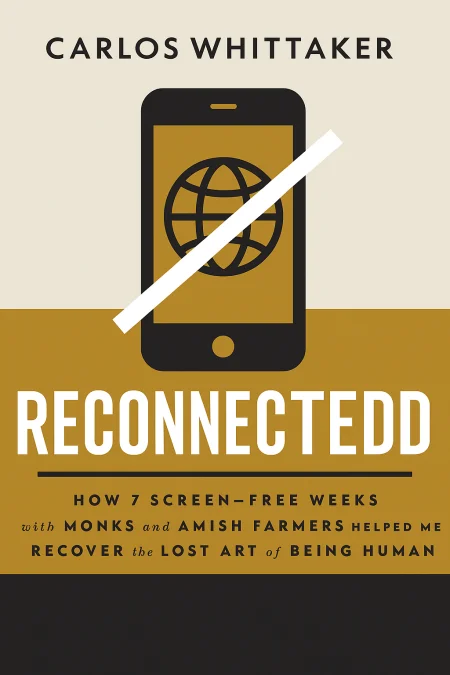
Reconnected
Seven Screen-Free Weeks to Rediscover the Art of Being Human
Book Edition Details
Summary
In a world drowning in digital noise, Carlos Whittaker's radical seven-week retreat from screens unfolds a tale of profound transformation. Trading pixels for presence, Whittaker immerses himself in the simplicity of a monastery, the earthy rhythms of an Amish farm, and the warmth of family life. Through his journey, he discovers the boundless joy that lies beyond the glow of smartphones and the depth of real human connection in an age of superficial engagement. As he shares his insights, Whittaker invites readers to imagine a life reconnected with nature, neighbors, and oneself. This book is not just a recounting of personal revelation; it's a manifesto for reclaiming life's rich textures from the tyranny of screens. With vivid storytelling and actionable wisdom, "Reconnected" is a beacon for anyone yearning to break free from digital chains and rediscover the beauty of the analog world.
Introduction
Picture this: a man stands in a scorching desert parking lot, phoneless and panic-stricken, watching his best friend drive away. The silence feels deafening. This isn't a scene from a survival thriller—it's the beginning of one writer's radical experiment to reclaim his humanity in our hyperconnected world. We live in an age where the average person spends over seven hours daily staring at screens, yet feels more disconnected than ever. We're constantly informed but rarely present, perpetually busy but seldom purposeful. The irony is striking: the very technology designed to bring us together often leaves us feeling isolated, anxious, and somehow smaller than we were meant to be. This is the story of what happens when someone decides to step completely away from the digital noise for seven transformative weeks. It's about discovering that the art of being human isn't lost—it's simply been buried under layers of notifications, endless scrolling, and the relentless pursuit of digital validation. Through intimate encounters with contemplative monks and hardworking Amish families, we explore what we've sacrificed for convenience and what we might reclaim through intentional disconnection. This journey reveals that the answer isn't to abandon technology forever, but to remember what it means to be fully alive, deeply present, and genuinely connected to ourselves, others, and something greater than our screens.
The Monastery Awakening: Finding Presence in Silence
The first challenge came within hours of arriving at Saint Andrew's Abbey. Without the familiar comfort of a smartphone's blue glow, every moment stretched longer than expected. Breakfast conversations felt awkward without the safety net of checking messages. Walking paths meant actually noticing the ground beneath your feet, the sky overhead, the sounds of birds rather than podcasts. The monks moved through their days at what seemed like an impossibly slow pace. They walked deliberately, ate mindfully, and spoke only when words held weight. Their entire existence revolved around fixed hours of prayer, manual labor, and contemplation. Initially, this rhythm felt suffocating—like being trapped in slow motion while the rest of the world raced ahead. But something remarkable began to emerge in this enforced stillness. Without the constant input of news, social media, and digital entertainment, space opened up for deeper reflection. Uncomfortable thoughts and emotions that had been numbed by endless scrolling suddenly demanded attention. The silence revealed how much we typically avoid our inner lives by staying perpetually distracted. The desert monastery became a mirror, reflecting not just the beauty of uninterrupted sunrises and starlit skies, but also the restless hunger for stimulation that had taken root over years of digital dependency. In choosing to sit with discomfort rather than escape into a screen, the foundation was laid for rediscovering what it means to be present—not just physically, but emotionally and spiritually. This presence, it turned out, was the first key to unlocking a more authentic way of being human.
Amish Wisdom: Community Over Technology
The Miller family sheep farm presented an entirely different challenge. Here, technology wasn't absent—it was carefully chosen. Electric bikes hummed alongside horse-drawn plows, generators powered homes disconnected from public utilities, and smartphones emerged for specific purposes before disappearing again. The Amish weren't anti-technology; they were pro-community, evaluating each innovation through the lens of whether it would bring people together or drive them apart. Days began before dawn with hearty breakfasts that lasted nearly an hour, not because the food was complex but because conversation mattered. Meals weren't fuel stops between activities—they were the activities. Evening gatherings around fire pits stretched for hours, with stories shared, problems solved collectively, and genuine laughter echoing across farmland. Children played freely while adults worked side by side, creating a rhythm where individual needs served the greater whole. The most striking difference wasn't the absence of modern conveniences but the presence of genuine interdependence. When someone's house burned down, the community rebuilt it in days. When medical bills mounted, neighbors organized auctions and contributed resources without question. No one worried about retirement or healthcare because the community itself was the safety net. This wasn't just idealism—it was a practical, lived reality. Working the land from sunrise to sunset revealed another truth: physical labor and meaningful relationships fed the soul in ways that digital connections never could. Hands dirty with soil, muscles tired from honest work, conversations flowing without the interruption of notifications—this was what human life had looked like for thousands of years before screens reshaped our daily existence. The Amish had chosen to preserve not just old ways, but perhaps better ways of being together.
The Return Home: Integrating Ancient Ways with Modern Life
Returning to the digital world after seven weeks felt like stepping into a different universe. The phone's weight in hand seemed both familiar and foreign, its black screen reflecting a person who had been fundamentally changed. The first flood of notifications—1,492 text messages—was met not with anxiety to catch up, but with the simple decision to delete them all. What had once seemed urgent now felt insignificant compared to the richness of unmediated experience. The real test wasn't avoiding technology forever, but learning to engage with it intentionally. Morning coffee tasted different when savored without scrolling. Conversations deepened when phones stayed in other rooms. Walks became meditative rather than multitasking opportunities. The goal wasn't to become a digital hermit, but to own the technology rather than being owned by it. Brain scans revealed measurable changes—improved emotional processing, better thought coordination, and enhanced activity in areas associated with spiritual connection. But the most profound transformations couldn't be captured by medical imaging: the ability to sit with boredom without immediately reaching for stimulation, the practice of making eye contact during conversations, the courage to get lost and figure out directions through intuition and human connection. The challenge became maintaining these practices while re-engaging with a world that rewards constant connectivity. It meant setting boundaries that felt radical in their simplicity: phones banned from bedrooms, meals eaten without screens, notifications turned off except for true emergencies. It required remembering that being bored, getting lost, and feeling uncomfortable weren't problems to be solved instantly but opportunities for growth and self-discovery.
Summary
This journey reveals that our hyperconnected age has quietly stolen some of humanity's most essential experiences: the ability to be present with discomfort, to savor moments without immediately sharing them, to form deep community bonds that transcend individual convenience. We've gained unprecedented access to information and entertainment, but lost touch with the rhythms of reflection, genuine conversation, and spiritual contemplation that have sustained human flourishing for millennia. The path forward isn't to abandon digital tools but to rediscover our agency in how we use them. Like the Amish evaluating each technology for its impact on community, we can choose connection over isolation, presence over productivity, and depth over digital shallow waters. This means creating sacred spaces—both physical and temporal—where screens cannot intrude, where silence can speak, and where we remember what it feels like to be fully alive. The art of being human isn't lost, merely buried under layers of notifications and endless scroll. It's waiting to be rediscovered through intentional choices: longer meals, slower walks, deeper breaths, and the radical act of looking each other in the eyes. In reconnecting with these ancient rhythms, we don't step backward into the past but forward into a more authentic future where technology serves our humanity rather than diminishing it.
Related Books
Download PDF & EPUB
To save this Black List summary for later, download the free PDF and EPUB. You can print it out, or read offline at your convenience.
By Carlos Whittaker
