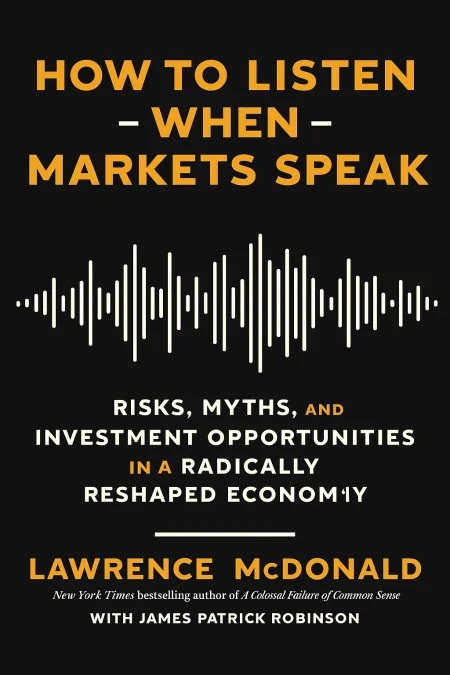
How to Listen When Markets Speak
Risks, Myths, and Investment Opportunities in a Radically Reshaped Economy
byLawrence McDonald, James Patrick Robinson
Book Edition Details
Summary
In the midst of financial turbulence, a seismic shift is brewing beneath the surface of the global economy, threatening to uproot entrenched wealth and reorder the investment landscape. Lawrence G. McDonald, a seasoned expert with a front-row seat to the Lehman Brothers debacle, illuminates the path forward with "How to Listen When Markets Speak." This eye-opening guide arms savvy investors with the tools to decode economic whispers and anticipate the tidal waves of change. As the era of easy money crumbles, McDonald unveils his innovative strategies to navigate a world marked by enduring inflation and volatile commodity markets. With sharp insights into the shifting power dynamics of global currencies and the promise of tangible assets over volatile growth stocks, this book empowers readers to outsmart reactionary trends and safeguard their financial future. Prepare to see the market through a fresh lens and secure your place ahead of the curve.
Introduction
Picture the moment when the Berlin Wall fell in November 1989, as jubilant crowds wielded hammers and pickaxes against the concrete symbol of division. Few could have imagined that this triumph of freedom would set in motion a chain of economic events that would reshape global finance for the next three decades. What began as the victory of capitalism over communism evolved into an unprecedented experiment in monetary policy, asset bubbles, and financial engineering that would ultimately threaten the very system it was meant to protect. This remarkable journey traces how America's unipolar moment created the conditions for the greatest bull market in history, only to sow the seeds of its own destruction through increasingly desperate attempts to maintain prosperity through artificial means. We witness the transformation from a world of stable currencies and sound money to one of quantitative easing, zero interest rates, and asset price inflation that has left entire generations unable to afford homes or build wealth through traditional means. The story reveals why the investment strategies that worked for thirty years are now failing, and how the return of inflation and geopolitical competition is forcing a fundamental reordering of the global economy. Whether you're an investor struggling to understand why your portfolio no longer performs as expected, a policymaker grappling with the unintended consequences of monetary intervention, or simply someone seeking to comprehend how today's economic challenges emerged from yesterday's solutions, this analysis provides essential insights into the forces reshaping our financial future. As we stand at the threshold of a new era dominated by hard assets and multipolar competition, understanding this transformation isn't merely helpful—it's crucial for navigating what lies ahead.
The Unipolar Moment: Post-Soviet Collapse and Economic Transformation (1991-2008)
The dissolution of the Soviet Union on Christmas Day 1991 marked more than just a political victory; it unleashed the most extraordinary deflationary wave in modern economic history. When Mikhail Gorbachev lowered the hammer and sickle for the final time, he unknowingly triggered a transformation that would define global markets for the next three decades. The world shifted from a dangerous bipolar standoff to a peaceful unipolar system dominated by American power, fundamentally altering the economics of everything from energy prices to manufacturing costs. This new world order released unprecedented disinflationary forces across the global economy. Vast supplies of raw materials from the former Soviet bloc flooded international markets, while cheap labor from Asia became available to Western corporations on an unprecedented scale. The risk-free rate on U.S. Treasury bonds plummeted from 15 percent in the early 1980s to less than 1 percent by the 2010s, while stock market valuations expanded dramatically as investors embraced the promise of perpetual growth. Global trade exploded from less than $5 trillion in 1990 to over $28 trillion by 2022, as countries previously locked behind the Iron Curtain joined the capitalist system. The United States leveraged its dominant position to maintain control over global energy markets through its relationship with Saudi Arabia and other oil producers. This petrodollar system ensured that oil remained denominated in dollars while keeping energy prices stable enough to suppress inflation across the Western world. Meanwhile, China's entry into the World Trade Organization in 2001 accelerated the offshoring of American manufacturing, creating a deflationary spiral that would benefit financial assets for two decades while hollowing out the industrial heartland. The consequences were profound and seemingly permanent. Inflation fell from the double-digit rates of the 1970s to barely 2 percent in the 2010s, creating what economists called the "Great Moderation." This environment proved perfect for the greatest bull market in financial history, with the S&P 500 surging over 1,300 percent between 1990 and 2021. An entire generation of investors came to believe that low inflation, rising asset prices, and American dominance were the natural order of things, setting the stage for the shocks that would follow.
Crisis Response and Monetary Extremism: The Fed's Great Experiment (2008-2020)
The collapse of Lehman Brothers on September 15, 2008, shattered more than just a venerable investment bank—it destroyed the illusion that free markets could regulate themselves without government intervention. The housing bubble's spectacular implosion revealed that decades of deregulation and financial innovation had created a system so interconnected and leveraged that the failure of a single institution could threaten global economic collapse. Ben Bernanke's Federal Reserve faced a choice between allowing natural market forces to clear the system or embarking on the most ambitious monetary experiment in human history. Bernanke chose intervention on a scale that would have been unimaginable just years earlier. Interest rates plunged to zero while the Fed's balance sheet exploded from under $1 trillion to over $4.5 trillion through successive rounds of quantitative easing. The central bank purchased government bonds and mortgage securities on an unprecedented scale, effectively monetizing the federal debt while backstopping the housing market. This marked the birth of what critics called "helicopter money"—the direct injection of newly created dollars into the financial system. The unintended consequences of this monetary extremism rippled throughout the economy in ways that policymakers neither anticipated nor fully understood. Ultra-low interest rates punished savers while rewarding speculators, creating massive distortions in asset prices that benefited the wealthy at the expense of working-class Americans. Corporate America responded by issuing cheap debt to fund over $5 trillion in stock buybacks during the 2010s, artificially inflating share prices while neglecting productive investment. The wealth gap widened to levels not seen since the Gilded Age, as those who owned financial assets saw their wealth multiply while median household income stagnated. Perhaps most dangerously, this era established the precedent that the Federal Reserve would always intervene to prevent major market declines. The "Fed put" evolved from an implicit understanding to an explicit guarantee, encouraging increasingly reckless behavior throughout the financial system. By 2020, when the COVID-19 pandemic struck, investors had become so accustomed to central bank intervention that any hint of policy normalization triggered violent market selloffs. The stage was set for an even more dramatic response that would finally break the deflationary paradigm that had dominated since the Soviet collapse.
Breaking Point: Inflation Returns and Dollar Dominance Questioned (2020-Present)
The COVID-19 pandemic provided the catalyst for the most dramatic shift in economic policy since the stagflation crisis of the 1970s. Faced with a complete economic shutdown and the prospect of mass unemployment, policymakers abandoned all pretense of fiscal restraint and monetary orthodoxy. The Federal Reserve's balance sheet exploded to nearly $9 trillion while Congress authorized over $6 trillion in direct payments to individuals and businesses. In just two years, more than 40 percent of all dollars ever created came into existence, fundamentally altering the global monetary landscape. The inflationary consequences arrived with stunning speed and persistence. After three decades of disinflation, consumer prices began rising at rates not seen since the early 1980s, catching Federal Reserve officials completely off guard. Supply chain disruptions, labor shortages, and massive fiscal stimulus combined to create a perfect storm of rising costs that spread from goods to services to wages. The Fed, having spent years trying unsuccessfully to generate inflation, suddenly found itself fighting the very monster it had tried to create. Russia's invasion of Ukraine in February 2022 transformed an economic crisis into a geopolitical one with profound implications for the dollar-based international system. The weaponization of dollar reserves through sanctions, while effective in pressuring Moscow, raised uncomfortable questions about the long-term stability of a monetary system controlled by a single nation. Countries around the world began questioning the wisdom of holding large dollar reserves that could be frozen at Washington's discretion, leading to increased interest in alternatives ranging from gold to digital currencies to bilateral trade agreements. The era of easy money and unquestioned dollar dominance that had defined the post-Cold War period was clearly ending. Rising interest rates made the government's massive debt burden increasingly unsustainable, while persistent inflation eroded the purchasing power of American consumers and the real value of dollar-denominated assets. The stage was set for a fundamental reordering of the global economy, with profound implications for investors who had grown accustomed to three decades of falling rates and rising asset prices.
The Great Rotation: From Financial Assets to Hard Commodities
As the old economic order crumbles under the weight of its own contradictions, a new paradigm is emerging based not on financial engineering but on tangible, productive assets that can maintain their value in an inflationary environment. The great rotation from growth stocks to value investments, from financial assets to hard commodities, represents more than just another market cycle—it signals a fundamental shift in how wealth is created and preserved in an era of currency debasement and resource scarcity. The energy sector stands at the epicenter of this transformation, having been systematically starved of capital for over a decade due to environmental, social, and governance mandates and climate policies. Years of underinvestment have created severe supply constraints just as global demand continues to grow, particularly in developing nations seeking to improve their living standards. The transition to renewable energy, while necessary for environmental reasons, requires massive amounts of copper, lithium, rare earth elements, and other critical materials, creating a paradox where the green revolution depends entirely on traditional mining and extraction industries. Geopolitical factors are accelerating this shift toward hard assets as nations prioritize resource security over economic efficiency. China's dominance in critical mineral processing, Russia's control over energy supplies, and the fragmentation of global supply chains have made strategic stockpiling a national priority for developed nations. The era of just-in-time delivery and global optimization is giving way to one of supply chain resilience and domestic production, fundamentally altering the economics of commodity markets and creating sustained demand for physical assets. For investors, this transformation requires a complete rethinking of traditional portfolio construction principles that have guided wealth management for generations. The classic 60/40 allocation between stocks and bonds is breaking down as both asset classes face headwinds from inflation and rising interest rates. The new paradigm demands greater emphasis on real assets—energy, metals, agriculture, and other commodities—that can generate positive returns regardless of monetary policy. Those who recognize this shift early and position themselves accordingly stand to benefit from one of the greatest wealth transfers in modern history.
Summary
The thread connecting four decades of financial history reveals the central paradox of modern economic policy: each intervention designed to solve a crisis inevitably creates the conditions for an even larger crisis down the road. The post-Cold War boom, built on globalization and financialization, contained the seeds of the 2008 financial crisis. The response to that crisis, through unprecedented monetary expansion and zero interest rates, set the stage for today's inflationary pressures and asset bubbles. Each policy response, while successful in the short term, created larger distortions that required even more dramatic interventions, leading inexorably to the breaking point we face today. The implications for investors and policymakers are profound and unavoidable. The era of falling interest rates and rising asset prices that defined the past four decades is ending, replaced by a new paradigm of higher inflation, resource scarcity, and multipolar geopolitical competition. Traditional investment strategies based on the assumption of perpetual monetary accommodation and dollar dominance will prove increasingly inadequate in this new environment. The future belongs to those who understand that sustainable wealth comes not from financial engineering but from owning productive assets that can generate value regardless of monetary policy or political intervention. Three critical lessons emerge from this historical analysis that should guide decision-making in the years ahead. First, recognize that all economic cycles eventually reverse, and the longer they persist, the more dramatic and disruptive the reversal tends to be. Second, understand that government intervention, while often necessary in the short term, always creates unintended consequences that manifest years or decades later in unexpected ways. Finally, position yourself for the world that is emerging rather than clinging to strategies that worked in the world that is disappearing. The great rotation toward hard assets represents not merely an investment opportunity but a fundamental reordering of the global economy that will define the next generation of wealth creation and preservation.
Related Books
Download PDF & EPUB
To save this Black List summary for later, download the free PDF and EPUB. You can print it out, or read offline at your convenience.
By Lawrence McDonald
