
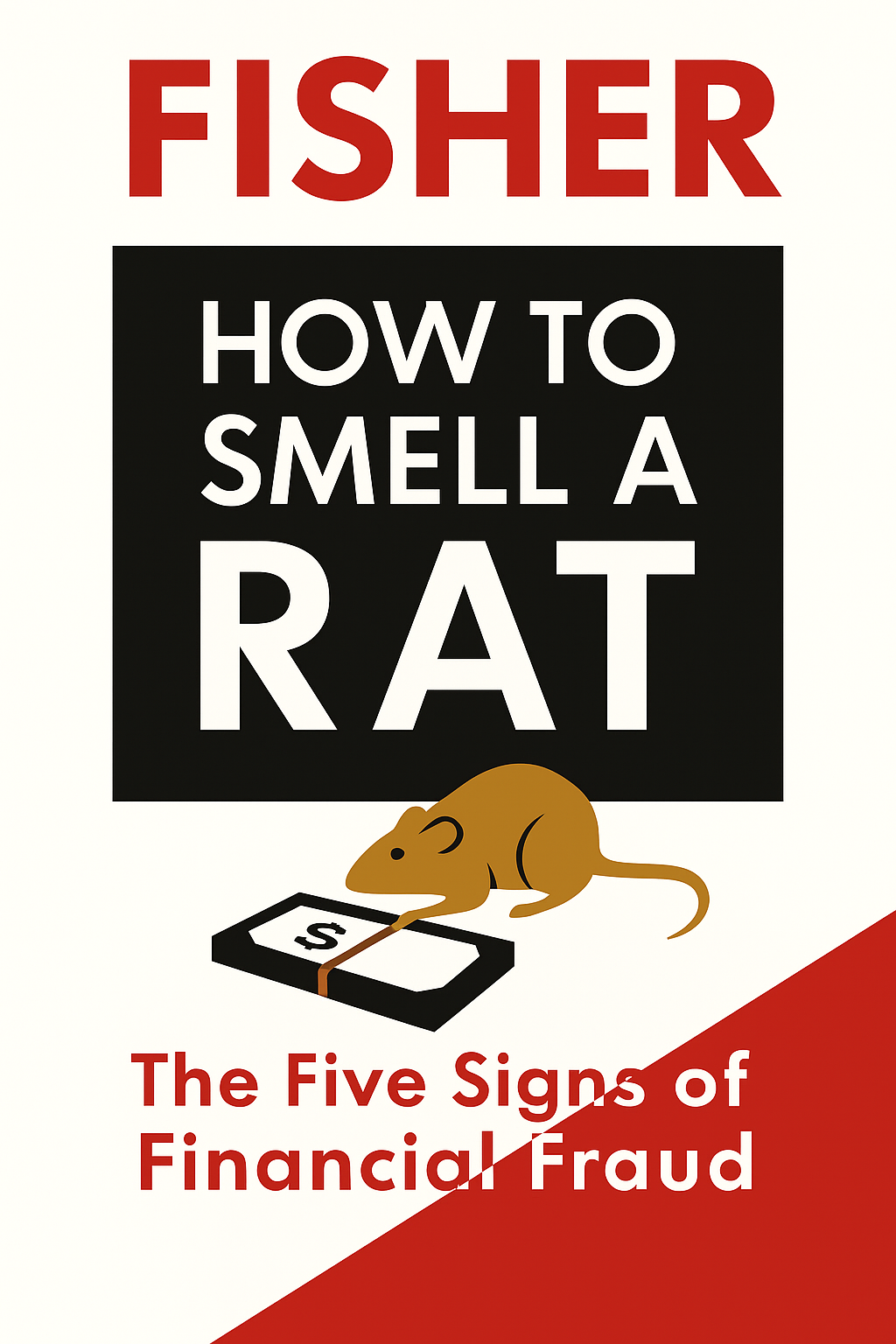
How to Smell a Rat
The Five Signs of Financial Fraud
byFisher
Book Edition Details
Summary
In a world where financial deception lurks behind seemingly trustworthy facades, "How to Smell a Rat" serves as your indispensable guide to sidestepping the snares of cunning fraudsters. Kenneth L. Fisher, with Lara Hoffmans, dissects the art of the swindle with razor-sharp insight, unveiling the notorious tricks of history's most infamous financial con artists. This isn't just a manual; it's a battle cry for the vigilant, arming you with the wisdom to recognize the red flags before you're ensnared. Through real-world stories and expert advice, Fisher equips you with the critical tools to protect your assets and peace of mind. Whether you're a seasoned investor or a financial novice, this book empowers you to navigate the murky waters of finance with confidence and clarity.
Introduction
Financial fraud represents one of the most devastating yet preventable threats to personal wealth accumulation. When investors fall victim to sophisticated Ponzi schemes and embezzlement operations, they often lose not merely a portion of their assets, but their entire life savings in an instant. The catastrophic nature of these losses distinguishes financial fraud from ordinary market volatility, where patient investors can typically recover over time through economic cycles. The core challenge lies in recognizing that fraudsters deliberately construct elaborate facades designed to exploit fundamental human psychology and social trust mechanisms. These criminals understand that most people rely on social proof, authority figures, and institutional credibility when making complex financial decisions. By systematically analyzing the structural patterns underlying virtually every major financial fraud throughout history, from Charles Ponzi's original scheme to Bernard Madoff's unprecedented $65 billion operation, clear warning signs emerge that transcend individual tactics or personalities. The analytical framework presented here operates on the principle that prevention through pattern recognition proves far more effective than attempting to recover stolen assets after the fact. Rather than examining the psychological profiles of individual fraudsters or the regulatory failures that enabled their operations, this systematic approach focuses on identifying the operational necessities that every financial fraud must possess to function successfully.
The Structural Foundation of All Financial Fraud
Every significant financial fraud in recorded history shares one fundamental structural characteristic that makes embezzlement operationally possible. Fraudulent operations require that the decision-maker who determines investment strategies also maintains direct access to client assets through custody arrangements. This dual control mechanism represents the essential infrastructure that enables systematic theft, regardless of the sophistication of other deceptive elements employed by the perpetrator. The custody relationship creates the practical means through which fraudsters can manipulate account statements while simultaneously redirecting actual funds for personal use or to pay earlier investors in pyramid fashion. When legitimate investment management separates these functions between independent institutions, potential thieves lose the operational capability to steal client money, even if they possessed criminal intent. This separation creates what effectively amounts to an impenetrable structural barrier against embezzlement. Historical analysis reveals that attempted frauds without custody access remain limited to relatively minor schemes involving false performance claims or excessive fees. The truly catastrophic wealth destruction occurs exclusively when fraudsters gain direct access to client funds through integrated custody arrangements. Large-scale embezzlement requires this operational foundation because fraudsters must continuously manipulate both reported performance and actual asset locations to maintain their deception over extended periods. The implications of this structural requirement extend beyond individual wealth protection to broader systemic risk considerations. When investors understand and consistently apply custody separation principles, they eliminate the operational foundation that enables large-scale financial fraud, thereby reducing both personal vulnerability and systemic risk within financial markets.
The Psychology and Tactics of Fraudulent Operations
Fraudsters employ consistently positive performance claims as their primary psychological weapon for attracting and retaining victims over extended periods. These fabricated returns serve multiple strategic purposes within the deception framework, simultaneously drawing in new investors while preventing existing clients from requesting withdrawals that would expose the fraudulent operation. The psychological appeal of steady, market-beating returns without volatility exploits fundamental human preferences for certainty and superior outcomes. Legitimate investment management inevitably produces periods of negative performance due to market volatility and the inherent unpredictability of financial markets. Professional money managers typically experience roughly thirty percent of their investment decisions proving incorrect over time, resulting in portfolio volatility that reflects genuine market engagement. Fraudsters understand that displaying authentic negative performance periods would trigger client scrutiny and potential redemptions that would collapse their schemes. The mathematical impossibility of generating consistently positive returns while engaging in legitimate market activities creates a reliable detection mechanism for potential fraud. Market history demonstrates that average returns emerge from extreme variations, with normal market behavior producing dramatic swings in both directions rather than steady progression. When performance claims violate these fundamental market characteristics, they signal potential fraudulent activity regardless of other persuasive elements. Sophisticated fraudsters also employ complex tactical descriptions to discourage detailed scrutiny from potential victims. By presenting investment strategies using technical terminology and proprietary methodologies that appear beyond typical investor comprehension, criminals create psychological barriers that prevent thorough due diligence. This tactical obfuscation exploits the tendency for individuals to avoid admitting knowledge gaps in areas where they feel they should possess expertise.
Due Diligence as the Ultimate Defense Against Deception
Individual investor due diligence represents the most reliable defense against financial fraud, far exceeding the protective capabilities of regulatory oversight or professional intermediaries. Regulatory agencies possess limited investigative resources relative to the number of investment managers operating within their jurisdictions, making comprehensive oversight practically impossible. Even well-intentioned regulatory efforts typically identify fraudulent operations only after significant damage has occurred, rather than preventing initial victimization. Professional intermediaries, including feeder funds and investment consultants, frequently fail to provide adequate protection because their economic incentives may not align perfectly with comprehensive fraud detection. These intermediaries often receive compensation structures that reward asset gathering over thorough due diligence, creating potential conflicts between their business interests and client protection. Historical analysis reveals that many sophisticated institutional investors fell victim to major frauds despite employing professional intermediary services. Effective due diligence requires systematic verification of custody arrangements, performance claims, and operational transparency rather than reliance on reputation, credentials, or social proof. The verification process must include direct communication with independent custodial institutions, examination of regulatory filings for consistency with marketing claims, and careful analysis of performance patterns for mathematical plausibility. This systematic approach prevents criminals from exploiting social and psychological biases that enable deception. The fundamental principle underlying effective due diligence recognizes that legitimate investment operations welcome scrutiny and provide transparent access to operational details. Investment managers with nothing to hide demonstrate their integrity through comprehensive disclosure and independent verification systems, while fraudulent operations typically employ various tactics to discourage thorough investigation. The investor's willingness to conduct rigorous due diligence often determines the difference between wealth preservation and catastrophic loss.
Building a Fraud-Free Financial Future Through Vigilance
Long-term wealth preservation requires systematic application of fraud prevention principles rather than reliance on regulatory protection or market oversight mechanisms. The persistence of financial fraud throughout history, despite continuously evolving regulatory frameworks, demonstrates that criminal innovation typically outpaces institutional prevention efforts. Individual vigilance therefore represents the primary defense against evolving fraudulent tactics and emerging deception methods. The separation of investment decision-making from asset custody functions provides the foundational protection against embezzlement, but comprehensive security requires additional verification measures. These include regular direct communication with independent custodial institutions, systematic verification of performance claims against market benchmarks, and ongoing monitoring of operational transparency indicators. Consistent application of these verification procedures creates multiple barriers against fraudulent operations. Successful fraud prevention also requires resistance to psychological manipulation tactics employed by sophisticated criminals. These tactics often exploit natural human tendencies toward social proof, authority deference, and exclusivity appeals that can override rational analysis. By recognizing these psychological vulnerabilities and implementing systematic verification procedures, investors can maintain objective evaluation criteria despite persuasive marketing efforts. The cumulative effect of widespread fraud prevention awareness creates positive systemic benefits beyond individual wealth protection. When large numbers of investors consistently demand custody separation, operational transparency, and performance verification, the operational environment becomes increasingly hostile to fraudulent operations while supporting legitimate investment management. This collective vigilance contributes to overall market integrity and reduces systemic fraud risk for all participants.
Summary
The prevention of financial fraud fundamentally depends on understanding that criminals require specific operational capabilities to execute large-scale theft, and that systematic denial of these capabilities through custody separation and verification procedures provides near-complete protection against embezzlement. This structural approach to fraud prevention proves far more reliable than attempting to identify criminal intent or relying on regulatory oversight for protection. Through consistent application of verification principles and resistance to psychological manipulation tactics, investors can maintain their wealth while contributing to broader market integrity and systemic fraud reduction.
Related Books
Download PDF & EPUB
To save this Black List summary for later, download the free PDF and EPUB. You can print it out, or read offline at your convenience.
By Fisher
