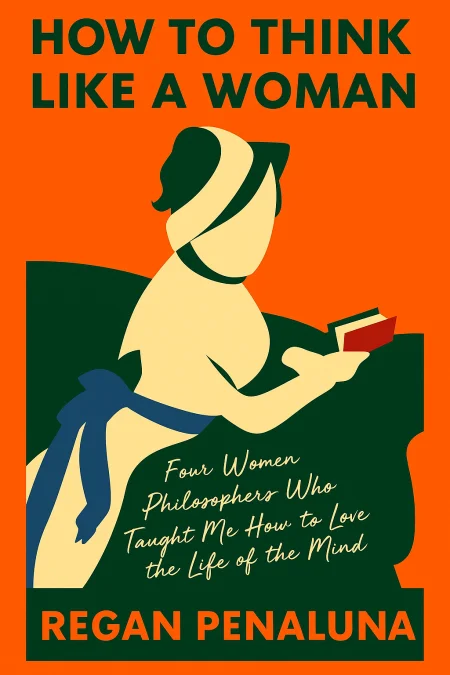
How to Think Like a Woman
Four Women Philosophers Who Taught Me How to Live a Life of the Mind
Book Edition Details
Summary
In the kaleidoscope of ideas that shape our world, Regan Penaluna embarks on a daring odyssey through the overlooked corridors of philosophy, where the whispers of forgotten women echo with vitality. "How to Think Like a Woman" is more than a memoir; it's a manifesto of reclamation, chronicling Penaluna's journey from an inquisitive girl in Iowa to a defiant scholar amidst academia's patriarchal bastions. When a chance encounter with the writings of Damaris Cudworth Masham sparks a revelatory quest, she unearths a lineage of intellectual pioneers—Mary Astell, Catharine Cockburn, and Mary Wollstonecraft—whose revolutionary voices challenge the male-dominated narrative. This book isn't just a reflection on history; it's a bold reimagining of philosophy's future, where equality and truth forge new paths. Witty, incisive, and profoundly human, Penaluna's exploration resonates with anyone who dares to question the status quo and dreams of a world where every voice is heard.
Introduction
In the candlelit chambers of 17th and 18th-century England, four extraordinary women dared to challenge the most fundamental assumption of their age: that serious philosophical thinking was the exclusive domain of men. Mary Astell, writing from her modest Chelsea lodgings, proposed revolutionary ideas about women's education that scandalized London society. Damaris Masham engaged in passionate intellectual debates with John Locke while managing household duties and raising children. Mary Wollstonecraft traveled alone through Scandinavia with her infant daughter, crafting groundbreaking theories about women's rights between moments of personal heartbreak. Catherine Cockburn balanced a successful theatrical career with rigorous philosophical inquiry, proving that brilliant minds could excel across multiple intellectual domains. These remarkable thinkers emerged during the Enlightenment, an era that proclaimed reason and individual liberty while systematically excluding half of humanity from its promises. They lived in a world where universities barred women entirely, where prominent philosophers constructed elaborate arguments for female intellectual inferiority, and where even the most progressive thinkers rarely questioned basic assumptions about women's nature. Yet these four refused to accept their prescribed limitations, wielding their pens like weapons against centuries of exclusion. Through their struggles, we discover profound insights into the nature of intellectual courage, the power of education to transform lives, and the complex relationship between personal freedom and social justice. Their stories reveal how authentic philosophical inquiry often begins with questioning what seems most natural and inevitable, how brilliant minds can flourish even under the most constraining circumstances, and how the fight for intellectual recognition requires both extraordinary resilience and unwavering determination to think independently.
Pioneers Against Convention: Astell and Masham's Educational Revolution
Mary Astell's journey to philosophical prominence began with an act of desperate courage. At twenty-two, she sewed her life savings into her clothing and boarded a dangerous stagecoach from Newcastle to London, armed with nothing but fierce ambition and an unshakeable belief in women's intellectual capacity. Her childhood had been marked by tragedy and loss, but also by her uncle's secret philosophical tutoring that opened her mind to possibilities beyond the narrow confines prescribed for women. In London's Chelsea district, surrounded by other unmarried women scraping together livings as teachers and governesses, Astell harbored grander ambitions. When poverty threatened to destroy her dreams, she boldly petitioned the Archbishop of Canterbury for patronage. Her audacity paid off, and with his support, she published her revolutionary proposal for an all-women's college where ladies could pursue rigorous intellectual training without male interference. She envisioned a sanctuary where women could escape their "mechanical" existence and discover their rational capacities. Damaris Masham's intellectual awakening took a different path, shaped by her father's position as a Cambridge philosopher and her passionate correspondence with John Locke. Their relationship began with playful philosophical exchanges, but beneath the literary romance lay genuine intellectual respect. When Locke praised her understanding of complex metaphysical questions and sought her guidance on theoretical problems, Masham experienced the intoxicating validation of serious intellectual engagement that had been systematically denied to women of her generation. Both women recognized that excluding female voices from philosophical discourse impoverished the discipline itself. Astell argued that denying women education was not merely unjust but intellectually wasteful, depriving society of half its potential wisdom. Masham went further, suggesting that women's experiences provided unique insights into human nature that male philosophers consistently overlooked. Their pioneering efforts established the foundation for all subsequent feminist philosophical inquiry, proving that brilliant minds knew no gender boundaries.
Love, Loss, and Liberation: Wollstonecraft's Revolutionary Struggle
Mary Wollstonecraft's philosophy was forged in the crucible of personal struggle against male tyranny, beginning with her violent, alcoholic father and extending through her tumultuous romantic relationships. Her early experiences protecting her mother from domestic abuse and helping her sister escape a destructive marriage convinced her that women's oppression was not natural but socially constructed. These formative encounters with male violence and female subjugation would fuel her revolutionary vision of women's rights and autonomous selfhood. Wollstonecraft's intellectual development occurred largely outside formal institutions, through friendships with brilliant women and connections to radical dissenting communities. Her work as a teacher and governess exposed her to the stark inequalities in education that kept women intellectually dependent on men. She observed how girls were trained from childhood to value appearance over substance, to seek male approval rather than develop independent judgment, and to accept their supposed intellectual inferiority as natural law. The publication of her masterwork established Wollstonecraft as the most radical feminist voice of her generation. She systematically demolished the philosophical arguments used to justify women's subordination, particularly targeting influential theories about female education. Wollstonecraft argued that apparent differences between men and women resulted from unequal education and social conditioning, not innate biological limitations. She envisioned a world where women could pursue careers, participate in politics, and develop their rational faculties to their fullest potential. Yet Wollstonecraft's personal life revealed the painful contradictions facing even the most liberated women of her era. Her passionate affair with Gilbert Imlay left her emotionally devastated and twice suicidal, forcing her to confront the gap between her philosophical ideals and her lived experience. Her travels through Scandinavia with her infant daughter demonstrated both her remarkable independence and her continued vulnerability to male abandonment. Wollstonecraft's struggle to reconcile her desire for love with her commitment to autonomy illuminated the complex psychological work required for women to achieve genuine selfhood in a patriarchal world.
The Maternal Mind: Cockburn's Balance of Duty and Intellect
Catherine Cockburn's life embodied the central tension facing intellectual women: how to honor both the life of the mind and the demands of family responsibility. Her early success as a playwright and philosopher seemed to promise a future of uncompromised intellectual achievement, yet marriage and motherhood brought a seventeen-year silence that she later described as bidding farewell to serious writing. This apparent retreat masked a more complex reality of stolen moments for reading and philosophical reflection between domestic duties. Cockburn's philosophical works reveal a thinker grappling with questions that male philosophers rarely considered: how to balance self-development with care for others, whether maternal love conflicted with rational judgment, and what constituted genuine freedom for women embedded in networks of family obligation. Her defense of empiricism was groundbreaking not just for its intellectual rigor but for its implicit argument that women could engage with the most challenging philosophical problems of their era. The letters to her son and niece demonstrate Cockburn's innovative approach to combining philosophical instruction with maternal guidance. Rather than abandoning her intellectual life for motherhood, she found ways to integrate both roles, using her philosophical insights to guide the next generation while continuing to develop her own thinking. Her advice about treating women as rational equals reflected her belief that true freedom required mutual recognition and respect between the sexes. Cockburn's later philosophical works on moral theory and religious questions showed how her experience as a mother enriched rather than diminished her intellectual contributions. She understood human nature not as an abstract concept but as lived reality, bringing insights about care, responsibility, and emotional complexity that purely academic philosophers missed. Her life proved that intellectual excellence and maternal devotion need not be mutually exclusive, though the tension between them required constant negotiation and occasional compromise.
Reclaiming Women's Voices: Philosophy's Hidden Heritage Revealed
The systematic exclusion of women philosophers from the traditional canon represents more than historical oversight; it reflects deliberate choices about whose voices deserve preservation and whose insights matter for understanding human experience. The recovery of these remarkable thinkers reveals how much philosophical wisdom has been lost through centuries of gender-based discrimination in academic institutions and publishing houses. Their contributions challenge fundamental assumptions about philosophical methodology and subject matter. While male philosophers often pursued abstract theoretical questions in isolation from lived experience, women philosophers consistently connected metaphysical speculation to practical concerns about education, social justice, and human relationships. Their work suggests that philosophy divorced from social reality may be not just incomplete but actively misleading. They demonstrated that serious thinking could emerge from domestic spaces, that maternal experience could inform moral theory, and that personal struggle could generate universal insights. The contemporary recovery of these lost voices requires more than simply adding female names to reading lists. It demands a fundamental reconsideration of what counts as philosophical knowledge, whose experiences deserve serious theoretical attention, and how the discipline's methods and priorities might change when informed by previously excluded perspectives. University curricula still largely ignore women's contributions to philosophical history, while textbooks continue to present a narrative of philosophical development that excludes half of humanity's intellectual heritage. These four pioneering women provide a roadmap for transformation, showing how philosophical inquiry becomes richer and more truthful when it embraces the full range of human experience. Their example encourages contemporary thinkers to question not just specific philosophical conclusions but the assumptions underlying who gets to participate in serious intellectual discourse. Their legacy challenges us to create educational and professional environments where brilliant minds can flourish regardless of gender, ensuring that future generations inherit a more complete understanding of human wisdom.
Summary
The lives and works of Mary Astell, Damaris Masham, Mary Wollstonecraft, and Catherine Cockburn demonstrate that philosophical excellence has never been limited by gender, only by the opportunities society provides for its development and recognition. Their struggles to claim intellectual authority while navigating the constraints of their era offer profound lessons about the relationship between personal freedom and social justice, showing how individual liberation and collective progress are inextricably linked. These remarkable women teach us that thinking philosophically means refusing to accept artificial limitations on intellectual curiosity and moral imagination. Their example encourages us to question not just specific conclusions but the assumptions underlying who gets to participate in serious intellectual discourse and whose experiences count as philosophically relevant. From their courage, we learn that authentic thinking often requires breaking free from prescribed roles and expectations, that brilliant insights can emerge from the most constrained circumstances, and that the pursuit of truth demands both intellectual rigor and extraordinary resilience. Their legacy challenges contemporary readers to create environments where all brilliant minds can flourish, ensuring that future generations inherit a richer and more complete understanding of human wisdom and possibility.
Related Books
Download PDF & EPUB
To save this Black List summary for later, download the free PDF and EPUB. You can print it out, or read offline at your convenience.
By Regan Penaluna
