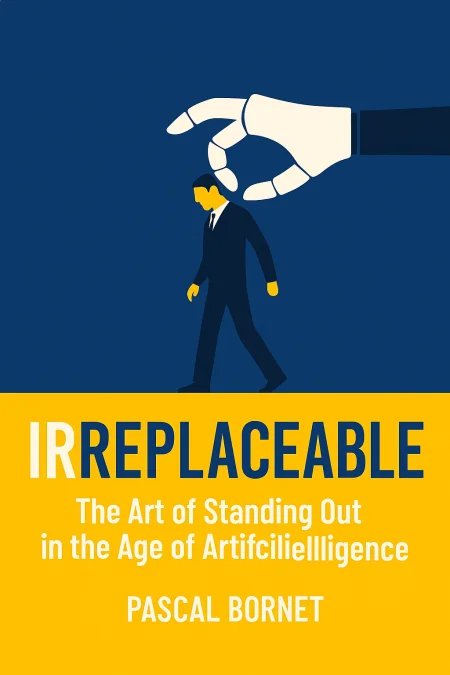
IRREPLACEABLE
The Art of Standing Out in the Age of Artificial Intelligence
Book Edition Details
Summary
In a world hurtling toward an AI-driven future, Pascal Bornet, a luminary in technology and human ingenuity, reveals a manifesto for flourishing amidst automation. "IRREPLACEABLE" challenges us to reimagine our coexistence with intelligent machines, spotlighting the irreplicable essence of human creativity and adaptability. Bornet unveils the Three Competencies of the Future, vital for navigating this brave new world. From harnessing AI to amplify your career without succumbing to obsolescence, to nurturing children with skills that transcend technology, this guide offers an arsenal of strategies to sidestep the pitfalls of "AI Obesity" and catalyze innovation. Perfect for forward-thinking individuals and visionary leaders, this book is your compass in an era where AI is the vehicle—not the destination—to a more human-centric world. Become IRREPLACEABLE, and discover how to thrive where technology meets humanity.
Introduction
Imagine waking up one morning to find that your smartphone has learned your daily routines so well that it starts making decisions for you—what to eat, whom to call, even which route to take to work. At first, this feels like magic, a glimpse into a future where technology anticipates our every need. But as days pass, you begin to notice something unsettling: you're no longer making choices; the choices are being made for you. This scenario isn't science fiction—it's happening now, subtly and gradually, as artificial intelligence weaves itself deeper into the fabric of our daily lives. We find ourselves at a crossroads where technology promises unprecedented convenience while simultaneously threatening something far more precious: our humanity, our uniqueness, our irreplaceable nature. The author of this transformative guide spent over two decades implementing AI projects across the globe, witnessing firsthand both the extraordinary potential and the hidden dangers of our AI-driven future. Through countless interactions with millions of followers and speaking engagements worldwide, he discovered a troubling pattern: people everywhere are grappling with the same fundamental question—how do we remain human in an increasingly artificial world? This book emerges from those conversations, offering not just survival strategies but a blueprint for thriving in the age of AI. You'll discover how to harness technology's power while preserving what makes you uniquely human. More importantly, you'll learn to become truly irreplaceable—not by competing with machines, but by doubling down on the qualities that no algorithm can replicate: genuine creativity, critical thinking, and authentic human connection.
The IRREPLACEABLE Imperative: Understanding AI's True Impact
Picture this: You're standing in an airport, holding boarding passes for you and your family, watching the gate agent scan empty seats on a plane that hasn't yet departed. Despite being just feet away from the boarding gate, having been visible to the crew throughout your wait, you're told the flight is closed because an automated door system detected no one in the queue. The human agent, capable of empathy and common sense, instead parrots the machine's decision: "The door is closed." This moment of frustration reveals a profound truth about our current relationship with technology. When humans become so intertwined with their systems that they lose their capacity for judgment and compassion, they've essentially made themselves redundant. The agent wasn't following protocol; she was surrendering her humanity to a machine's logic. Yet just days later, another encounter painted a different picture. At a Social Security office, facing a similar bureaucratic impasse, a different kind of human response emerged. The agent there saw beyond the rigid rules, understood the human story behind the request, and found a way to help—bending protocol not out of rebellion, but out of recognition that serving humanity sometimes requires more than following algorithms. These contrasting experiences illuminate the central challenge of our time: as AI becomes more sophisticated and ubiquitous, our human qualities become either more valuable or completely obsolete, depending on how we choose to engage with this transformation. The first agent had already been replaced by her machine; she just hadn't realized it yet. The second agent demonstrated what it means to be irreplaceable—bringing uniquely human insight to situations where pure logic falls short. The imperative is clear: we must consciously choose to amplify our humanity rather than diminish it, to become more distinctly human rather than more machine-like, if we hope to remain relevant in an AI-dominated future.
Building Human-AI Synergy: Skills for the Future
In 2005, a fascinating chess tournament brought together an unlikely mix of competitors: supercomputers, grandmasters, and amateur players paired with modest desktop computers. The results shattered conventional wisdom about human versus machine capability. While the human-AI teams predictably outperformed solo humans, what stunned everyone was that they also defeated the standalone supercomputers. Most remarkable of all, the ultimate winners weren't seasoned grandmasters with high-end technology, but two ordinary chess enthusiasts working alongside modest computers. This tournament revealed a profound principle that extends far beyond chess: the most powerful force in our technological age isn't human versus machine, but human with machine. The winning teams didn't try to match the computers' tactical calculations. Instead, they leveraged distinctly human strategic thinking—intuition, pattern recognition, and strategic foresight—that the AI couldn't replicate. Consider Maya, a software developer who discovered this principle firsthand. Initially focused on mastering technical skills like coding and debugging, Maya decided to invest in developing what this book calls the "Humics"—genuine creativity, critical thinking, and social authenticity. As she deepened her problem-solving abilities and enhanced her adaptability in team dynamics, something remarkable happened. She began designing cross-platform innovations that worked seamlessly across devices, became an agile leader capable of motivating diverse development teams, and created user-centric software that anticipated needs rather than just responding to them. Maya's transformation illustrates a counterintuitive truth: in an age where AI excels at technical execution, our competitive advantage lies not in becoming more machine-like, but in becoming more distinctly human. While AI can process data and identify patterns, it cannot replicate the emotional intelligence that builds trust, the creative insight that solves unprecedented problems, or the authentic leadership that inspires teams to achieve the impossible. The secret isn't competing with AI's strengths—its speed, accuracy, and computational power—but complementing them with our irreplaceable human capabilities. This synergy creates what mathematicians might call a multiplier effect, where one plus one equals three.
Becoming IRREPLACEABLE at Work and Life
Three friends faced the same challenge—learning to work with AI—but their approaches revealed three distinctly different destinies. Alex, the cautious traditionalist, viewed AI with suspicion and clung to time-tested methods. When drought threatened the community gardens, Alex's old-school approach faltered while AI-enhanced systems thrived elsewhere. Fear of technology didn't just limit Alex's efficiency; it isolated her from an increasingly connected world. Kiran represented the opposite extreme. Embracing AI with uncritical enthusiasm, she delegated everything from email filtering to family scheduling to algorithmic systems. But when a digital assistant's limitations caused important messages to be misfiled and family schedules to collapse, Kiran found herself enslaved by the very tools meant to liberate her. Her overdependence had created a different kind of vulnerability. Then there's Rishi, the inventive chef who found the golden mean. She used AI-powered cooking apps for inspiration but always added her personal touch, combining data-driven suggestions with intuitive understanding of flavors and ingredients. "Technology brings the ingredients together," Rishi explained, "but the heart makes the meal." When systems failed or suggested something inappropriate, she adapted seamlessly, using AI as a sophisticated sous chef rather than a replacement for her culinary judgment. Rishi's approach embodies what it means to be irreplaceable in the AI age. She demonstrates that mastery comes not from avoiding technology or surrendering to it, but from creating a dynamic partnership where human insight guides artificial capability. Her meals weren't just more delicious than purely AI-generated recipes; they carried the story, emotion, and cultural understanding that no algorithm could provide. This principle extends beyond the kitchen to every aspect of modern work and life. Whether you're analyzing data, creating content, or solving complex problems, the path to irreplaceability lies in using AI to amplify your uniquely human strengths rather than replace them. The future belongs not to those who fear change or those who embrace it blindly, but to those who dance skillfully with both human wisdom and artificial intelligence.
Leading Organizations in the AI Era
When 190-year-old John Deere decided to embrace AI transformation, skeptics wondered if such an established company could reinvent itself for the digital age. The agricultural giant faced a world where farming needed to become more efficient, sustainable, and precise, yet their success would ultimately depend on maintaining their connection to the farmers they served. Rather than simply automating existing processes, John Deere took a different approach. They acquired Blue River Technology for $305 million, gaining not just advanced AI capabilities but also a team of skilled engineers who understood how to blend human expertise with machine learning. The result was revolutionary: smart tractors and harvesters that could analyze real-time data on soil conditions, crop health, and weather patterns, then provide insights to help farmers make better decisions. But here's what made John Deere truly irreplaceable in the AI era: they designed these systems as partners, not replacements. A farmer's decades of experience reading land conditions, understanding local weather patterns, and knowing when crops were ready for harvest remained central to every decision. The AI provided data and suggestions; the farmer provided wisdom, intuition, and final judgment. The transformation paid off dramatically. John Deere's stock price increased by 400% since 2016, but more importantly, they helped farmers reduce chemical usage by up to 90% while improving crop yields. They achieved this by ensuring that every innovation respected the irreplaceable value of human expertise while leveraging AI's computational power. This success story reveals a crucial principle for any organization navigating the AI revolution: technology alone never determines success. Companies thrive when they use AI to amplify human capabilities rather than replace them, when they maintain the emotional intelligence that builds customer trust, and when they preserve the creative problem-solving that drives innovation. John Deere didn't just digitize farming; they humanized technology, ensuring that every algorithm served the deeper purpose of helping people feed the world more sustainably. The lesson for leaders is clear: becoming an irreplaceable organization in the AI era requires more than implementing advanced technology—it demands the wisdom to know when human judgment matters most.
Summary
In a world racing toward artificial intelligence, the greatest risk isn't that machines will become too powerful, but that we'll become too much like them. The stories throughout this exploration reveal a fundamental truth: our irreplaceable value lies not in competing with AI's computational strength, but in embracing the distinctly human qualities that no algorithm can authentically replicate. The chess tournament where amateur humans with modest computers defeated supercomputers, the chef who transformed AI suggestions into meals infused with heart and culture, the farmer whose wisdom guided smart tractors toward sustainable abundance—these stories illuminate the same principle. Our future success depends on creating partnerships with AI that amplify our humanity rather than diminish it. The path forward requires three essential competencies: becoming AI-Ready by learning to collaborate effectively with artificial intelligence, becoming Human-Ready by developing our capacities for genuine creativity, critical thinking, and authentic connection, and becoming Change-Ready by building the resilience and adaptability needed to thrive in an accelerating world. Most importantly, we must remember that being irreplaceable isn't about perfection or superiority—it's about authenticity. In a world of artificial intelligence, authenticity becomes the ultimate competitive advantage. When we bring our full humanity to our partnership with AI—our stories, emotions, ethical judgment, and capacity for love—we create value that no machine can replicate and no algorithm can replace. The future belongs not to those who resist change or surrender to it, but to those who dance skillfully between human wisdom and artificial capability, remaining irreplaceably, authentically, and courageously human.
Related Books
Download PDF & EPUB
To save this Black List summary for later, download the free PDF and EPUB. You can print it out, or read offline at your convenience.
By Pascal Bornet
