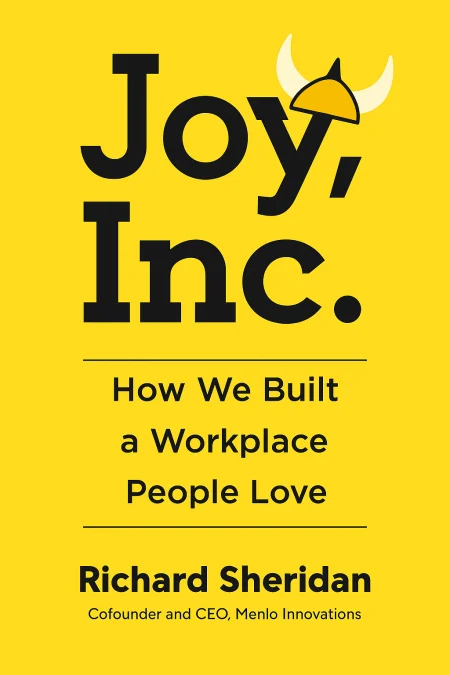
Joy Inc.
How We Built a Workplace People Love
Book Edition Details
Summary
In the heart of Ann Arbor, where software dreams come alive, Menlo Innovations defies the conventional workplace mold. This isn’t just a tech hub; it’s a playground of possibility, where joy is the driving force. Led by Rich Sheridan, a visionary with a knack for storytelling, Menlo has dismantled the fear-laden office culture to craft a vibrant ecosystem of creativity and collaboration. Picture a realm where mistakes fuel growth, teamwork reigns supreme, and the pursuit of happiness isn't just encouraged—it's mandatory. "Joy, Inc." is your backstage pass to this revolutionary environment, offering a blueprint for transforming any organization into a haven of positivity and productivity. Dive into Sheridan’s world to discover how fostering openness and dignity can lead to remarkable success, both in spirit and in the marketplace. For anyone yearning for a workplace that thrives on enthusiasm and ingenuity, this is your guide to crafting a culture where joy is the ultimate KPI.
Introduction
Picture this: It's Monday morning, and instead of the familiar dread creeping into your stomach, you feel a genuine excitement about walking into your office. The space buzzes with collaborative energy, laughter punctuates serious conversations about meaningful work, and when 6 PM rolls around, you leave feeling energized rather than drained. This isn't a fantasy—it's the daily reality at a software company in Ann Arbor, Michigan, where hundreds of visitors travel from around the world just to witness what joy at work actually looks like. Most of us have resigned ourselves to the belief that work is simply something we endure to fund the life we actually want to live. We've accepted that bureaucracy, fear-based management, and soul-crushing processes are inevitable parts of professional life. But what if everything we've been told about how businesses must operate is wrong? What if there's a way to create organizations where people genuinely love coming to work, where quality soars, and where profits follow naturally from human fulfillment? This transformation didn't happen overnight, nor did it come from following conventional business wisdom. Instead, it emerged from a radical reimagining of fundamental assumptions about leadership, space, collaboration, and what it means to put human dignity at the center of how we work together. The lessons learned along this journey offer a blueprint for any organization ready to choose joy over the status quo.
From Death Marches to Joy: The Journey of Cultural Transformation
At thirteen years old, Rich Sheridan fell in love with a machine. Sitting at a Teletype terminal in his high school computer lab, he typed two simple lines of code that made the computer respond with "HI RICH." In that moment, he knew he'd found his calling—he would be a software artist, creating digital sculptures that would delight users around the world. For years, this passion sustained him through college and into a successful corporate career, climbing from programmer to vice president while his stock options soared into the millions. But by his forties, that bright flame had dimmed to barely glowing embers. The industry he loved had become a nightmare of death marches, all-nighters, and products so poorly designed that entire industries normalized the phrase "stupid users." Projects were routinely canceled after consuming millions of dollars and destroying team morale. The very technology meant to improve human life had become a source of suffering for both creators and users. Sheridan found himself dreading work, taking long drives on country roads just to delay his arrival at the office, where he'd spend half his day playing computer solitaire. The breaking point came during a promotion offer that should have been the pinnacle of success. Initially rejecting the VP role, Sheridan realized he had a choice: surrender to cynicism or fight to reclaim the joy that first drew him to technology. That decision led him to discover Extreme Programming and witness a video about IDEO's collaborative workspace, sparking an experiment that would transform not just his team, but eventually inspire thousands of organizations worldwide. When passion dies in the workplace, we often blame external circumstances—difficult clients, impossible deadlines, or incompetent leadership. But the real tragedy occurs when we stop believing that work can be a source of meaning and satisfaction. The journey back to joy requires the courage to question everything we've accepted as inevitable about how organizations must function, and the persistence to rebuild from the ground up with human dignity as the foundation.
Pairing, Space, and Humanity: The Foundations of Joyful Work
The first time visitors walk into Menlo Innovations, they often stop in stunned silence. Gone are the familiar cube farms and closed-door offices. Instead, they see a wide-open factory floor where pairs of people sit side by side at simple tables, engaged in animated conversations about their work. Colorful yarn stretches across walls covered with hand-drawn papers, while a disco ball hangs from the twenty-foot ceiling. The energy is palpable, the noise of collaboration constant, and somehow, despite what seems like chaos, serious software development is clearly happening. The most radical element isn't the space itself, but how people work within it. Every team member works in pairs, switching partners weekly, sharing one computer between two people. To traditional managers, this seems like paying two people to do one job—surely the height of inefficiency. Yet this pairing system eliminates the towers of knowledge that cripple most organizations, ensures that vacation requests are never denied, and creates a learning environment where expertise spreads organically throughout the team. When Tracy brought her newborn daughter Maggie to work every day for four months, skeptics worried about productivity and professionalism. Instead, they discovered that babies and dogs in the workplace created an atmosphere of humanity that made client meetings more civil and reminded everyone that work exists to support life, not consume it. The team's offer to hold Maggie when she cried revealed something profound about what happens when an organization truly embraces the whole person. Physical space shapes human behavior in ways we rarely acknowledge. Isolated cubicles with high walls don't just prevent distractions—they prevent the serendipitous conversations that spark innovation. When we design workplaces around fear and control rather than trust and collaboration, we get exactly what we design for: fearful, controlled workers who do the minimum required. But when we create spaces that honor human dignity and our fundamental need for community, extraordinary things become possible.
Making Mistakes Faster: How Fear-Free Innovation Drives Results
Jenny, a hospital contract administrator, was furious when she learned that Menlo's programmers worked two to a computer. "I understand your people work in pairs," she said accusingly during an emergency meeting. "I'm not paying for both of these people!" The confrontation came during their work on a patient information system for transplant surgery, and her demand to stop pair programming immediately seemed non-negotiable. Sheridan's response was simple and devastating: "We work in pairs for the same reason your hospital does. Your daughter's life was at stake during her recent surgery, which is why surgeons showed up as a pair, along with pairs of anesthesiologists and nursing teams. For the system we're building, if we get something as basic as tissue type wrong for a transplant, we might kill the patient. We believe people's lives are at stake if we don't have that type of discipline and quality checking as well." The conversation about pairing never came up again, but more importantly, it revealed a fundamental truth about organizational fear. When we manufacture artificial fear as a management tool, we create systems where bad news goes underground and small problems fester into catastrophic failures. The space shuttle Challenger explosion, Knight Capital's $400 million software error, and countless canceled projects all share a common thread: cultures where admitting problems carried greater risk than hiding them. At Menlo, the motto "Make Mistakes Faster" isn't about celebrating failure—it's about creating psychological safety that allows teams to surface problems while they're still small and fixable. When estimation goes wrong, there's no punishment, only learning. When experiments fail, the focus shifts immediately to what can be learned rather than who can be blamed. This isn't permissiveness; it's recognition that innovation requires taking risks, and sustainable risk-taking only happens when people feel safe. Fear is the invisible killer of organizational potential. When teams operate from fear, blood flows away from the creative centers of the brain toward fight-or-flight responses. But when we systematically remove manufactured fear and replace it with trust, we unlock human capacity that most organizations never even glimpse.
Scaling Joy: Building Sustainable Systems That Put People First
Most businesses eventually face what seems like an impossible choice: grow and lose the culture that made success possible, or stay small and limit their impact on the world. Traditional scaling approaches focus on systems, processes, and hierarchies—the very things that often drain joy from organizations as they expand. But what if there was a way to scale the human elements that create extraordinary cultures, making them stronger rather than weaker as organizations grow? When Menlo needs to double the speed on a project, they don't ask existing team members to work overtime or scramble to hire specialists who might take months to become productive. Instead, they simply pull over more tables and computers, assign additional pairs who have already rotated through the project, and continue working. Because everyone shares the same foundational practices and no one owns particular pieces of code, scaling up or down becomes as natural as rearranging furniture. This breaks what the software industry calls Brooks's Law—the assumption that adding people to late projects only makes them later. The secret lies in building systems that inherently create capacity rather than consume it. Weekly pair rotation means the team constantly practices onboarding new members to projects. Shared coding standards and automated testing ensure that knowledge doesn't disappear when people leave. Most importantly, the entire culture is built around teaching and learning rather than hoarding expertise, so growth actually strengthens the organization's collective capability. Perhaps the most radical element is Menlo's "leveraged play" strategy, where they defer up to 50% of their fees in exchange for equity in client companies. This aligns everyone's interests around creating products that users genuinely love rather than simply completing contracted features. When Accuri Cytometers sold for $205 million, every Menlo employee received substantial bonuses—but Tracy later said the peer-driven promotion she'd received that same week meant more than the money. True scalability isn't about finding ways to extract more output from the same inputs. It's about creating systems that multiply human potential rather than diminish it. When we build organizations around trust, learning, and shared purpose, growth becomes an opportunity to amplify joy rather than a threat to what makes work meaningful. The question isn't whether joy-centered cultures can scale—it's whether we have the courage to challenge every assumption about how organizations must function as they grow.
Summary
The transformation of Menlo Innovations reveals a profound truth: the choice between profitability and human dignity is a false dilemma created by outdated assumptions about how work must function. When we design organizations around trust rather than control, collaboration rather than competition, and human flourishing rather than mere efficiency, we don't sacrifice results—we transcend what we believed was possible. The thousands of visitors who travel to witness Menlo's culture aren't seeking a feel-good story; they're desperate for proof that there's an alternative to the soul-crushing environments most of us have accepted as inevitable. The path forward begins with a single, radical act: deciding that joy at work isn't a luxury but a necessity, not just for individual fulfillment but for organizational excellence. This requires the courage to run small experiments that challenge conventional wisdom, the patience to build systems that honor human dignity, and the persistence to keep choosing trust over fear even when it feels risky. Whether you're a CEO ready to tear down walls or a team member determined to bring more humanity to your corner of the organization, the journey starts with refusing to accept that work must be something we endure rather than something that energizes us. The most remarkable discovery from Menlo's experiment isn't that joy and profit can coexist—it's that they're actually interdependent. When people feel safe, valued, and connected to meaningful purpose, they don't just work harder; they work with a creativity and commitment that no amount of fear-based motivation can generate. The organizations that embrace this truth won't just survive the future of work—they'll define it.
Related Books
Download PDF & EPUB
To save this Black List summary for later, download the free PDF and EPUB. You can print it out, or read offline at your convenience.
By Richard Sheridan
