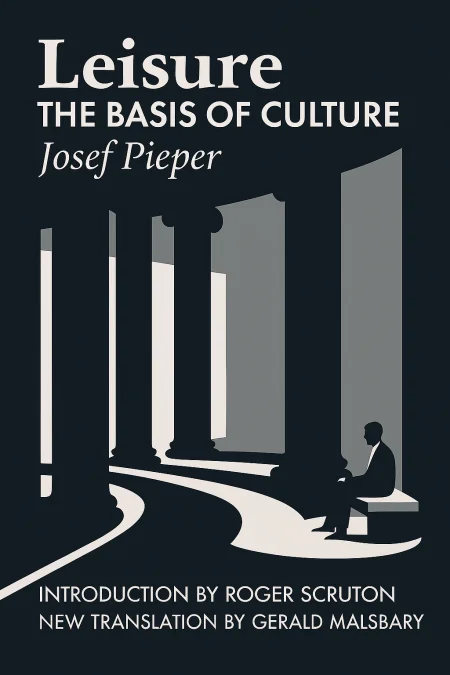
Leisure
The Basis of Culture
byJosef Pieper, Roger Scruton, Gerald Malsbary
Book Edition Details
Summary
In a whirlwind of relentless productivity, Josef Pieper's "Leisure: the Basis of Culture" dares to halt time, urging readers to reconsider the sacred art of doing nothing. Unveiling a forgotten truth cherished by the ancients and medieval minds alike, Pieper casts leisure not as idleness, but as a vital wellspring of culture, spirituality, and profound thought. His essays dismantle the modern obsession with ceaseless labor, issuing a clarion call to reclaim our collective humanity through the lost grace of contemplative silence. As we teeter on the brink of a cultural abyss, this timeless manifesto is more than a book—it's an urgent invitation to rediscover the profound power in pausing, and the transformative potential of leisure.
Introduction
Modern society operates under a fundamental misconception about the nature of human fulfillment and intellectual life. The prevailing assumption that productivity, utility, and constant activity represent the highest human achievements has created what might be termed a "world of total work" - a realm where every aspect of existence must justify itself through measurable output and social function. This worldview has systematically eroded the foundations upon which genuine culture and philosophical inquiry have historically rested. The challenge to this mechanistic understanding emerges through an exploration of leisure, not as mere rest or entertainment, but as a distinct mode of human being that transcends utilitarian calculation. Philosophical reflection, authentic contemplation, and cultural creation all depend upon a capacity for receptive openness to reality - a stance fundamentally opposed to the aggressive manipulation of the world for predetermined ends. Through careful analysis of the medieval distinction between liberal and servile arts, the nature of wonder as philosophy's source, and the essential role of divine worship in sustaining genuine celebration, a compelling case emerges for recovering dimensions of human experience that industrial modernity has largely abandoned.
The Nature of Leisure Against the World of Total Work
The contemporary understanding of leisure as merely recuperation from work represents a profound inversion of the classical hierarchy of human activities. Leisure, properly conceived, constitutes not the absence of activity but rather a fundamentally different mode of being - one characterized by contemplative receptivity rather than productive manipulation. This distinction reveals itself most clearly when contrasted with what has emerged as the "world of total work," where every human capacity must demonstrate its utility within a comprehensive system of production and consumption. The classical tradition, reaching back through Aquinas to Aristotle, maintained that genuine human flourishing required space for activities that serve no purpose beyond themselves. The liberal arts - literally the "free" arts - were distinguished from servile work precisely because they aimed not at satisfying material needs but at the full development of human capacities for understanding and celebration. Modern society has systematically collapsed this distinction, reducing even intellectual activity to "work" and scholars to "intellectual workers" whose value derives from their functional contribution to social productivity. This reduction manifests most clearly in the contemporary treatment of knowledge itself. Where the medieval understanding recognized both discursive reasoning (ratio) and intuitive contemplation (intellectus) as essential components of human knowing, modern epistemology has increasingly privileged active, analytical thought over receptive awareness. Knowledge becomes purely the product of human effort rather than a response to reality's self-disclosure. The implications extend far beyond academic philosophy, affecting how society values different forms of human activity and ultimately determining what kinds of human beings we aspire to become. The world of total work necessarily excludes genuine leisure because it cannot accommodate activities whose value transcends immediate utility. Where everything must serve the satisfaction of collective needs, there remains no protected space for the superfluous, the celebratory, or the purely contemplative. Yet without such space, human culture withers into mere efficiency, and the deepest questions about existence remain unasked.
Philosophy as Transcendence Beyond Utilitarian Existence
Philosophical inquiry represents perhaps the most radical challenge to utilitarian assumptions because it asks questions that cannot be answered within the framework of practical problem-solving. When genuine philosophical wonder arises - the fundamental astonishment that there is something rather than nothing - it shatters the comfortable boundaries of everyday calculation and forces attention toward the mystery of existence itself. Such questioning serves no immediate social function and produces no measurable outcomes, yet it addresses what is most essential to human beings as rational creatures capable of grasping universal truths. The incommensurability between philosophical activity and the world of work becomes evident when one imagines philosophical questions erupting into contexts dominated by practical concerns. The merchant focused on profit margins, the technician absorbed in procedural efficiency, the administrator organizing social functions - none of these legitimate activities creates space for fundamental questioning about the nature of justice, beauty, or being itself. Yet such questioning represents the distinctively human capacity to transcend environmental limitations and encounter reality as a totality rather than merely as a collection of useful resources. Philosophy shares this transcendent character with other fundamental human activities: authentic poetry, genuine religious devotion, profound love, and the confrontation with mortality. All of these experiences pierce through the dome of conventional assumptions and reveal dimensions of existence that cannot be reduced to practical utility. Their family resemblance explains why totalitarian systems inevitably suppress not only philosophy but also art, religion, and any form of love that transcends service to collective goals. The freedom that philosophy requires is not the mere absence of external constraints but rather the positive capacity to orient oneself toward truth for its own sake rather than for any ulterior purpose. This "uselessness" of philosophy represents not a deficiency but its essential dignity as a liberal art - an activity worthy of free persons precisely because it serves no master other than reality itself. Such freedom becomes impossible within systems that demand total mobilization of human resources for predetermined social objectives, revealing why the crisis of philosophy coincides with the emergence of thoroughly administered societies.
Wonder as the Essential Structure of Philosophical Inquiry
The capacity for wonder represents the distinctively human response to encountering reality as mysterious rather than merely problematic. While problems call for solutions and difficulties demand technical intervention, mystery evokes a receptive attentiveness that allows beings to manifest themselves according to their own nature rather than according to human purposes. This contemplative stance makes possible both philosophical insight and authentic cultural creation, neither of which can be produced through willful effort alone. Wonder differs fundamentally from curiosity or puzzlement because it arises not from ignorance that seeks information but from a deepening awareness of the inexhaustible richness of what appears most familiar. The philosopher does not turn away from ordinary things toward some special realm of abstractions but rather sees ordinary things - justice, friendship, knowledge, beauty - as infinitely more profound than conventional usage suggests. This transformation of perspective cannot be manufactured through methodological techniques but emerges spontaneously when the mind achieves the proper receptive orientation toward reality. The structure of wonder mirrors the structure of hope in its combination of present awareness and future orientation. The person who wonders neither possesses complete understanding nor despairs of ever achieving it, but remains actively engaged with questions that exceed any final answer. This ongoing character distinguishes philosophical inquiry from scientific investigation, which aims at definitive solutions to specific problems. Philosophical questions can never be definitively closed because they concern the essential nature of reality itself, which remains mysterious not due to current limitations of knowledge but because of its intrinsic inexhaustibility. Modern philosophy has tended to interpret wonder primarily as doubt, emphasizing the negative moment of recognizing the inadequacy of conventional beliefs. Yet authentic wonder is fundamentally affirmative, representing a joyful recognition of reality's richness rather than skeptical dissolution of apparent certainties. The person who truly wonders experiences not the anxiety of groundlessness but the excitement of discovery, finding in the world's mystery an invitation to deeper understanding rather than a cause for despair. This positive character of wonder explains why philosophy has historically been associated with celebration rather than with the grim determination characteristic of merely technical thinking.
Christian Philosophy and the Theological Foundation of Wisdom
The relationship between philosophical inquiry and religious tradition reveals itself most clearly in the recognition that every genuine philosophy presupposes some prior interpretation of reality as a meaningful whole. The great philosophical traditions have never emerged from purely autonomous reason but have developed in dialogue with received wisdom about the fundamental character of existence. This dependence does not compromise philosophy's integrity but rather provides the existential foundation without which purely abstract thinking remains sterile and disconnected from lived human concerns. Christian philosophy exemplifies this relationship in particularly clear form because Christianity offers not merely a set of doctrines but a comprehensive vision of reality as created, fallen, and redeemed. This theological framework does not provide ready-made answers to philosophical questions but rather opens dimensions of existence that purely naturalistic approaches cannot adequately address. The recognition of reality as gift rather than mere factuality, the acknowledgment of evil as genuine corruption rather than mere limitation, the hope for ultimate fulfillment beyond natural capacities - these theological insights expand rather than constrain the scope of philosophical reflection. The claim that Christian philosophy achieves greater truthfulness than alternatives rests not on privileged access to supernatural information but on its willingness to acknowledge the full range of human experience, including those dimensions that resist reduction to manageable categories. The mystery that theology recognizes in reality corresponds to the inexhaustibility that philosophical wonder encounters in the most ordinary phenomena. Rather than simplifying the philosopher's task, theological awareness complicates it by preventing premature closure and demanding continued openness to what exceeds systematic comprehension. This theological dimension does not eliminate philosophy's autonomy but rather establishes the proper context within which autonomous thinking can flourish. Just as leisure requires protection from the totalitarian claims of work, philosophical reflection requires protection from the reductionist pressures of purely secular rationality. The recognition that human reason participates in divine wisdom provides the metaphysical foundation for maintaining both philosophy's dignity as more than mere problem-solving and its humility as less than comprehensive system-building. Within this framework, the love of wisdom can pursue its proper object without either despairing of truth or claiming to possess it absolutely.
Summary
The fundamental insight emerging from this analysis concerns the indispensable role of non-utilitarian dimensions of human existence in sustaining both individual flourishing and cultural vitality. The capacity for leisure, wonder, and contemplative openness to reality represents not a luxury that productive societies can afford after meeting basic needs but rather the foundation upon which genuine human culture necessarily rests. Without protected space for activities that serve no purpose beyond themselves, human beings inevitably lose touch with those aspects of existence that make life worth living and thinking worth pursuing. The recovery of this understanding requires not merely intellectual assent but the practical cultivation of habits of receptive attention that allow reality to disclose itself according to its own nature rather than according to human designs for mastery and control.
Related Books
Download PDF & EPUB
To save this Black List summary for later, download the free PDF and EPUB. You can print it out, or read offline at your convenience.
By Josef Pieper
