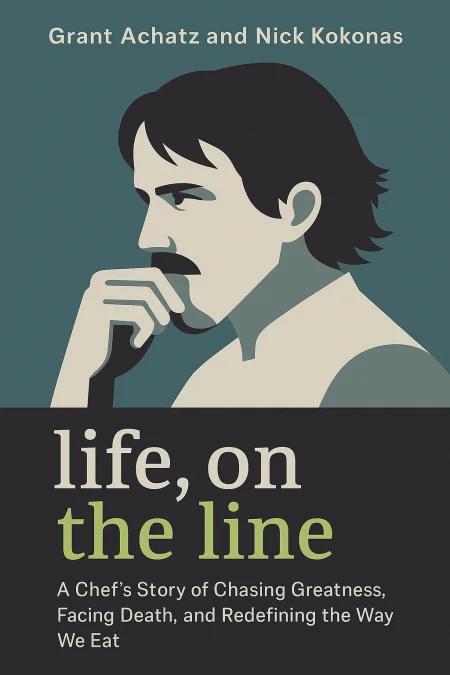
Life, on the Line
A Chef’s Story of Chasing Greatness, Facing Death, and Redefining the Way We Eat
Book Edition Details
Summary
Amid the dazzling lights of the culinary world, where fame and flavor dance together, Grant Achatz carved his name into the annals of gastronomy. At the peak of his career, having dazzled the elite with Alinea's groundbreaking dishes, Achatz faced a terrifying diagnosis—stage IV tongue cancer. Stripped of his ability to taste, he stood on the brink of losing everything that defined him. Yet, in the crucible of adversity, a tale of resilience and reinvention simmered. With sheer determination and a chef's relentless pursuit of perfection, Achatz trained his team to be his taste buds, orchestrating flavors with an artistry that defied logic. "Life, on the Line" is a stirring testament to human tenacity, the boundless creativity that emerges from constraint, and the profound bonds forged in kitchens that double as battlegrounds. Witness the extraordinary journey of a chef who refused to let fate dictate his menu.
Introduction
In the gleaming kitchen of Alinea, where liquid nitrogen creates ethereal clouds and edible helium balloons float above astonished diners, Grant Achatz represents the ultimate triumph of vision over circumstance. At thirty-two, this Michigan native had already revolutionized American fine dining, transforming a simple restaurant concept into what critics declared the nation's most innovative culinary experience. Yet his greatest victory would come not from James Beard Awards or four-star reviews, but from a battle that threatened to destroy the very essence of his identity as a chef—his ability to taste. Achatz's journey from his family's humble diner to the pinnacle of molecular gastronomy reveals the anatomy of creative genius forged under extraordinary pressure. His story demonstrates how true innovation emerges from the marriage of relentless technical mastery and the courage to completely reimagine what's possible. Through his remarkable evolution, readers will discover how a small-town cook developed an uncompromising vision for culinary excellence, how he learned to balance creative risk-taking with business acumen, and how personal adversity became the catalyst for his most profound contributions to the culinary arts. His path illuminates the price of perfectionism, the power of collaborative leadership, and the transformative potential that emerges when someone refuses to accept conventional limitations in pursuit of an impossible dream.
Foundation Years: From Small-Town Diner to Culinary Excellence
Grant Achatz's culinary awakening began in the most unlikely of places—his family's modest diner in St. Clair, Michigan, where the young boy learned to crack eggs and flip pancakes before he could properly reach the stove without standing on a milk crate. While other children played video games, Grant found himself drawn to the rhythmic dance of the kitchen, absorbing lessons about hospitality and the profound satisfaction that comes from nourishing people. The diner wasn't glamorous, with its worn equipment and simple menu, but it provided the foundational understanding that great cooking begins with caring for others and attention to detail, no matter how humble the setting. His transformation accelerated dramatically when he enrolled at the Culinary Institute of America, where instructors quickly recognized an unusual intensity in his approach to learning. Unlike peers who viewed culinary school as job training, Achatz treated every lesson as a revelation, filling notebooks with detailed observations about flavor combinations, cooking methods, and the science behind culinary transformations. His brief stint at Charlie Trotter's legendary Chicago restaurant, though challenging, opened his eyes to the theatrical possibilities of fine dining and the meticulous standards required at the highest levels of the profession. The defining moment of his early career came when Thomas Keller offered him a position at The French Laundry in California's Napa Valley. Under Keller's demanding tutelage, Achatz discovered that cooking could be elevated to pure art form, where every element on the plate served a purpose beyond mere sustenance. He learned to see food as a medium for storytelling and emotional connection, absorbing Keller's philosophy that perfection wasn't accidental but the result of relentless attention to detail and unwavering commitment to excellence. The French Laundry experience fundamentally shaped Achatz's understanding of leadership and innovation. He observed how Keller balanced respect for classical techniques with creative evolution, never changing for change's sake but always pushing boundaries in service of a greater vision. These lessons in disciplined creativity would become the cornerstone of Achatz's own revolutionary approach, teaching him that true innovation must be built upon an unshakeable foundation of technical mastery and deep respect for the craft itself.
Revolutionary Vision: Innovation and Boundary-Breaking at Trio and Alinea
When Achatz took over the kitchen at Trio in suburban Evanston, he faced the ultimate test of transforming his culinary philosophy into reality. At twenty-six, with no experience running his own kitchen, he was determined to create something entirely unprecedented in American dining. His breakthrough came with dishes that seemed to defy the laws of physics—the Black Truffle Explosion, a ravioli that literally burst with truffle essence in diners' mouths, represented more than technical innovation; it was theater, surprise, and pure flavor combined into a single unforgettable moment that challenged every assumption about what food could be. The critical acclaim that followed, including four stars from the Chicago Tribune, validated Achatz's belief that American diners were hungry for experiences that engaged all their senses. His "pizza" course—a stamp-sized piece of edible paper that dissolved on the tongue while delivering concentrated pepperoni essence—demonstrated his unique ability to transform familiar flavors into revolutionary presentations. Each dish became a small revolution, incorporating aromatic elements, temperature contrasts, and unexpected textures that turned dining into participatory theater. The creation of Alinea in 2005 represented the ultimate manifestation of Achatz's vision, built in partnership with Nick Kokonas, whose business acumen perfectly complemented the chef's creative genius. Together, they rejected every convention of fine dining, from eliminating tablecloths to developing custom serviceware that turned each course into interactive art. The restaurant's design reflected Achatz's belief that dining should be transformative—electronic doors opened silently to reveal intimate chambers where guests embarked on four-hour culinary journeys encompassing thirty meticulously orchestrated courses. Perhaps most remarkably, Achatz insisted on constantly evolving the menu, refusing to rest on successful dishes while other restaurants built reputations on signature items. This commitment to perpetual innovation required enormous resources and risk but established Alinea as a destination unlike any other in the world. When Ruth Reichl named it America's number one restaurant just eighteen months after opening, the recognition validated not just Achatz's techniques but his fundamental belief that cuisine could be elevated to the level of high art while never losing sight of flavor as the ultimate goal.
Triumph Over Adversity: Cancer, Courage, and Culinary Legacy
In July 2007, at the absolute pinnacle of his success, Achatz received devastating news that would have destroyed a lesser person: stage four tongue cancer, with doctors recommending removal of most of his tongue and portions of his jaw. For a chef whose entire identity depended on his ability to taste, the diagnosis seemed like a death sentence not just for his body but for everything he had worked to achieve. The conventional treatment would leave him unable to speak clearly, swallow normally, or—most catastrophically—taste the food that had defined his life's work and revolutionary contributions to American cuisine. Rather than accept this grim prognosis, Achatz chose an experimental treatment path at the University of Chicago that prioritized preserving his tongue through aggressive chemotherapy and radiation. The decision required extraordinary courage, as the alternative treatment was newer, less proven, and carried severe risks of its own. For months, he endured treatments that left him barely able to function, his weight dropping precipitously as his body fought both the cancer and the cure, yet he made the remarkable choice to continue working at Alinea throughout his ordeal. Standing at the pass with a feeding tube protruding from his head, Achatz relied on his meticulously trained team to serve as his palate, trusting years of shared experience and rigorous standards to maintain the restaurant's excellence. His presence in the kitchen became a powerful symbol of determination and leadership under impossible circumstances, inspiring his staff to work harder than ever to preserve the vision he had created. The physical and emotional toll was enormous—he lost his hair, his skin became severely damaged from radiation, and simple acts like swallowing water became agonizing ordeals. When Achatz was declared cancer-free and his sense of taste gradually returned, his victory represented more than personal triumph—it marked a professional renaissance that elevated his status from innovative chef to cultural icon. The experience fundamentally changed his perspective on his craft, stripping away everything superficial to reveal essential truths about flavor, memory, and human connection. His post-cancer cooking displayed new emotional depth and resonance, while his continued innovations, including the revolutionary Next Restaurant concept, proved that his greatest contributions to culinary arts emerged not despite his adversity but because of his refusal to let circumstances define his limitations or diminish his impossible dreams.
Summary
Grant Achatz's extraordinary journey from small-town diner cook to global culinary revolutionary demonstrates that the highest form of creativity emerges not from comfort, but from the willingness to risk everything in pursuit of an impossible vision that challenges every conventional boundary. His story reveals that true leadership means inspiring others to exceed their own limitations, whether guiding a kitchen team through his cancer treatment or transforming diners' understanding of what food can accomplish beyond mere sustenance. Through his relentless pursuit of innovation built upon classical mastery, his courage in facing life-threatening illness while maintaining uncompromising professional standards, and his continued evolution as both artist and entrepreneur, Achatz embodies the transformative power of refusing to accept that limitations are permanent rather than simply obstacles to be creatively overcome. His legacy offers profound insights for aspiring leaders, creative professionals, and anyone facing seemingly insurmountable challenges: that our greatest contributions often emerge from our darkest moments, that innovation requires the courage to fail spectacularly in service of something greater than immediate success, and that the most extraordinary achievements come from maintaining insatiable curiosity about what might be possible when we dare to completely reimagine the boundaries of our chosen fields.
Related Books
Download PDF & EPUB
To save this Black List summary for later, download the free PDF and EPUB. You can print it out, or read offline at your convenience.
By Grant Achatz
