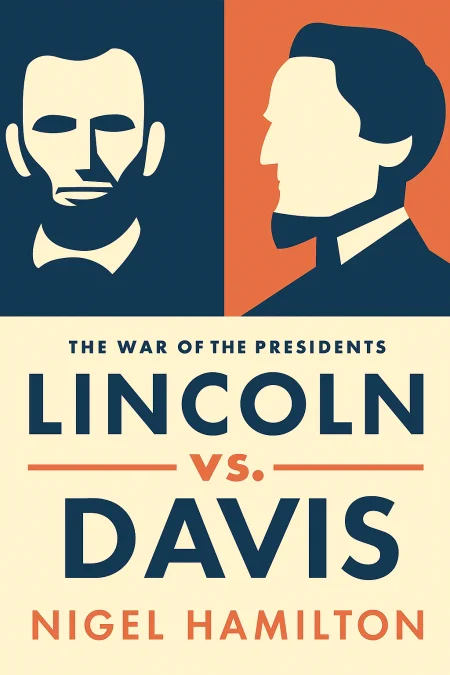
Lincoln vs. Davis
The War of the Presidents
Book Edition Details
Summary
In the crucible of a nation divided, two titans of leadership emerge with destinies intertwined. Nigel Hamilton's "Lincoln vs. Davis" paints a riveting tableau of the American Civil War through the eyes of its polar protagonists: Abraham Lincoln, a humble lawyer thrust into the whirlwinds of command, and Jefferson Davis, a seasoned soldier defending a fractured dream. Against the backdrop of a nation ablaze, Hamilton intricately weaves the narrative of a rail-splitter turned emancipator, whose audacious gamble on freedom reshaped the Union's fate. The book captures the strategic dance of these rivals, each maneuvering through a labyrinth of political machinations and military gambits. Rich with historical nuance and vivid character portraits, this dual biography unveils the personal and ideological battlegrounds that shaped America's identity, delivering a saga of courage, folly, and redemption that echoes through the ages.
Introduction
In the winter of 1861, two tall, melancholy men from Kentucky found themselves on a collision course that would reshape American history forever. Abraham Lincoln, the prairie lawyer turned politician, journeyed from Springfield to Washington to preserve a fracturing Union. Jefferson Davis, the West Point graduate and Mexican War veteran, reluctantly traveled from his Mississippi plantation to Montgomery to lead a newborn Confederacy. Born within months and miles of each other, these unlikely rivals would command opposing forces in the bloodiest conflict America had ever known. Their parallel struggles reveal how personal character, strategic miscalculations, and the moral weight of slavery transformed a political crisis into an epic battle for the nation's soul. Through intimate portraits of both presidents, we witness how two intelligent, principled leaders could make such similar mistakes about the very nature of their conflict. The story illuminates timeless questions about leadership under extreme pressure, the price of moral compromise, and how individual decisions can unleash forces beyond anyone's control. This dual biography offers fresh insights into America's defining moment for readers fascinated by presidential leadership, military strategy, and the human drama behind historical turning points. It reveals how the fog of war obscures not just battlefield conditions but the fundamental nature of conflict itself.
Two Presidents, Two Nations: The Path to War (1861)
The year 1861 opened with America balanced on a knife's edge, and two very different men preparing to claim leadership of what they believed to be their rightful nations. Lincoln's journey to Washington was marked by assassination threats and the humiliating need to travel in disguise through Baltimore, while Davis reluctantly accepted the Confederate presidency he never sought, viewing it as a burden rather than an honor. Both men understood that war was likely inevitable, yet neither fully grasped how their opponent would wage it. Lincoln, the consummate politician, struggled with military concepts and relied heavily on advisors whose loyalty was questionable. His Secretary of State William Seward actively undermined presidential authority while secretly negotiating with Confederate commissioners. Davis, by contrast, brought a soldier's clarity to his role, immediately focusing on coastal defense strategy and the capture of key fortifications like Fort Sumter. The fundamental tension lay not just in their different backgrounds, but in their opposing visions of American democracy. Lincoln saw the Union as indissoluble, a sacred compact that no state could abandon at will. Davis viewed it as a voluntary association that had become tyrannical, forcing the South to choose between submission and independence. Both men were conservatives by nature, yet circumstances would push them toward revolutionary actions that neither initially desired. Their wives embodied these same tensions. Mary Todd Lincoln's fierce ambition for the presidency contrasted sharply with Varina Howell Davis's private doubts about the Confederate cause. These personal dynamics would profoundly influence the decisions that followed, as both presidents navigated the treacherous waters between political necessity and moral conviction, setting the stage for the crisis that would soon engulf Fort Sumter.
Strategic Miscalculations and the Fog of War (1861-1862)
The crisis at Fort Sumter revealed both presidents at their most calculating and most vulnerable. Lincoln's month-long vacillation over the fortress exposed his inexperience with military command, while his cabinet split between those favoring evacuation and the few demanding a fight. Secretary Seward's secret negotiations promised Confederate commissioners that the fort would be surrendered, even as Lincoln privately planned its reinforcement through a complex web of deception. Davis pursued Fort Sumter not for symbolic reasons as commonly believed, but as the cornerstone of his coastal defense strategy. He needed the fortress intact to protect against Union amphibious invasion, understanding that control of key harbors would determine the Confederacy's survival. His appointment of General Beauregard to conduct the siege demonstrated strategic thinking, though he hoped to obtain the fort through intimidation rather than bombardment. The actual battle proved anticlimactic militarily but catastrophic politically. The Union fleet's failure to intervene exposed the government's military incompetence, yet Lincoln's immediate response transformed apparent defeat into political victory through his proclamation calling up 75,000 volunteers. This masterstroke united the North while inadvertently triggering Virginia's secession and expanding the very rebellion Lincoln sought to crush. The weeks following Fort Sumter plunged both presidents into what military theorists call the fog of war, where confusion and incomplete information led to decisions with far-reaching consequences. Lincoln's desperate pleas that he had no intention of bringing on war contrasted sharply with his public proclamations, while Davis found himself defending territory he had never intended to protect. These mutual misunderstandings would drive both sides toward a total war that neither had originally planned.
The Peninsula Campaign and Confederate Overreach (1862)
The Peninsula Campaign became a masterclass in how good intentions and weak leadership can produce catastrophic results. Lincoln's promotion of the charismatic George McClellan promised vigorous action but delivered only elaborate preparations and endless delays. Despite commanding vastly superior forces, McClellan allowed himself to be repeatedly deceived by Confederate ruses, spending a month preparing to assault largely empty fortifications at Yorktown. Lincoln's paralysis during this period revealed the dangerous gap between his moral instincts and his political courage. Though privately opposed to slavery, he continued to suppress any military commanders who dared make emancipation a war issue. When General David Hunter freed slaves in occupied territories, Lincoln swiftly countermanded the order. The president seemed determined to fight a war against a slave-based rebellion while pretending slavery didn't exist. Meanwhile, Jefferson Davis and Robert E. Lee experienced the intoxication of victory. Their brilliant defense of Richmond had not only saved the Confederate capital but demonstrated that Southern forces could outfight and outmaneuver their Northern counterparts. The success bred a dangerous overconfidence that would lead Davis to abandon his previously cautious defensive strategy in favor of Lee's aggressive vision of carrying the war into Union territory. The Peninsula Campaign's failure forced Lincoln to confront a harsh reality: you cannot defeat an enemy while refusing to acknowledge the source of their strength. Davis's success, paradoxically, tempted him toward the strategic overreach that would ultimately provide Lincoln with the crisis he needed to finally act on slavery. The stage was set for Lee's fateful invasion of Maryland.
Antietam's Aftermath: Emancipation Changes Everything (1862-1863)
Lee's invasion of Maryland in September 1862 represented the Confederacy's boldest gamble and greatest strategic error. Davis's decision to authorize Lee's offensive reflected both the confidence born of recent victories and a fundamental misunderstanding of the political dynamics that would determine the war's outcome. By abandoning the moral high ground of defensive warfare, the Confederacy handed its greatest weapon to its enemy. The invasion was premised on the belief that Marylanders would welcome Confederate liberation and that European powers stood ready to recognize Southern independence following another dramatic military success. Lee's proclamation to the people of Maryland, promising to free them from Northern tyranny, revealed the Confederate leadership's blindness to the irony of slaveholders posing as liberators. Lincoln's response to Lee's invasion demonstrated how crisis could crystallize political will. The preliminary Emancipation Proclamation of September 22, 1862, represented Lincoln's recognition that the war's moral dimension could no longer be ignored. By making emancipation a war aim, Lincoln transformed the conflict from a struggle over union into a crusade against slavery, making European intervention on behalf of the Confederacy politically impossible. The Battle of Antietam, while tactically inconclusive, proved strategically decisive because it provided Lincoln with the victory he needed to issue his proclamation. Davis's gamble had backfired spectacularly, forcing his opponent to play what Lincoln called his last card and fundamentally altering the war's character. The hundred days between the preliminary proclamation and its implementation would determine whether America would emerge from the crisis as one nation committed to freedom or remain forever divided by the institution of slavery.
Summary
The parallel presidencies of Lincoln and Davis illuminate how individual character and leadership style can shape historical outcomes in moments of supreme crisis. Lincoln's political instincts, his willingness to grow and adapt, and his ultimate moral courage enabled him to transform a war for union into a war for human freedom. Davis's military expertise and administrative competence served the Confederacy well in the war's early phases, but his inability to think politically about slavery and his susceptibility to the overconfidence bred by early success ultimately doomed his cause. The story offers profound lessons for contemporary leaders facing existential challenges. First, the willingness to acknowledge and learn from failure proves more valuable than early success built on flawed premises. Lincoln's painful education in military affairs and his eventual embrace of emancipation demonstrated how great leaders must be willing to abandon comfortable assumptions when reality demands change. Second, moral clarity, even when delayed, can provide the foundation for sustainable victory over opponents who mistake tactical brilliance for strategic wisdom. Finally, the ability to expand one's vision beyond immediate circumstances and embrace larger purposes can transform apparent defeat into ultimate triumph. These two presidents, born in the same state and shaped by similar hardships, remind us that leadership in crisis requires not just competence but the courage to grow beyond one's original limitations and confront the fundamental moral questions that define a nation's character.
Related Books
Download PDF & EPUB
To save this Black List summary for later, download the free PDF and EPUB. You can print it out, or read offline at your convenience.
By Nigel Hamilton
