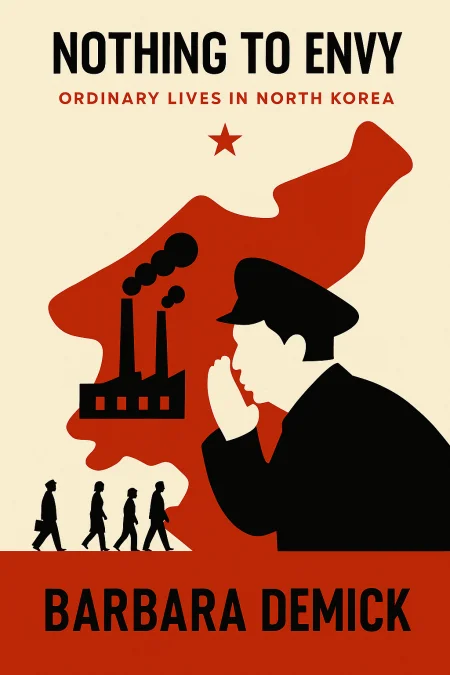
Nothing to Envy
Real Lives in North Korea
Book Edition Details
Summary
In a nation where every whisper could unravel a life, six North Koreans dare to dream amid the shadows of tyranny. "Nothing to Envy" by Barbara Demick peels back the iron curtains to reveal a world few outsiders have seen—a realm of forbidden loves, quiet rebellions, and a populace striving to survive under an oppressive regime. Through the vivid tapestry of personal stories, Demick captures the raw, human spirit against the backdrop of a brutal famine and the death of a dictator. Experience the intimate moments when loyalty turns to disillusionment, and survival becomes an act of silent defiance. This is not just a chronicle of hardship; it's a poignant reminder of the resilience and hope that flickers even in the darkest of places.
Introduction
In the darkness of North Korea's blackouts during the 1990s, young couples found unexpected freedom in the shadows, walking hand in hand through empty streets while their nation crumbled around them. This haunting image captures the profound human drama that unfolded as one of the world's most isolated societies faced its greatest crisis. Through the intimate stories of ordinary citizens from Chongjin, North Korea's industrial heartland, we witness how people navigated love, survival, and hope amid the collapse of everything they had been taught to believe. The famine years revealed the stark contradictions of a system that promised paradise while delivering devastation. Teachers watched their students starve while continuing to praise the Dear Leader. Doctors treated patients with beer bottles for IV drips. Market women discovered capitalism while living under communism's most rigid form. These personal accounts illuminate three critical questions: How do totalitarian systems maintain control even as they fail their people? What happens when ideology collides with the basic human need to survive? And how do individuals preserve their humanity when the state abandons its most fundamental responsibilities? This exploration offers invaluable insights for anyone seeking to understand authoritarian resilience, the psychology of survival under extreme conditions, and the quiet revolutions that emerge when people must choose between obedience and life itself.
Socialist Paradise: The Early Promise (1945-1990)
The North Korea that emerged from Japanese occupation in 1945 seemed to fulfill its promises of equality and prosperity. Kim Il-sung's regime created a society where everyone had shelter, food, and purpose, even if that purpose was rigidly defined by the state. Factory workers like Mrs. Song lived in heated apartments with running water, received regular food rations, and genuinely believed they were blessed to live under the loving care of their fatherly leader. Children grew up knowing exactly what to expect: education, job assignment, marriage approval, and a lifetime of service to the collective good. This system worked because it provided security in exchange for freedom. The public distribution system guaranteed basic sustenance, while the songbun classification system ensured everyone knew their place in society. Mi-ran's family, despite their father's shameful background as a former South Korean soldier, could still aspire to education and modest advancement. Jun-sang's Japanese-Korean heritage marked him as politically suspect, yet his academic excellence opened doors to university in Pyongyang. The regime's genius lay in making even the oppressed feel they had something to lose. The Great Leader's charisma was genuine, rooted in his role as liberator from Japanese occupation and architect of postwar reconstruction. His image adorned every wall not merely through coercion but because many citizens felt authentic gratitude. The propaganda worked because it contained enough truth to be believable. North Korea had indeed achieved higher living standards than South Korea through the 1960s, and its citizens could see tangible improvements in their daily lives. Yet beneath this surface stability lay fatal contradictions. The economy depended entirely on Soviet and Chinese subsidies, while the regime's paranoid isolation prevented the technological advancement necessary for long-term prosperity. The very success of the early decades created expectations that would prove impossible to sustain once the Cold War ended and patron states withdrew their support.
System Collapse: Famine and Failure (1990-1998)
The death of Kim Il-sung in July 1994 marked more than the passing of a leader; it symbolized the end of an era when the state could fulfill its basic promises to its people. The elaborate displays of grief that followed revealed both genuine sorrow and deep anxiety about an uncertain future. Citizens who had never questioned their system suddenly found themselves confronting its fundamental failures as factories closed, electricity disappeared, and food rations dwindled to nothing. The famine that followed was not merely a natural disaster but a man-made catastrophe born of systemic dysfunction. While floods and droughts provided convenient scapegoats, the real causes lay in decades of economic mismanagement, military overspending, and the regime's refusal to adapt to changing global conditions. The public distribution system, once the regime's greatest achievement, became its most visible failure as distribution centers stood empty while people starved. Dr. Kim watched helplessly as malnourished children filled her hospital, their bodies consuming themselves in the absence of adequate nutrition. The medical system she had proudly served could offer nothing but beer bottles for IV drips and herbal remedies for diseases that required modern medicine. The cruel irony was that humanitarian aid rice appeared in markets while people died of hunger, sold by corrupt officials who profited from their citizens' desperation. The regime's response revealed its true priorities: maintaining political control took precedence over saving lives. Rather than acknowledge the crisis and seek meaningful reform, Kim Jong-il launched the "Arduous March" campaign, reframing starvation as patriotic sacrifice. The famine became a test of loyalty, with survival itself transformed into an act of political defiance. This period established the template for North Korean crisis management: deny, deflect, and double down on ideological purity while allowing the most vulnerable to perish.
Underground Revolution: Markets and Survival (1998-2005)
From the ashes of state socialism emerged an underground economy driven by the most unlikely entrepreneurs: middle-aged housewives who had never imagined themselves as capitalists. Mrs. Song's transformation from loyal party member to cookie vendor exemplified how survival instincts overcame ideological conditioning. These women, dismissed by the regime as politically irrelevant, became the backbone of North Korea's economic recovery through sheer necessity and maternal determination. The markets that sprouted across the country represented more than economic adaptation; they constituted a quiet revolution in social relations. Women who had once depended on their husbands' state salaries now earned more than men trapped in worthless government jobs. The rigid hierarchy of the old system gave way to the brutal meritocracy of the marketplace, where success depended on cunning, connections, and the ability to navigate between legal commerce and criminal survival. This period revealed the remarkable resilience of human nature under extreme conditions. People learned to make medicine from tree bark, to trade pottery for salt, to transform industrial waste into useful goods. The homeless children known as "wandering swallows" developed sophisticated survival strategies, while their very existence challenged the regime's claims of socialist superiority. Kim Hyuck's journey from privileged child to border-crossing entrepreneur illustrated how quickly social categories could collapse when the state abandoned its responsibilities. The regime's grudging tolerance of these markets reflected its own weakness rather than genuine reform. Kim Jong-il understood that completely suppressing private trade would trigger revolution, yet he also recognized that allowing it to flourish would undermine the ideological foundations of his rule. This tension created a perpetual cat-and-mouse game between entrepreneurs and authorities, with the rules constantly shifting based on political calculations rather than economic logic.
Breaking Chains: Escape and Awakening (2005-Present)
The final phase of this historical transformation was marked not by dramatic uprisings but by quiet acts of individual defiance that collectively challenged the system's psychological hold over its people. Mi-ran's secret romance with Jun-sang became a form of resistance against the regime's control over personal relationships, while her eventual escape represented the ultimate rejection of the only world she had ever known. Their love story, conducted in darkness and secrecy, symbolized the human spirit's refusal to be completely subordinated to state power. The decision to leave North Korea required not just physical courage but psychological revolution. Defectors had to overcome a lifetime of indoctrination, family loyalty, and fear of the unknown. Mi-ran's inability to say goodbye to Jun-sang reflected the impossible choices faced by those who chose freedom over security, individual fulfillment over collective obligation. Her transformation from true believer to harsh critic illustrated how personal experience could shatter even the most carefully constructed ideological frameworks. The regime's increasingly desperate efforts to maintain control through border crackdowns and prison camps revealed its awareness that the old system was dying. The very existence of labor camps like the one where Kim Hyuck was imprisoned demonstrated that the state now ruled primarily through fear rather than genuine consent. Yet even in these institutions of repression, human connections persisted, as prisoners cared for each other and maintained dignity in the face of deliberate dehumanization. These individual stories of awakening and escape represented the beginning of North Korea's long-term transformation, even if that change remained largely invisible to outside observers. Each person who chose survival over obedience, each family that prioritized food over ideology, each young person who questioned the system's promises contributed to an erosion of legitimacy that would prove impossible to reverse completely.
Summary
The transformation of North Korea from socialist paradise to survival state reveals the fundamental tension between ideological purity and human needs that defines all authoritarian systems. The regime's initial success in providing security and meaning to its citizens created genuine loyalty, but its inability to adapt to changing conditions exposed the hollowness of its promises. The famine years demonstrated how quickly elaborate systems of control can crumble when they fail to deliver basic necessities, forcing ordinary people to choose between obedience and survival. The emergence of underground markets and individual resistance strategies shows that human ingenuity and the drive for freedom cannot be completely suppressed, even under the most totalitarian conditions. The women who became reluctant entrepreneurs, the children who learned to survive on the streets, and the young people who chose love over loyalty all contributed to a quiet revolution that transformed North Korean society from within. Their stories remind us that political change often begins not with grand gestures but with countless small acts of defiance and adaptation. For contemporary observers, these experiences offer crucial insights into the nature of authoritarian resilience and vulnerability. First, we must recognize that even the most repressive systems depend ultimately on their ability to meet basic human needs and maintain some degree of legitimacy. Second, we should understand that real change often comes from the margins of society, driven by those whom the powerful dismiss as irrelevant. Finally, we must appreciate that the human capacity for adaptation and resistance ensures that no system of control, however elaborate, can completely extinguish the desire for dignity, connection, and freedom.
Related Books
Download PDF & EPUB
To save this Black List summary for later, download the free PDF and EPUB. You can print it out, or read offline at your convenience.
By Barbara Demick
