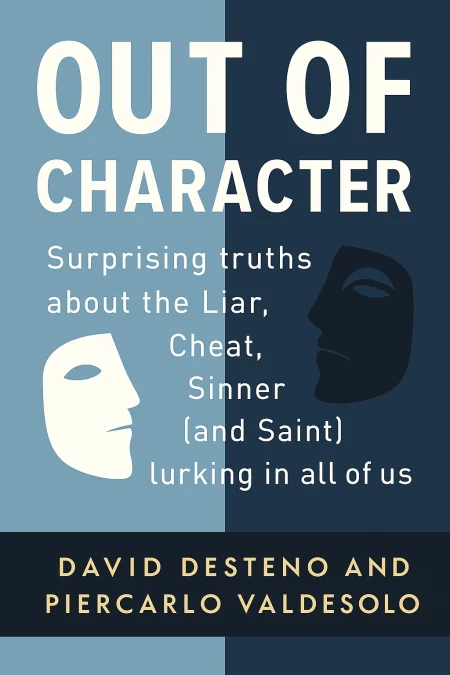
Out of Character
Surprising Truths about the Liar, Cheat, Sinner (and Saint) Lurking in All of Us
byDavid DeSteno, Piercarlo Valdesolo
Book Edition Details
Summary
In the shadowy dance of morality and impulse, "Out of Character" dares to dismantle the façade of fixed human nature. Psychologists DeSteno and Valdesolo delve into the heart of our capricious behavior, revealing that what we often deem as unchangeable traits are but marionettes swayed by unseen psychological forces. Through captivating anecdotes and revealing experiments, the authors unravel the mysteries behind the astonishing choices of public figures and everyday individuals alike. From the gambler risking it all to the unexpected betrayal of a virtuous crusader, each story illuminates the unpredictable tapestry of human actions. Prepare to question the essence of character itself as this book challenges the rigid lines between saints and sinners, urging us to reconsider the complexities beneath our everyday decisions.
Introduction
Mark Sanford was once everything Americans admired in a leader. An Eagle Scout from childhood, a devoted family man, a principled governor who slept on a futon in his office rather than waste taxpayers' money on fancy accommodations. Yet one day in 2009, this paragon of virtue vanished from his responsibilities, telling his staff he was hiking the Appalachian Trail. Instead, he was in Argentina with his mistress, penning passionate love letters while his family waited at home. How does an Eagle Scout become an adulterer? How does moral character seemingly flip overnight? The answer challenges everything we believe about human nature. We've been taught that character is fixed, carved into our souls like ancient marks on coins. Good people do good things, bad people do bad things, and moral failure reveals someone's "true colors." But groundbreaking research reveals a startling truth: character isn't a permanent trait but a dynamic state, constantly shifting between competing psychological forces. Within each of us lie the seeds of both saint and sinner, hero and hypocrite, compassionate helper and callous bystander. The difference isn't who we are, but which internal system gains control in any given moment. This book will show you how these hidden battles shape every moral choice you make, and more importantly, how understanding them can help you become the person you truly want to be.
The Flexible Nature of Virtue and Vice
Tom Cruise's transformation from beloved Hollywood golden boy to controversial figure offers a window into character's surprising fluidity. As a struggling young actor, Cruise embodied humility and determination. Despite suffering from dyslexia and enduring constant bullying as he moved between fifteen different schools, he channeled his pride into relentless work. He took any job he could find, slept on a futon, and approached every audition with infectious intensity. Directors praised his professionalism, noting he never arrived late to set and eschewed typical movie star luxuries. This pride drove him to excellence, motivating the grueling effort that built his career. Yet somewhere along his meteoric rise, that same pride curdled into hubris. The humble young man who once ran to the bathroom between takes transformed into someone lecturing interviewers about moral superiority, jumping on couches, and dismissing others as unenlightened. The pride that once fueled his success now alienated audiences worldwide. What changed wasn't Cruise's essential nature, but the balance of psychological forces within him. Success had shifted the scales, transforming adaptive pride into destructive arrogance. This isn't a story of hidden character flaws finally revealed, but of how the same trait can serve us brilliantly or destroy us completely, depending on context and circumstance. Understanding this fluidity is the first step toward managing our own character's evolution.
Love, Lust, Pride, and Social Bonds
Lisa Nowak seemed the epitome of rational achievement. A Navy captain, aeronautical engineer, and NASA astronaut who had survived the most rigorous psychological screening imaginable, she represented humanity's best and brightest. Yet in February 2007, this accomplished mother of three drove 900 miles from Texas to Florida wearing a diaper to avoid stops, armed with a steel mallet and knife, intent on confronting her lover's new girlfriend in an airport parking garage. Colleagues who knew her were stunned. This was completely "out of character" for someone they'd trusted with space missions. But Nowak's breakdown wasn't an aberration of faulty character screening. It was jealousy in its rawest form, demonstrating how quickly our protective instincts can overwhelm rational thought. Evolutionary psychology suggests that jealousy serves a crucial function: safeguarding relationships essential for long-term survival and child-rearing. When we perceive threats to valued connections, ancient alarm systems activate, flooding us with emotions that can override years of training and discipline. Nowak's tragedy illustrates how the same psychological mechanisms that help us form deep bonds and protect what matters most can, under extreme circumstances, transform us into people we don't recognize. Her story reminds us that the capacity for both profound love and destructive jealousy exists within everyone, waiting for the right trigger to tip our internal scales toward actions that surprise even ourselves.
Compassion, Fairness, and the Golden Rule
During World War I's brutal winter of 1914, British and German soldiers faced each other across the blood-soaked trenches of Belgium. Military commanders had deliberately conditioned their troops to see the enemy as inhuman monsters, ensuring they would kill without hesitation. Yet on Christmas Eve, something extraordinary happened. German soldiers placed candles on small Christmas trees near their positions. Soon, voices rang out across no-man's-land singing Christmas carols. Soldiers from both sides ventured into the space between trenches, exchanging gifts and stories, laughing and chatting with men they'd been trying to kill hours before. For one magical night, sworn enemies became fellow human beings celebrating shared traditions. But the very next day, the shooting resumed with full intensity. How could the same soldiers who had broken bread together return to murderous combat so easily? The answer lies in how rapidly our minds categorize others as "us" or "them." During that Christmas truce, the warring armies saw their similarities, their shared humanity. They were all husbands and fathers missing home, fellow Christians celebrating the same holy day. But military necessity quickly reasserted the divisions that made killing possible again. This tragic cycle reveals how compassion and cruelty aren't fixed character traits but responses triggered by our perception of similarity and difference. The same psychological mechanisms that can transform enemies into friends can just as quickly reverse, reminding us that our capacity for both connection and callousness lies closer to the surface than we'd ever dare imagine.
Risk, Prejudice, and Managing Character
Mohammad Sohail was closing his convenience store in New York when a hooded man burst in wielding a baseball bat, demanding cash. Instead of opening the register, Sohail pulled out a rifle and aimed it at the intruder's head. The would-be robber collapsed, sobbing, "I'm sorry. I have no food. My whole family is hungry." In that moment, Sohail saw not a criminal but a desperate father. He gave the man $40 and bread, asking only for a promise never to rob again. The man disappeared into the night. Months later, Sohail received an anonymous letter with $50 inside. The reformed thief wrote of finding steady work and turning his life around, thanking Sohail for the act of compassion that had changed everything. This remarkable story illuminates the hidden mechanisms governing fairness and trust. Gratitude, it turns out, functions as a powerful social glue, compelling us to reciprocate kindness even when no one is watching and no reward is expected. The robber's decision to repay Sohail with interest wasn't rational calculation but an emotional compulsion driven by deep psychological systems that evolved to maintain the cooperative relationships essential for human survival. Sohail's initial act of seeing humanity in his attacker, and the robber's later choice to honor that trust, both demonstrate how quickly our character can shift when different internal systems take control. Sometimes the voice urging immediate self-protection gives way to the deeper wisdom that recognizes our fundamental interconnectedness with others.
Summary
The stories woven throughout these pages reveal a profound truth about human nature: we are not fixed moral entities but dynamic beings whose character emerges from an ongoing battle between competing psychological forces. The Eagle Scout who becomes an adulterer, the accomplished astronaut driven to violence by jealousy, the soldiers who can embrace enemies one day and shoot them the next, and the criminal who finds redemption through unexpected kindness all demonstrate that our capacity for both virtue and vice lies closer to the surface than we ever imagined. This flexibility isn't a flaw in human design but perhaps our greatest evolutionary advantage. The ability to adapt our responses to changing circumstances, to balance immediate needs with long-term consequences, has enabled our species to thrive in countless environments and situations. Understanding these hidden forces doesn't excuse poor choices or moral failures, but it does offer something far more valuable: the possibility of conscious influence over outcomes that once seemed beyond our control. By recognizing the signals that tip our internal scales, by knowing when to trust our instincts and when to pause for reflection, we can begin to author our own character rather than remain passive witnesses to its fluctuations. The saint and sinner within us will always coexist, but awareness of their eternal struggle is the first step toward ensuring the better angels of our nature more often prevail.
Related Books
Download PDF & EPUB
To save this Black List summary for later, download the free PDF and EPUB. You can print it out, or read offline at your convenience.
By David DeSteno
