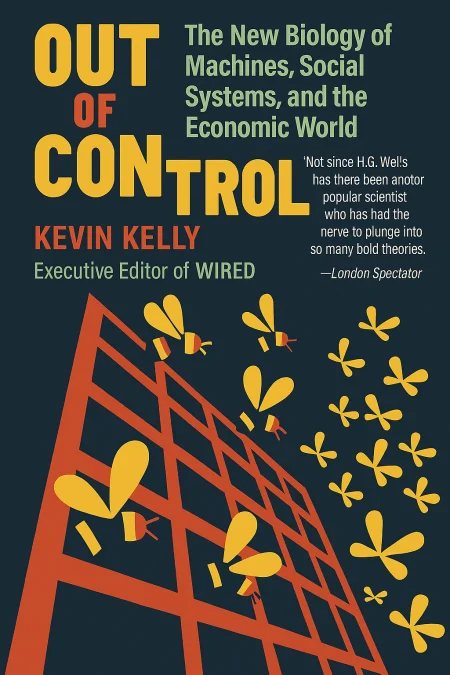
Out of Control
The New Biology of Machines, Social Systems and the Economic World
Book Edition Details
Summary
A time when machines echo the complexity of life itself – that's the captivating world laid out in "Out of Control." Kevin Kelly, writing with uncanny foresight from the vantage point of 1994, sketches a provocative portrait of our technological trajectory. Envision a society reshaped by the Internet's tentacles and the creeping intelligence of artificial systems, blurring lines between man and machine. This book isn't just a peek into the future; it's a vivid, almost sentient narrative that resonates with today's realities and tomorrow's possibilities. For readers fascinated by the convergence of technology and humanity, Kelly's narrative is both a cautionary tale and a thrilling glimpse into an evolving digital epoch.
Introduction
How do we maintain meaningful control in a world where our most important systems are becoming too complex for any single mind to comprehend? From global financial markets that react in milliseconds to internet networks that route billions of messages without central coordination, we face a fundamental paradox: the more sophisticated our systems become, the less we can manage them through traditional command-and-control methods. This reality challenges our deepest assumptions about management, organization, and the very nature of control itself. The theoretical framework presented here draws from complexity science, evolutionary biology, and cybernetics to reveal how truly adaptive systems operate according to biological rather than mechanical principles. The core insight suggests that sustainable control emerges not from rigid hierarchy but from distributed networks that exhibit life-like properties of self-organization, adaptation, and evolution. This paradigm addresses several critical questions: How do coherent behaviors emerge from the interactions of autonomous agents? What principles govern systems that can adapt without external direction? How can we design organizations and technologies that thrive in uncertainty rather than being paralyzed by it? The answers point toward a revolutionary understanding of how to work with complexity rather than against it.
Swarm Intelligence and Distributed Network Systems
Swarm intelligence represents a fundamental departure from hierarchical thinking, revealing how sophisticated collective behavior emerges from the interactions of simple autonomous agents following basic local rules. This theoretical framework challenges the assumption that complex coordination requires centralized control, demonstrating instead that the most adaptive systems distribute decision-making across networks of independent actors. The architecture of swarm systems operates through three essential mechanisms: local interaction protocols, parallel information processing, and emergent coordination patterns. Individual agents respond only to immediate environmental cues and nearby neighbors, yet information propagates throughout the entire network without requiring global communication channels. Multiple agents process different aspects of problems simultaneously rather than waiting for sequential instructions from a central authority. Most remarkably, coherent system-level behaviors emerge spontaneously from these distributed interactions, creating collective intelligence that exceeds the capabilities of any individual component. The mathematical elegance of swarm systems lies in their scalability and resilience properties. Unlike traditional hierarchies that become increasingly fragile as they grow more complex, swarm networks become more robust through redundancy and distributed error correction. When individual nodes fail, the system automatically routes around damage and continues functioning. This principle explains why the internet remains operational despite constant hardware failures, why market economies can process billions of transactions without central coordination, and why biological ecosystems maintain stability across centuries despite the constant death and birth of individual organisms. Consider how ant colonies discover optimal foraging paths through a process called stigmergy, where individual ants leave chemical trails that other ants can detect and reinforce. No single ant possesses a map or understands the overall strategy, yet the colony consistently finds the shortest routes to food sources. Successful paths become reinforced through positive feedback as more ants follow stronger chemical signals, while unsuccessful routes fade away naturally. This same algorithmic principle now guides internet routing protocols, supply chain optimization systems, and even urban traffic management, demonstrating how biological swarm intelligence can inspire powerful technological solutions that adapt continuously to changing conditions.
Evolution as Technology and Self-Organizing Complexity
Evolution operates as nature's most sophisticated search algorithm, capable of exploring vast possibility spaces to discover solutions of remarkable elegance and complexity. When evolutionary principles are applied to artificial systems, they become powerful technologies for creating rather than merely copying life, generating solutions that often surprise their human creators with their ingenuity and effectiveness. The mechanics of evolutionary systems involve three fundamental processes operating in continuous cycles: variation generation, selection pressure, and inheritance mechanisms. Random mutations and recombinations create diverse variants within populations, while environmental challenges eliminate less successful variants and preferentially reproduce more successful ones. Beneficial traits accumulate over generations through inheritance, leading to increasingly sophisticated adaptations. Unlike traditional optimization methods that require complete problem specifications, evolutionary systems discover solutions through exploration and experimentation, making them invaluable for addressing challenges that resist conventional engineering approaches. Self-organizing complexity emerges when evolutionary processes operate on systems with sufficient diversity and interaction density. Individual components following simple local rules create feedback loops that amplify successful patterns while suppressing unsuccessful ones. These dynamics naturally drive systems toward states of increasing organization and capability, creating what complexity theorists call "emergent properties" that cannot be predicted from studying individual components in isolation. The process positions systems at the edge of chaos, a critical zone between rigid order and complete randomness where maximum adaptability and innovation occur. Real-world applications demonstrate evolution's capacity to solve problems that stump traditional design methods. Evolutionary algorithms have designed antenna configurations for NASA spacecraft that outperform human-engineered alternatives while using unconventional shapes no human designer would have conceived. They have optimized factory schedules, evolved trading strategies, and generated pharmaceutical compounds with novel therapeutic properties. In each case, the evolutionary process discovered entirely new categories of solutions that expanded understanding of what was possible, illustrating how artificial evolution can serve as a creativity amplification technology that extends human problem-solving capabilities into previously unexplored domains.
Network Economics and Digital Platform Dynamics
Network economics reveals how value creation and distribution operate fundamentally differently in interconnected digital systems compared to traditional industrial models. The shift from linear value chains to network effects creates new rules for competition, cooperation, and wealth generation that challenge conventional economic assumptions about scarcity, ownership, and market dynamics. The theoretical foundation rests on three core principles that distinguish network economics from traditional models: increasing returns to scale, network externalities, and winner-take-all dynamics. Unlike physical goods where additional units typically cost more to produce, digital products and services often exhibit decreasing marginal costs as networks expand. Each new participant adds value not just for themselves but for all existing users, creating positive feedback loops that accelerate growth exponentially. These dynamics lead to market structures where early leaders can achieve dominant positions that become increasingly difficult for competitors to challenge through traditional means. Network effects manifest through multiple interconnected mechanisms that compound over time. Direct network effects occur when users benefit immediately from additional participants, as with communication platforms where more users mean more potential connections. Indirect network effects emerge when complementary products and services increase in value alongside user base growth, creating ecosystems of interdependent offerings. Data network effects arise when larger user populations generate better insights and improvements, enabling platforms to enhance their services continuously while raising barriers for competitors who lack equivalent data resources. Consider how digital platforms like operating systems demonstrate these principles in practice. An operating system becomes more valuable as more users adopt it because software developers focus their efforts on platforms with larger audiences, which creates more applications and utilities for users, which in turn attracts more users in a self-reinforcing cycle. This dynamic explains why platform competition often results in winner-take-all outcomes where one or two dominant players capture the majority of market value. Understanding these network dynamics becomes crucial for navigating digital transformation, requiring strategies focused on building communities and ecosystems rather than simply optimizing individual products or services.
The Nine Laws of Complex Adaptive Systems
Complex adaptive systems across biological, technological, and social domains operate according to fundamental principles that can be distilled into universal laws governing how life-like properties emerge in artificial systems. These laws provide a practical framework for designing and managing systems that exhibit the resilience, creativity, and adaptability characteristic of living organisms. The nine laws operate synergistically to create systems that are simultaneously stable and dynamic. The first cluster focuses on structural principles: distribute being across networks rather than concentrating control in single points, enable control to emerge from bottom-up interactions rather than top-down commands, and grow through modular components that can be combined and recombined flexibly. The second cluster addresses dynamic principles: cultivate increasing returns where success breeds more success, maximize diversity and experimentation at system edges where innovation typically originates, and honor errors as essential sources of learning and adaptation rather than failures to be eliminated. The final cluster encompasses meta-principles that govern how systems evolve over time: pursue multiple goals simultaneously rather than optimizing single metrics that can lead to brittle specialization, seek persistent disequilibrium that maintains dynamic stability rather than static balance, and recognize that change itself changes through evolutionary processes that continuously alter the rules of adaptation. These principles work together to create what complexity theorists call "adaptive landscapes" where systems can navigate changing conditions while maintaining their essential functions and identity. Successful ecosystems embody these laws through their organizational structure and behavioral patterns. Forests distribute essential functions across countless species and individuals, with no central authority coordinating activities yet remarkable stability and productivity emerging from local interactions. Growth occurs through modular expansion as new species colonize available niches and form symbiotic relationships with existing organisms. The greatest diversity exists at ecosystem boundaries where different habitats meet, generating innovations that can spread throughout the system. Disturbances like fires or storms create opportunities for renewal and evolution rather than simply causing damage, maintaining the dynamic balance necessary for long-term health and resilience. These same principles apply to human organizations and technological systems, suggesting that the most successful artificial systems will be those that most closely approximate the organizational logic of living systems.
Summary
The fundamental insight of complex adaptive systems is that true control emerges not from imposing rigid structures but from creating conditions where beneficial patterns can self-organize naturally through the distributed intelligence of autonomous agents. This paradigm shift transforms our understanding of leadership, design, and governance across every domain of human activity, suggesting that the most effective approach to managing complexity involves working with natural tendencies toward adaptation and evolution rather than against them. The implications extend far beyond technology to encompass new approaches to organizational management, urban planning, and social coordination that recognize the creative potential unleashed when we learn to cultivate emergence rather than commanding compliance, ultimately pointing toward a future where human and artificial intelligence collaborate as partners in navigating an increasingly complex and interconnected world.
Related Books
Download PDF & EPUB
To save this Black List summary for later, download the free PDF and EPUB. You can print it out, or read offline at your convenience.
By Kevin Kelly
