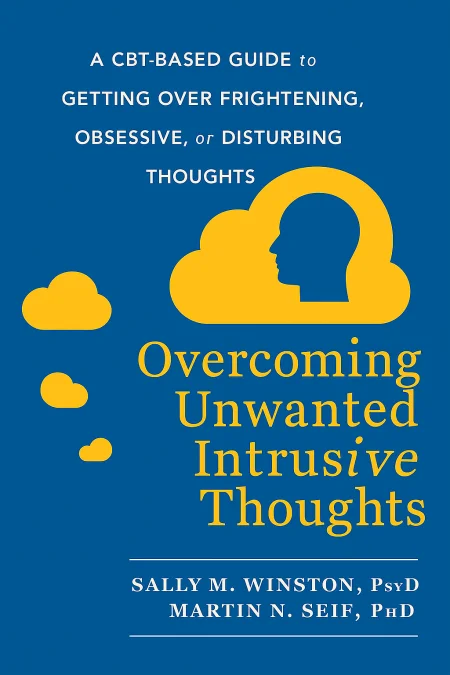
Overcoming Unwanted Intrusive Thoughts
A CBT-Based Guide to Getting Over Frightening, Obsessive, or Disturbing Thoughts
bySally M. Winston, Martin N. Seif
Book Edition Details
Summary
A tempest rages in the mind, where fleeting shadows morph into monsters of anxiety. "Overcoming Unwanted Intrusive Thoughts" is a lifeline for those ensnared by relentless mental whirlwinds. This empathetic guide, forged by two seasoned anxiety experts, reveals the secrets of cognitive behavioral therapy (CBT) to dismantle the stigma of disturbing thoughts. Through candid insights and compassionate counsel, it dismantles the myths and fears that chain you to cycles of guilt and dread. Here, sanity finds its sanctuary as you learn to navigate your thoughts without fear, freeing yourself to embrace a life unburdened by the echo of unwanted mental invaders. Amidst relatable narratives and science-backed strategies, reclaim peace and rediscover the power to live authentically.
Introduction
Why do certain thoughts feel like uninvited guests that refuse to leave our minds, despite our desperate attempts to banish them? This phenomenon affects millions of people who find themselves tormented by thoughts that seem completely alien to their character and values. The book presents a groundbreaking framework for understanding unwanted intrusive thoughts through the lens of neuroscience, cognitive psychology, and acceptance-based therapeutic approaches. The central theoretical foundation revolves around three key concepts: the ironic process of mental control, the neurological basis of anxiety responses, and the paradoxical nature of thought suppression. Rather than viewing these thoughts as meaningful messages or character flaws, the authors propose a radical shift in perspective that treats them as neurological hiccups requiring acceptance rather than resistance. This framework challenges conventional wisdom about mental control and offers a structured path toward freedom from the cycle of mental torment that keeps these thoughts alive and thriving.
Understanding Intrusive Thoughts and Their Mechanisms
The theoretical foundation for understanding intrusive thoughts rests on distinguishing between ordinary mental wandering and the sticky, repetitive thoughts that cause distress. At its core, an intrusive thought becomes problematic not because of its content, but because of our relationship to it. The framework identifies three distinct internal voices that create the commentary around these thoughts: Worried Voice, False Comfort, and Wise Mind. This triadic model demonstrates how internal dialogue perpetuates mental suffering. Worried Voice articulates fears and worst-case scenarios, always asking "what if" questions that generate anxiety. False Comfort attempts to provide reassurance and solutions, but paradoxically keeps the conversation alive by engaging with Worried Voice's concerns. Meanwhile, Wise Mind represents the observer self that recognizes thoughts as mental events rather than facts requiring action. The ironic process of mental control serves as the foundational mechanism explaining why thoughts become stuck. When we attempt to suppress any thought, our minds create a monitoring process that continuously scans for the forbidden content, inadvertently keeping it active in our awareness. This creates what the authors call the "Chinese finger trap" phenomenon, where struggling harder makes escape more difficult. The theoretical implications suggest that mental control operates on paradoxical principles, where less effort often produces more effective results than forceful attempts at thought management.
The Brain Science Behind Unwanted Thoughts
The neurological framework centers on the amygdala's role as an overzealous security system that sounds false alarms in response to harmless thoughts. This ancient brain structure evolved to detect genuine threats, but in modern life, it often misidentifies safe mental content as dangerous. The two-pathway model of fear processing explains why we feel afraid before we can rationally evaluate the situation. The fast pathway bypasses the thinking brain entirely, sending danger signals directly to the amygdala within milliseconds. The slow pathway processes information through the cortex, allowing for rational evaluation, but arrives half a second later. This neurological timing creates first fear, an automatic response beyond conscious control, followed by second fear, which we can influence through our interpretation and response. Consider a person standing on a balcony who suddenly thinks "I could jump." The amygdala immediately sounds the alarm, creating a whoosh of terror before the rational mind can evaluate the thought as merely a random mental event. If the person interprets this alarm as meaningful, engaging in internal arguments about their safety or sanity, they transform a passing thought into a persistent tormentor. Understanding this neurological sequence empowers individuals to recognize that their initial fear response is simply biology in action, not an indication of genuine danger or hidden desires.
Acceptance-Based Strategies for Managing Intrusive Thoughts
The acceptance framework fundamentally reframes the relationship with unwanted thoughts from one of opposition to one of allowing. This approach draws from mindfulness principles and paradoxical intervention strategies that recognize fighting thoughts as the very mechanism that gives them power. Acceptance does not mean approval or resignation, but rather a willingness to experience mental content without immediately attempting to change or eliminate it. The six-step RJAFTP protocol provides a structured approach to acceptance: Recognize, Just thoughts, Accept and allow, Float and feel, Time pass, and Proceed. Each step builds upon the previous one, creating a comprehensive response that interrupts the typical cycle of resistance and struggle. This framework acknowledges that unwanted thoughts will continue to arise, but transforms the experience from one of torment to one of curious observation. Practical application resembles learning to ignore a rude stranger on the street. Just as engaging with someone making offensive comments typically escalates the situation, arguing with intrusive thoughts feeds their intensity. The acceptance approach treats thoughts like clouds passing through the sky of consciousness, present but temporary, requiring no intervention. This shift in perspective often feels counterintuitive initially, as our instinct tells us to fight disturbing content. However, numerous case examples demonstrate that people who master this approach find their thoughts naturally lose intensity and frequency, much like how an ignored bully eventually loses interest and moves on.
Practical Techniques for Recovery and Prevention
The practical framework emphasizes deliberate exposure as the primary mechanism for rewiring neural pathways and reducing thought sensitivity. This approach reverses the typical avoidance patterns that maintain intrusive thoughts, instead encouraging individuals to intentionally invoke their most feared mental content while practicing acceptance responses. The exposure methodology operates on principles of habituation and inhibitory learning. The "Five A's" framework guides optimal practice: Attitude of acceptance, Assign accurate assessment, Active allowance of awareness and affect, Avoid avoidances, and Action advance activities anyway. These principles ensure that exposure work promotes genuine learning rather than mere endurance. The process requires individuals to remain present with uncomfortable sensations while recognizing thoughts as neurological events rather than meaningful messages. Imagine someone tormented by thoughts of harming others deciding to deliberately sing these thoughts to familiar tunes while going about daily activities. This technique transforms terrifying mental content into something absurd and manageable through repetition and recontextualization. The approach acknowledges that recovery involves temporary increases in discomfort as the brain learns new response patterns. However, this framework provides hope that persistent, unwanted thoughts can lose their grip through systematic application of counter-intuitive strategies that honor the brain's natural capacity for neuroplasticity and adaptation.
Summary
The essence of overcoming unwanted intrusive thoughts lies in understanding that the cure for mental tyranny is not control but surrender, transforming our relationship with thoughts from adversarial to observational. This theoretical framework offers profound implications for mental health treatment, challenging traditional approaches that emphasize symptom elimination rather than acceptance. By recognizing intrusive thoughts as universal human experiences that become problematic only through our resistance, individuals can reclaim their mental freedom and redirect energy toward meaningful life activities rather than futile internal battles.
Related Books
Download PDF & EPUB
To save this Black List summary for later, download the free PDF and EPUB. You can print it out, or read offline at your convenience.
By Sally M. Winston
