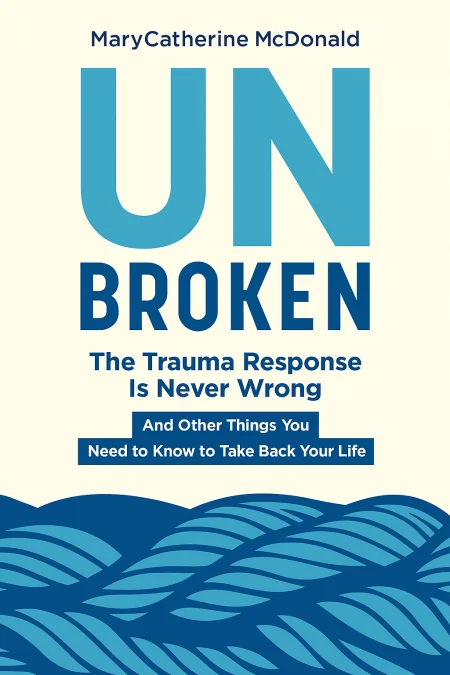
Unbroken
The Trauma Response Is Never Wrong And Other Things You Need to Know to Take Back Your Life
Book Edition Details
Summary
In the intricate tapestry of human experience, trauma is often woven as an unseen thread, misunderstood and stigmatized. Enter Dr. MaryCatherine McDonald, a pioneering voice who challenges the narrative that trauma is a flaw or weakness. With "The Trauma Response Is Never Wrong," she invites us into a revelatory conversation where our body's responses are not betrayals but allies in survival. Blending cutting-edge neuroscience with heartfelt stories, Dr. McDonald dismantles myths and guides us toward understanding our triggers as signposts, not pitfalls. She explores the silent yet profound moral injuries that shape our worldview and empowers us with the tools to rewrite our inner narratives. This book is an urgent call to recognize our innate resilience, to find a relational sanctuary for healing, and to embrace the truth that while trauma may bend us, it cannot break the indomitable human spirit.
Introduction
Picture a woman lying flat on her apartment floor, not out of despair, but out of an intuitive wisdom her body possessed before her mind could understand it. She had been navigating panic attacks with nothing more than jumping jacks and anxiety medication, feeling broken and ashamed of her seemingly irrational responses to overwhelming grief. Then a simple reframe changed everything: what she thought was dysfunction was actually her nervous system's brilliant attempt to ground and regulate itself. This moment of recognition illuminates a profound truth that challenges everything we've been taught about trauma. The responses we've learned to judge, hide, or medicate away are not signs of weakness or brokenness. They are evidence of our incredible capacity for survival and adaptation. When we understand trauma not as damage to be fixed, but as a natural neurobiological response to overwhelming experiences, everything shifts. The shame dissolves, replaced by curiosity and compassion. The stories that follow reveal how trauma responses manifest in ways both expected and surprising. Through each person's journey, we discover that healing isn't about returning to who we were before, but about integrating these experiences with wisdom and grace. These narratives offer more than understanding; they provide practical tools for rewiring our nervous systems and reclaiming our sense of safety in the world. Most importantly, they remind us that we are not broken, and we never were.
When Trauma Shatters Our View of the World
Malcolm sits in dimly lit rooms, speaking in rapid, jagged sentences about his military deployments. He insists he's fine, that he has everything under control, even as he describes marching the perimeter of his house each night and participating in underground fight clubs where grown men beat each other unconscious. His wife has left, unable to watch him destroy himself in his desperate attempt to make sense of surviving when his fellow soldiers did not. The fight club isn't random self-destruction; it's Malcolm's attempt to restore order to a world that no longer makes sense. War revealed a devastating truth: that good people die for no reason, that moral structures we count on are human-made and fragile. The carefully drawn map of how the world works came crashing down, leaving him lost in a landscape where his survival felt like a cosmic mistake. Every punch he takes is an attempt to balance some invisible scale, to make his continued existence feel justified. Malcolm's struggle represents what happens when trauma shatters our fundamental assumptions about reality. We all carry internal maps marked with beliefs about fairness, safety, and meaning. When traumatic events knock these maps off the wall, we're left scrambling to make sense of a world that no longer operates according to the rules we thought governed it. This shattering creates what clinicians call moral injury, the deep wound that occurs when our core beliefs about right and wrong prove insufficient to contain our lived experience. The path forward requires more than processing what happened; it demands creating new meaning from the fragments. Malcolm eventually moved to a place without a white picket fence and traded his dangerous fight club for structured martial arts training. He learned that when our original maps of meaning shatter, we don't have to wander forever lost. We can draw new ones, informed by hard-won wisdom about the world's complexity and our own resilience within it.
The Truth About Triggers and Traumatic Memory
Gabe's heart condition should have killed him at age ten, just as it killed his father. Instead, modern medicine gave him a defibrillator that keeps him alive by shocking his heart back to rhythm when it stops. But the device malfunctions sometimes, delivering crushing blows to his chest when no shock is needed, creating electrical storms that can render him unconscious. Now his own heartbeat has become a trigger, sending him into hyperventilation whenever he notices its rhythm. During their first session together, Gabe begins gasping for air within minutes of starting to talk. The irony is staggering: the device meant to save his life threatens his psychological stability, just as his trauma response system saves him from danger while making daily life nearly impossible. His amygdala, that primitive alarm system, cannot distinguish between the memory of past electrical storms and the simple sensation of his heart beating normally. This reveals a crucial misunderstanding about triggers. They aren't conscious reminders we can easily identify and avoid. Triggers are fragments of overwhelming experiences that got stored in disorganized ways when our recording systems went offline during moments of terror. Anything, including imperceptible internal states like heart rate fluctuations, can open portals to the past that flood the present with stress hormones and survival responses. Healing doesn't mean never feeling triggered again. It means learning to work with our nervous system's protective responses rather than against them. Gabe learned diaphragmatic breathing to activate his vagus nerve, manually switching his system from hypervigilance to calm. He discovered that his seemingly irrational responses actually made perfect neurobiological sense, and that understanding became the foundation for developing practical tools to navigate his unique relationship with his own precious, complicated heart.
Breaking Free from Cycles of Pain and Repetition
Grace travels to disaster sites as a first responder, helping communities rebuild after catastrophic events. She thrives in this work, finding deep meaning in supporting others through their worst moments. Yet suddenly she's experiencing classic trauma symptoms: nightmares, panic attacks, an inability to eat or travel for work. Everyone assumes her job finally caught up with her, but Grace lights up when discussing her work. The pain is coming from somewhere else entirely. The real source reveals itself when she mentions, almost dismissively, a recent breakup from a two-year relationship. She insists it's just a silly romantic disappointment, nothing compared to the tragedies she witnesses professionally. But when she talks about her ex-partner, her whole body language shifts. Her shoulders collapse, her eyes fill with tears, and her voice becomes hollow. This "simple breakup" involved moving in together, looking at houses, discussing marriage and children, then watching her partner drive away to start that same life with someone else. Grace's dismissal of her own pain illustrates how we create hierarchies of suffering that prevent healing. She had absorbed society's message that relationship losses don't qualify as "real" trauma, especially compared to natural disasters or violence. This judgment kept her from recognizing that her partner's sudden departure had knocked her carefully stored vulnerabilities off their high shelf, scattering fears about impermanence and safety throughout her life. The breakthrough came when Grace allowed herself to grieve not just the relationship, but the future she had envisioned within it. We don't just mourn what we've lost; we mourn the dreams and plans that disappeared alongside the person. When Grace finally gave herself permission to feel the full weight of this loss without shame, her nervous system could begin the work of integration, filing this painful experience alongside all her other memories rather than letting it hijack her present.
It's Never Too Late to Heal
Lily calls on a Friday evening, breathless with excitement about a recovered memory from childhood. She had hidden in her closet, determined for once not to stand at attention with her siblings when her terrifying father came home. In that moment of planned rebellion, she felt fully herself, ready to claim her own identity against his impossible demands for perfection. But when she heard his car in the driveway, her body moved without conscious decision, carrying her downstairs to assume her expected position of silent compliance. For decades, Lily carried shame about this moment of self-betrayal. Now, facing her own mortality as cancer spreads through her body, she finally understands what really happened. Her automatic response wasn't weakness; it was her nervous system's brilliant assessment of danger and its decision to prioritize survival over self-expression. The little girl who fled the closet lived to become a woman who escaped her family's cycle of addiction and abuse, the only one of her siblings to build a functional life. This realization illuminates something profound about trauma responses and identity formation. When we're raised in environments that demand we disappear ourselves to survive, we often mistake our protective adaptations for character flaws. Lily spent her life believing she was inherently weak, incapable of authentic connection, fundamentally flawed. The hypervigilance that kept her alive made intimacy feel impossible, leaving loved ones feeling they could never quite reach her through her defensive stance. Recovery means recognizing that the parts of ourselves we've learned to judge were often our greatest strengths in impossible circumstances. Lily's story reminds us that healing doesn't have a deadline. Even facing terminal illness, she found freedom in understanding her own resilience. The capacity to subvert power, to reclaim identity from those who tried to reduce us to their labels, remains available regardless of our age or circumstances. We can rewrite our stories about ourselves until our very last breath.
Summary
These stories illuminate a revolutionary understanding of trauma that moves us far beyond pathology and brokenness toward recognition of our incredible adaptive capacity. When overwhelming experiences fragment our sense of safety and meaning, our responses are not evidence of dysfunction but proof of our sophisticated survival systems at work. The hypervigilance, the seemingly irrational behaviors, the patterns we repeat despite our best intentions all make neurobiological sense when we understand trauma as unbearable experience lacking a relational home. Healing happens not in isolation but in connection with others who can help us bear what feels unbearable. Whether that's a therapist, a friend who validates our struggle, or even a stranger whose simple presence reminds us we're not alone, we heal in relationship. The tools that support this process work with our biology rather than against it: breath practices that activate our calming systems, grounding techniques that bring us into the present moment, and narrative approaches that help us integrate fragmented memories into coherent stories we can carry forward. Perhaps most importantly, these journeys remind us that trauma is not a life sentence. Our nervous systems remain plastic throughout our lives, capable of learning new responses and creating new neural pathways toward safety and connection. When we approach our struggles with curiosity rather than judgment, with tools rather than shame, we discover that our greatest wounds often become doorways to our deepest wisdom and most authentic strength.
Related Books
Download PDF & EPUB
To save this Black List summary for later, download the free PDF and EPUB. You can print it out, or read offline at your convenience.
By Marycatherine McDonald
