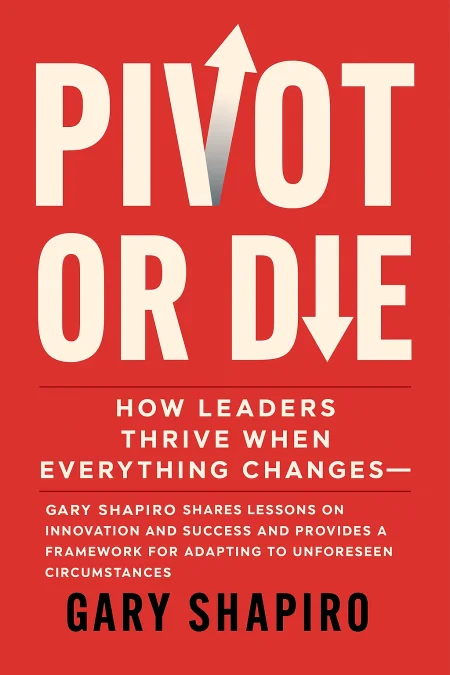
Pivot or Die
How Leaders Thrive When Everything Changes
Book Edition Details
Summary
In the high-stakes arena of technology, where fortunes rise and crumble with alarming speed, Gary Shapiro emerges as a sage of survival. As the visionary force behind CES, Shapiro has witnessed firsthand the electrifying ascent of ideas and the stark collapse of empires. In "Pivot or Die," he distills decades of insight into a gripping guide for leaders who refuse to become obsolete. Shapiro unveils a dynamic framework for mastering the art of the pivot, revealing how adaptability can turn failure into a catalyst for innovation and success into an opportunity for reinvention. Through compelling case studies and personal anecdotes, he crafts a roadmap for navigating the tumultuous waters of modern business, urging leaders to embrace agility as their compass. This manifesto isn't just about keeping up with change—it's about wielding it as your ultimate weapon in a world that never stands still.
Introduction
In January 2020, a tech industry leader sat in his Detroit home, finishing up work and looking forward to a weekend getaway. Then his wife, a practicing retinal surgeon, arrived home with news that would dramatically reshape their lives. She had heard on the radio that the Chinese government had quarantined the city of Wuhan to stop the spread of an unknown disease. While this story wasn't making headlines, she knew something big was coming. "We've been to China. We know what this means," she told him. "It means the disease is out of control." This moment marked the beginning of one of the biggest pivots in history, affecting technology, government, education, policy, trade, and every sector that touches our lives. In our rapidly changing world, the ability to process new information and act fast has become crucial for survival and success. Some pivots are small adjustments, while others represent fundamental transformations that can make or break organizations, careers, and even nations. The most successful leaders, entrepreneurs, and innovators share one critical trait: they are master pivoters. They focus on the big goal while remaining flexible about the steps needed to reach it. They understand that change isn't just inevitable—it's the source of opportunity. Whether you're running a startup, leading a Fortune 500 company, or simply navigating your personal journey, the principles of strategic pivoting can help you not just survive disruption, but thrive in the face of uncertainty.
From Garage Dreams to Global Impact: The Startup Revolution
In 2011, Jamie Siminoff was working out of his garage in the Pacific Palisades when his wife mentioned she couldn't hear the doorbell when she was outside or in the back of their Los Angeles home. This simple observation sparked an idea that would eventually become a billion-dollar business. Jamie created a Wi-Fi connected video doorbell he called DoorBot and drained his savings to order five thousand units from a factory in Taiwan. When he appeared on Shark Tank, every investor passed on his product. "I think it's a great business," Mark Cuban told him, "but I can't invest in something that's not going to be worth seventy million dollars someday." The rejection stung, but customer feedback revealed bigger problems. Reviews complained about poor picture quality, muffled sound, and constant Wi-Fi connection issues. Instead of giving up, Jamie pivoted. He partnered with Foxconn to redesign the product, put his email address on every box to personally respond to complaints, and made a crucial branding change—renaming DoorBot to Ring. This wasn't just marketing; it represented a fundamental shift from a convenience product to a security necessity. Ring first exhibited at CES with just a card table, but that visibility helped secure deals with major retailers. In 2018, Amazon acquired Ring for more than a billion dollars. The startup world is built on pivots like Jamie's story. Research shows that 40 percent of founders report pivoting to avoid failure, and those willing to pivot significantly increase their odds of success. The most successful startups share common traits: curiosity that drives them to ask questions and challenge assumptions, assertiveness to trust their instincts over expert opinions, resilience to recover from setbacks, and unwavering commitment to their mission. These characteristics enable entrepreneurs to navigate the volatile waters of innovation, turning failures into stepping stones and obstacles into opportunities for breakthrough success.
When Crisis Strikes: Forced Transformations That Define Success
When COVID-19 struck in early 2020, Delta Air Lines went from being America's most on-time airline and the top revenue-generating airline in the world to losing $100 million every day. CEO Ed Bastian faced an unprecedented challenge as the company issued $50 million in refunds daily and converted their Atlanta museum into a call center to handle the flood of customer calls. Operating at less than 5 percent of normal passenger load with over 500 planes grounded, Delta had to completely reimagine its business model overnight. Rather than simply cutting costs, Bastian focused on people-first solutions. The company avoided massive layoffs through voluntary leave programs while maintaining health insurance for employees. Delta pivoted its aircraft to transport medical workers around the country and shipped critical medical equipment. In 2021, Delta Cargo handled the first COVID-19 vaccine shipments, and the company transformed its Atlanta museum into a vaccination center. By 2023, Delta had not only recovered but achieved record revenue of $54.7 billion, demonstrating one of the most remarkable forced pivots in business history. Forced pivots occur when external circumstances—pandemics, natural disasters, economic downturns, or regulatory changes—require organizations to change or die. While these situations often present the most challenging circumstances, they also create opportunities for innovation and creative problem-solving. Companies like DroneUp, which grew over 1,000 percent during the pandemic by pivoting from small government partnerships to last-mile delivery services, prove that crisis can catalyze extraordinary growth. The organizations that thrive during forced pivots share key characteristics: they maintain their focus on core values while remaining flexible about methods, they invest in technology and partnerships that create new capabilities, and most importantly, they view disruption not as a threat to be endured but as an opportunity to be seized.
Learning from Failure: How Setbacks Fuel Innovation
In April 1956, Elvis Presley strode onto the stage at the Las Vegas New Frontier Hotel for his first Vegas gig. Despite having a number one hit and a new movie contract with Paramount Pictures, the performance was a disaster. The middle-aged audience sat through his act "as if he were a clinical experiment," according to Newsweek, while the Las Vegas Sun called his performance "overbearing to a captive audience." Opening night went so badly that the hotel moved Elvis's name to the bottom of the marquee for the remainder of his two-week run. Yet this spectacular failure became the foundation for what would later become one of the most successful entertainment partnerships in history. Similarly, the founders of Rovio Entertainment experienced their own dark night of the soul in 2009. After releasing more than fifty games without a major hit, the Finnish company was nearly bankrupt and had to lay off a third of their staff. With just $7 million left in funding, they decided to take one final shot at creating a successful game. Building on lessons from their failures, they knew they needed mass market appeal rather than niche audiences. When a graphic designer brought a concept image of disgruntled birds to a meeting, Angry Birds was born. The game became one of the most downloaded series in App Store history and transformed Rovio into a global entertainment company worth hundreds of millions. These stories illustrate a fundamental truth about American business culture: we don't just tolerate failure, we celebrate it as a necessary ingredient for future success. Failure breeds humility, creativity, and adaptability—essential qualities for innovation. The very act of thinking differently and problem-solving sharpens our mental faculties and makes us more thoughtful and imaginative. Companies and individuals who can learn from their mistakes, adapt their approach, and persist through adversity often discover that their greatest failures become the foundation for their most spectacular successes.
Building Tomorrow: Technology's Role in Solving Human Challenges
At CES 2023, a partnership was announced between the Consumer Technology Association and the United Nations Trust Fund for Human Security, creating the first "show with a purpose." This collaboration highlighted technologies specifically designed to improve human lives through innovations in accessibility, healthcare, agriculture, and public utilities. The response from exhibitors was overwhelmingly positive, reflecting a broader shift in the technology industry toward solutions that don't just entertain and profit, but solve real human problems. One remarkable example is SOURCE Water, a company that debuted at CES in 2018 with a solar-powered device that captures vapor from the air and transforms it into drinking water. What started as an idea to solve a family's water needs in Arizona has expanded to over fifty countries worldwide. This technology addresses multiple challenges simultaneously: providing clean drinking water in areas without reliable municipal supplies, reducing the massive carbon footprint associated with bottled water production and transportation, and creating sustainable solutions for communities facing water scarcity. The integration of artificial intelligence across industries is creating unprecedented opportunities to amplify human capabilities and solve complex global challenges. From predictive healthcare diagnostics to agricultural systems that optimize crop yields while reducing pesticide use, to accessibility technologies that give people with disabilities greater independence, we're witnessing a transformation where profit and purpose align. Companies are discovering that the technologies with the greatest potential for positive impact often represent the most promising business opportunities, creating a virtuous cycle where doing good and doing well become synonymous rather than competing objectives.
Summary
The art of pivoting represents far more than strategic business maneuvering—it embodies humanity's unique capacity to consciously choose our response to change and uncertainty. From garage entrepreneurs who transform simple observations into billion-dollar solutions, to global airlines that reinvent themselves overnight during crises, to technology innovators who turn their greatest failures into breakthrough successes, the most compelling stories of our time are fundamentally stories of strategic adaptation. The leaders who thrive understand that pivoting isn't about abandoning your core identity or values, but about maintaining unwavering commitment to your ultimate purpose while remaining flexible about the methods to achieve it. The future belongs to those who can balance analytical thinking with intuitive decision-making, who view obstacles as opportunities for creative problem-solving, and who understand that in our rapidly evolving world, the ability to pivot quickly and effectively has become the ultimate competitive advantage. Whether you're leading an organization through digital transformation, navigating personal career changes, or simply trying to make better decisions in an uncertain world, the principles of strategic pivoting offer a roadmap for not just surviving change, but transforming it into a source of strength, growth, and positive impact that extends far beyond your own success to benefit the communities and world around you.
Related Books
Download PDF & EPUB
To save this Black List summary for later, download the free PDF and EPUB. You can print it out, or read offline at your convenience.
By Gary Shapiro
