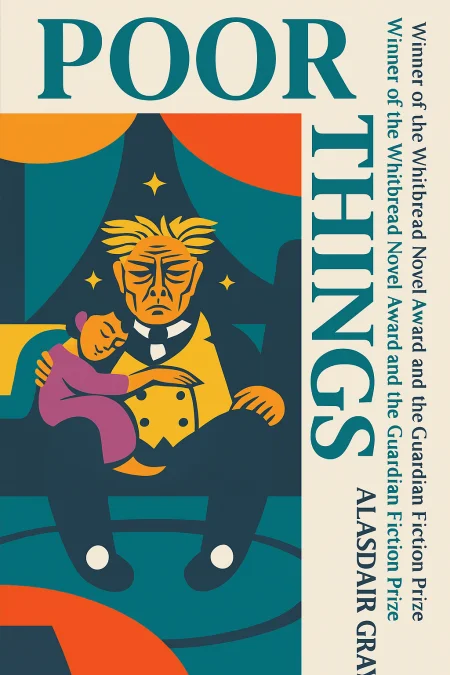
Poor Things
A Novel
Book Edition Details
Summary
Beneath the fog-laden streets of Victorian Glasgow, a tale of twisted ambition and scandal unfolds in Alasdair Gray's audacious "Poor Things." When Godwin Baxter, driven by a desire to engineer the ideal partner, resurrects Bella Baxter from the depths of death, he ignites a bizarre saga that skews the lines between love and possession. Bella, with the innocence of a child and the allure of a woman, becomes the object of an intense rivalry between her creator and Dr. Archibald McCandless, whose heart throbs with jealousy. Yet, Bella is no passive subject in this macabre experiment; she asserts her voice with a defiant vigor that challenges the male-dominated narrative. Gray's work is a masterstroke of satire, cleverly dissecting the archetype of the Victorian novel while offering a sharp political allegory on gender dynamics. This is a story where the grotesque and the comic dance in a provocative waltz, inviting readers to question the very fabric of identity and autonomy.
Introduction
In the gaslit streets of Victorian Glasgow, a brilliant surgeon stands at the threshold of an impossible discovery. His hands, scarred by countless operations, tremble not from age but from the weight of what he is about to attempt. The woman before him has lost everything—her past, her identity, even her life itself. Yet in this moment of ultimate darkness, science offers a glimmer of unprecedented hope. This is not merely a tale of medical innovation, but a profound exploration of what it means to be human when the very boundaries between life and death become negotiable. The story that unfolds challenges everything we think we know about identity, consciousness, and the ethical limits of human knowledge. Through the lens of Gothic Victorian sensibilities and cutting-edge scientific speculation, we encounter questions that resonate powerfully in our own age of genetic engineering and artificial intelligence. How do we define personhood? What responsibilities do creators bear toward their creations? Can science ever be truly separated from the social and political contexts in which it operates? As we follow this extraordinary journey of resurrection and self-discovery, we are invited to examine not only the marvels of human ingenuity but also the profound moral complexities that emerge when we dare to play with the fundamental forces of existence.
The Making of Bella: Science, Identity, and Victorian Social Control
A young woman's body is pulled from the murky waters of the River Clyde on a February morning in 1881. The authorities record her as a suicide—another tragic casualty of Victorian society's rigid moral constraints. But Dr. Godwin Baxter, son of the renowned surgeon Sir Colin Baxter, sees something different in this lifeless form. Where others see an end, he envisions a beginning. In the secrecy of his Park Circus laboratory, using techniques pioneered by his father, Baxter performs an operation that defies both medical convention and natural law. The woman who awakens bears no memory of her former existence, speaking and thinking like a child despite inhabiting an adult body. This miraculous resurrection comes with profound complications. The woman, whom Baxter names Bella, must navigate a world that expects her to conform to Victorian feminine ideals while possessing the unfiltered curiosity and directness of an infant mind. Her lack of social conditioning becomes both liberation and vulnerability. She approaches sexuality with innocent wonder rather than shame, speaks her mind without the constraints of polite society, and forms judgments based on her own moral intuition rather than inherited prejudices. Her very existence challenges the assumption that proper womanhood requires years of careful social molding. Baxter finds himself in the unprecedented position of being both creator and guardian. His motivations are complex—part scientific curiosity, part paternal protectiveness, and part romantic longing for a companion who might accept his own physical abnormalities without prejudice. He creates an elaborate fiction about Bella's origins, claiming she is his niece recovering from amnesia after a railway accident. This deception protects her from society's judgment while allowing him to guide her education in ways that would be impossible for a conventional Victorian woman. Yet the very act of creation raises uncomfortable questions about power and consent. Baxter has essentially manufactured an ideal companion—one who will be grateful for his care and dependent on his protection. His scientific achievement cannot be separated from the social context that made it both possible and necessary, revealing how even the most progressive Victorian men remained trapped within systems of patriarchal control, finding liberation through dominance rather than equality.
Love, Learning, and Liberation: A Woman's Journey Through Empire
Bella's education begins with toys and picture books, but her adult body and insatiable curiosity propel her rapidly beyond childhood diversions. Baxter, recognizing the limitations of his sheltered household, decides to take her on a world tour—ostensibly for her education, but perhaps also to delay the inevitable moment when she will no longer need his protection. Their travels expose Bella to the full complexity of the Victorian world, from European capitals to colonial outposts, revealing both the marvels and horrors of industrial civilization. In each city they visit, Bella encounters different models of womanhood and different forms of social control. She observes the confined lives of upper-class European women, the harsh realities of colonial exploitation, and the desperate struggles of the poor and displaced. Her lack of preconceived notions allows her to see clearly what others have been trained to ignore or rationalize. When she witnesses beggars in Alexandria, she is moved to immediate action, attempting to give away her purse and embrace starving children while her traveling companions explain why such gestures are futile or inappropriate. These experiences catalyze Bella's intellectual and emotional development. She begins to question not only the injustices she witnesses but also the explanations offered by those in positions of authority. When learned men attempt to justify poverty and exploitation through theories of racial superiority or economic necessity, Bella's moral clarity cuts through their sophisticated rationalizations. She develops her own philosophy based on direct observation and emotional empathy rather than inherited doctrine. Her romantic awakening follows a similarly unconventional path. Rather than accepting the Victorian notion that respectable women should submit passively to male desire, Bella approaches sexuality with the same direct curiosity she applies to everything else. Her affair with Duncan Wedderburn becomes a journey of discovery—both pleasurable and educational—that challenges conventional assumptions about feminine virtue and masculine authority. The liberation Bella achieves through travel and experience is not without cost. She becomes increasingly aware of her own anomalous position in society and the limitations imposed by her dependence on male protection. Her growing sophistication brings with it a sense of moral responsibility that will ultimately compel her to action, transforming her from an object of scientific curiosity into an agent of social change.
Truth, Memory, and Competing Narratives of the Self
As Bella's intellectual powers mature, she begins to question the official story of her origins. The tale of the railway accident and subsequent amnesia, which once provided convenient explanations for her unusual condition, no longer satisfies her growing need for authentic self-knowledge. Her investigations, aided by the devoted Dr. McCandless, uncover disturbing truths about both her past and Baxter's methods. The woman she once was—Victoria Blessington—had been trapped in a loveless marriage to a military hero, driven to suicide by the combined pressures of domestic violence, sexual repression, and social isolation. The revelation of her true identity creates a crisis that goes beyond personal trauma. Bella must grapple with the philosophical implications of her unique existence: Is she Victoria Blessington reborn, or an entirely new person who happens to inhabit that woman's body? Her memories, relationships, and moral development all belong to her life as Bella, yet she carries within her the biological and unconscious legacy of Victoria's experiences. This question of continuity and identity becomes even more complex when considered in light of Baxter's surgical intervention—the literal and metaphorical resurrection that gave her consciousness but erased her history. The competing narratives of Bella's life—the fairy tale of innocent awakening, the scientific miracle of resurrection, and the darker reality of a woman driven to escape intolerable circumstances—reflect broader tensions within Victorian society itself. Each version serves different interests and reveals different assumptions about women's nature, scientific authority, and social responsibility. Baxter's benevolent paternalism, Wedderburn's romantic fantasy, and the legal system's patriarchal control all depend on particular versions of Bella's story, none of which fully acknowledge her own agency or moral autonomy. Bella's ultimate rejection of these external definitions represents a crucial step toward authentic selfhood. She chooses to embrace both her constructed identity and her recovered history, refusing to be limited by either the innocence imposed by her creators or the victimhood implied by her origins. Her decision to pursue medical training and social reform work emerges from this synthesis of experience, representing not a return to her former self but the creation of something entirely new. This struggle for authentic identity resonates beyond the confines of Gothic fantasy, speaking to universal questions about the relationship between past and present, individual agency and social conditioning. In an age when scientific and technological intervention in human development is becoming increasingly possible, Bella's story offers both warning and inspiration about the responsibilities that come with such power.
Legacy and Literature: When Fiction Reveals Historical Truth
The final revelation of Bella's story comes through competing accounts that call into question everything we thought we knew about her extraordinary life. Dr. McCandless's romantic narrative of resurrection and love is challenged by a bitter letter from his wife, claiming that the entire tale is an elaborate fantasy designed to conceal more mundane realities of mental illness, domestic violence, and social hypocrisy. These conflicting testimonies force readers to confront fundamental questions about the nature of truth and the reliability of narrative itself. Yet this uncertainty serves a deeper purpose than mere literary trickery. The multiple versions of Bella's story reflect the historical reality that women's experiences in the Victorian era were consistently filtered through male perspectives, official records, and social conventions that obscured as much as they revealed. The fantastic elements of the resurrection plot may be literally impossible, but they illuminate psychological and social truths about women's constrained lives and limited options for escape or self-determination. The debate over Bella's "real" identity ultimately becomes less important than the moral and intellectual development she achieves regardless of her origins. Whether she is a resurrected suicide or a recovering amnesiac, her journey from innocence through experience to committed social action represents a form of education and empowerment that was rarely available to Victorian women through conventional means. Her work as a doctor serving the poor, her advocacy for women's rights, and her unwavering commitment to social justice stand as tangible achievements that transcend questions of supernatural intervention. The story's structure—with its nested narratives, editorial commentary, and documentary evidence—mirrors the complex ways in which historical truth emerges from competing perspectives and partial testimonies. Each voice in the narrative brings its own biases, motivations, and limitations, yet together they create a richer and more nuanced understanding than any single account could provide. This multiplicity of perspectives becomes particularly important when dealing with subjects like women's history, medical ethics, and social reform, where official records often obscure the experiences of those without power or voice.
Summary
Through the extraordinary tale of Bella Baxter's resurrection and education, we encounter a profound meditation on the relationship between scientific possibility and moral responsibility. The story's Gothic surface conceals sharp insights into Victorian social hypocrisy, women's constrained lives, and the ethical dilemmas that arise when human beings attempt to transcend natural limitations through technological means. Whether we read Bella's resurrection as literal truth or elaborate metaphor, her journey from artificial innocence to authentic moral agency offers timeless lessons about the nature of human development and social responsibility. The competing narratives that frame Bella's story remind us that historical truth is always constructed through partial perspectives and competing interests. This is particularly relevant in our own era of manipulated information and contested realities, where the ability to distinguish between authentic experience and manufactured narrative becomes crucial for maintaining both individual autonomy and social cohesion. Bella's ultimate achievement—her transformation from object to agent, from creation to creator—demonstrates the possibility of transcending limiting circumstances through education, moral courage, and commitment to justice. Her refusal to be defined by either her miraculous origins or her tragic past points toward a more hopeful understanding of human potential, one that acknowledges both our constructed nature and our capacity for authentic choice and meaningful action.
Related Books
Download PDF & EPUB
To save this Black List summary for later, download the free PDF and EPUB. You can print it out, or read offline at your convenience.
By Alasdair Gray
