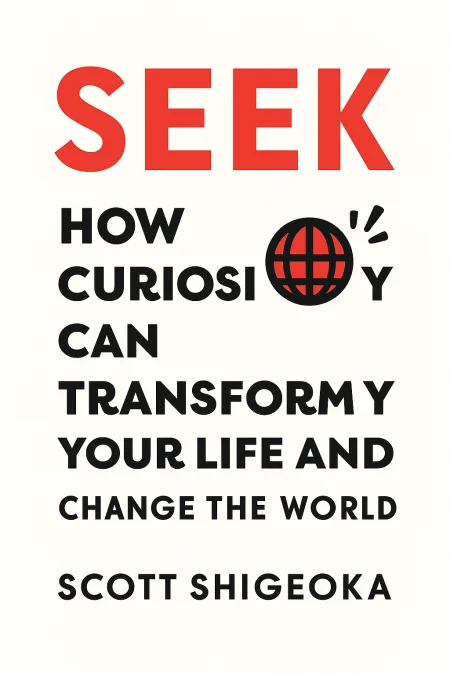
Seek
How Curiosity Can Transform Your Life and Change the World
Book Edition Details
Summary
In a world frayed by discord and misunderstanding, the power of curiosity becomes the beacon of hope. Scott Shigeoka, a luminary in the art of inquisitive thinking, invites readers to embrace Deep Curiosity as a transformative tool for healing and connection. "Seek" unfurls a tapestry of strategies drawn from rich research and Shigeoka’s own pioneering DIVE model—a framework that challenges you to shed biases, cultivate an open mindset, and approach life with renewed empathy. Whether mending fractured relationships, fostering harmony in the workplace, or rediscovering familial bonds, this book offers a heartfelt, practical guide for navigating the chasms that divide us. Let curiosity lead you to a deeper understanding of yourself and the world, offering a balm for the wounds of our polarized times.
Introduction
Imagine standing at the entrance of a Trump rally, your heart racing as you prepare to enter a sea of red caps and opposing viewpoints. This is exactly where one curious traveler found himself, not to argue or convert, but simply to understand. What he discovered in those conversations would challenge everything he thought he knew about connection, compassion, and the power of asking better questions. In our divided world, we've lost the art of genuine curiosity. We've replaced wonder with judgment, questions with assumptions, and dialogue with debate. We scroll past each other's humanity, dismiss opposing views without exploration, and even struggle to truly see ourselves with clear eyes. This epidemic of incuriosity is literally shortening our lives and fraying the bonds that hold communities together. Yet there exists a profound antidote to this disconnection. Deep curiosity goes beyond surface-level questioning to become a transformative force that can heal relationships, bridge divides, and unlock new possibilities for personal growth. It's the difference between asking "What do you do?" and "What makes you come alive?" Between assuming we know someone's story and genuinely seeking to understand their journey. This exploration will guide you through a practical framework for cultivating curiosity that creates real change. You'll discover how to let go of limiting assumptions, prepare your mind and environment for meaningful encounters, recognize the inherent dignity in every person you meet, and embrace life's challenges as opportunities for growth. These aren't just philosophical concepts, but actionable tools that can transform how you navigate everything from family dinners to workplace conflicts to your own inner landscape.
The Journey to Deep Curiosity
Sarah Jane Bradley danced her way toward a stranger at an unusual gathering, her turquoise rings catching the light as she moved to music playing over a Bluetooth speaker. The setting wasn't a typical party, but rather a Catholic convent in Northern California, where Sarah and four other millennials had come to live alongside elderly nuns for six months. This unlikely pairing brought together "nones," young spiritual seekers unaffiliated with traditional religion, and "women religious" who had devoted their lives to faith. The age gap was striking. The average Catholic sister in America is nearly eighty, while less than one percent are under forty. Buzz cuts met graying hair, tattoos contrasted with habit-wearing traditions, and progressive ideals encountered conservative structures. Yet when these two generations sat in circles for hours-long salons about sacred vows, something magical happened. Sarah, who initially bristled at the concept of chastity, found herself listening as the sisters shared their experiences with genuine openness. One sister revealed that taking vows hadn't stripped away her humanity or desires, but had redirected her love beyond a single partner to serve many people, especially the underserved. As Sarah absorbed these perspectives, her preconceived ideas began to loosen. She started to see chastity not as suppression, but as what she called a "deprivatization of love," allowing energy to flow toward the broader community rather than being contained within traditional romantic boundaries. This transformation happened because both groups chose to empty their metaphorical teacups, making room for new understanding. Like the parable of a student seeking wisdom from a teacher, our minds can become so full of assumptions, biases, and certainty that there's no space left for fresh insights. True curiosity requires us to pour out a little at a time, gradually releasing our grip on what we think we know. Sarah's willingness to detach from her initial judgments about religious life opened her to profound new perspectives about commitment, service, and the many ways people can express devotion to something greater than themselves.
The DIVE Model: Four Elements of Transformative Inquiry
When facing the aftermath of his father's death from cancer, one son found himself in an unlikely place of healing. Standing outside Iceland's largest prison on a makeshift stage lit by car headlights, he prepared to read a poem he'd written about his father's incarceration years earlier. The frozen ground beneath his feet and the silhouettes of prisoners watching from barred windows created a surreal backdrop for confronting grief that had haunted him for eight years. The poem, "Dear Father," emerged from a deliberate practice of curiosity about painful memories. Instead of avoiding thoughts about his father's five-year imprisonment, addiction struggles, and early death, the author chose to investigate these experiences with compassion. He made lists of unresolved questions, visualized both difficult and beautiful memories, and played music that reminded him of his father. Through this intentional exploration, he began to see beyond the abandonment and trauma to remember the man who built him a treehouse sanctuary, taught him chess, and first cultivated his sense of wonder about the world. This transformation illustrates the power of the DIVE framework for deep curiosity. Detach involves releasing assumptions, biases, and the need for certainty that prevent us from seeing clearly. Intend focuses on preparing both mindset and environment for meaningful exploration, like the careful setup that enabled the prison poetry reading. Value requires recognizing the inherent dignity of every person, including ourselves and those who have caused us pain. Embrace calls us to move toward life's challenges rather than away from them, finding growth in difficulty. The prison setting amplified this practice because it connected personal healing with broader social curiosity. By sharing his father's story in a place where other fathers were separated from their children, the author created bridges of understanding across seemingly insurmountable divides. The DIVE model doesn't operate linearly, but rather as interconnected muscles that strengthen together, each element supporting the others in creating space for profound connection and transformation to emerge.
Living Curiously: Limits, Boundaries, and Building Connection
Like a teenager preparing for his first major cliff dive in Hawaii, we must ask ourselves three critical questions before taking any leap into deep curiosity: Am I the right person? Is this the right time? Do I know when to stop or slow down? Standing twenty feet above crashing waves, the young diver drew confidence from his previous experience with smaller jumps, his familiarity with ocean environments, and his friend's reassurance that he could retreat at any moment. These same principles guide safe curiosity practice. Not every curious exploration belongs to every person. A Black death doula wisely declined to work with an extremely racist client, recognizing that no amount of professional skill could overcome such fundamental hostility to her existence. Similarly, we must honor both our own boundaries and those set by others. When someone explicitly requests that we not probe their experience, consent becomes paramount. The flow of curiosity also matters tremendously in power dynamics. Research shows that those with more social privilege benefit most from listening, while those with less power need opportunities to share their perspectives and be heard. Timing proves equally crucial. Just as driving requires sobriety and adequate fuel, curiosity demands emotional bandwidth and clear mental states. Sharing from our "scars" rather than "open wounds" protects both ourselves and others from retraumatization. A workshop facilitator learned this lesson painfully when pushing for vulnerability too early in a professional setting, before trust and safety had been established. The resulting emotional chaos taught him that even good intentions can cause harm without proper preparation and context. The traffic light system helps navigate these challenges. Red lights demand immediate stops when threats emerge or relationships show no improvement despite sustained effort. Yellow lights call for slowing down and reassessing, particularly when curiosity becomes predatory or manipulative. Most importantly, curiosity spreads naturally through modeling and practice. Like mirror neurons that cause us to mimic behaviors we observe, surrounding ourselves with genuinely curious people cultivates our own capacity for wonder. The ultimate goal isn't perfect curiosity, but rather the courage to keep seeking understanding across all the beautiful, messy complexity of human experience.
Summary
The path from incuriosity to genuine connection begins with a simple recognition: beneath every assumption lies a human story waiting to be understood. Whether encountering political opponents at rallies, elderly nuns sharing wisdom across generational divides, or our own painful memories demanding attention, the practice of deep curiosity offers a bridge between isolation and belonging. The framework is deceptively straightforward yet profound in its implications. We learn to detach from the certainties that blind us, set intentions that prepare us for meaningful encounters, value the dignity inherent in every person we meet, and embrace the difficulties that reveal our greatest opportunities for growth. This isn't merely about asking better questions, though that matters immensely. It's about fundamentally shifting from a posture of knowing to one of wondering, from judgment to genuine interest, from the safety of distance to the vulnerability of real connection. The teenager standing on that Hawaiian cliff understood something essential: the leap requires both courage and preparation, but the alternative—staying safely on solid ground—means missing the exhilaration of diving deep into life's vast possibilities. Your curiosity muscle strengthens with practice, spreading its influence naturally to those around you. Every genuine question asked, every assumption examined, every moment of choosing understanding over judgment ripples outward through families, workplaces, and communities. In a world desperate for healing across its many divides, perhaps our most radical act is simply to turn toward one another with open hearts and curious minds, ready to be transformed by what we discover together.
Related Books
Download PDF & EPUB
To save this Black List summary for later, download the free PDF and EPUB. You can print it out, or read offline at your convenience.
By Scott Shigeoka
