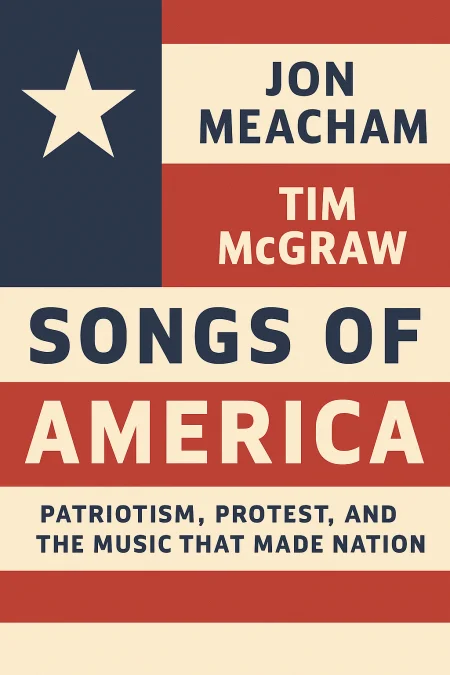
Songs of America
Patriotism, Protest, and the Music That Made a Nation
Book Edition Details
Summary
In a symphony of history and melody, Pulitzer Prize-winning historian Jon Meacham joins forces with Grammy-winning artist Tim McGraw to compose a vibrant tapestry of American spirit through song. "Songs of America" embarks on a sweeping odyssey from the fervent anthems of the Revolutionary War to the rebellious beats of the modern era. Here, music emerges as both witness and participant in the American story, capturing the hopes, struggles, and triumphs of a nation through its darkest and most exhilarating times. As Meacham dissects the historical resonance of each era's soundtrack, McGraw brings the performer's insight into how these tunes have not only mirrored but molded the American experience. This lyrical exploration invites readers to rediscover the profound power of music as a beacon of identity and a call to unity, echoing the past's lessons into our present and future.
Introduction
Picture Francis Scott Key straining through the smoke and chaos of battle in 1814, watching to see if the American flag still flew over Fort McHenry. His relief and joy would become "The Star-Spangled Banner," but this was just one note in a much larger symphony that has been playing since America's founding. From the earliest colonial protests to the civil rights marches, from Revolutionary War camps to Vietnam-era demonstrations, American history has been shaped not just by speeches and laws, but by the songs that stirred hearts, unified movements, and gave voice to the nation's deepest struggles and highest aspirations. This exploration reveals how music has served as both mirror and catalyst in American democracy, reflecting our contradictions while pushing us toward our ideals. Through the melodies of revolution, the spirituals of enslaved people, the anthems of war, and the protest songs of social movements, we discover that America's soundtrack tells a story more complex and compelling than any textbook. The songs Americans have sung together reveal not just what they believed, but how they felt about their country's promise and its failures, creating an emotional foundation for political movements that mere rhetoric could never achieve. Whether you're a history enthusiast curious about the forces that shaped the nation, a music lover interested in how art influences politics, or simply someone seeking to understand how cultural expression can challenge or reinforce power structures, this journey through America's musical heritage illuminates the ongoing tension between the nation we've been and the nation we aspire to become. The story of American music is ultimately the story of democracy itself, told through the voices of those who sang their way toward a more perfect union.
Revolutionary Foundations: From Colonial Resistance to National Identity (1760s-1840s)
The American experiment began not with a declaration, but with a song. In 1768, as British officials seized John Hancock's ship Liberty in Boston Harbor, John Dickinson penned "The Liberty Song" to rally colonial resistance. Set to a familiar British tune, his verses proclaimed "By uniting we stand, by dividing we fall" and spread like wildfire through the colonies. This wasn't mere entertainment but political organizing through melody, creating what John Adams called "the sensations of freedom" among ordinary colonists who might never read a political pamphlet. Music proved essential to forging American identity during the Revolutionary War. Soldiers marched to "Yankee Doodle," originally a British taunt that Americans proudly reclaimed. The war's songs revealed the conflict's complexity as loyalists had their own anthems defending "the best of kings," while patriots sang of liberty and divine providence. These competing musical narratives reflected a civil war within the broader revolution, as neighbors chose sides through song as much as sword. The young republic's survival depended on creating unity from diversity, and music played a crucial role in this delicate process. Joseph Hopkinson's "Hail Columbia" emerged during the partisan battles of the 1790s as a deliberately unifying anthem, celebrating shared Revolutionary heritage while transcending party divisions. When Francis Scott Key witnessed the bombardment of Fort McHenry in 1814, his "Star-Spangled Banner" captured not triumphant nationalism but anxious hope. The question "does that star-spangled banner yet wave?" reflected genuine uncertainty about the republic's survival. These early decades established music's dual role in American democracy as songs could both celebrate the nation's promise and critique its failures. Samuel Francis Smith's "My Country 'Tis of Thee" used the melody of "God Save the King" to assert American independence, while abolitionist versions of the same song exposed slavery's contradiction of democratic ideals. This pattern would repeat throughout American history, with each generation using music to wrestle with the gap between American ideals and American reality, ensuring that the revolutionary spirit of questioning and reform remained alive in the republic's soundtrack.
Civil War Crisis: Musical Battles for America's Soul (1850s-1890s)
The antebellum period witnessed America's musical conscience awakening to its greatest moral contradiction. Frederick Douglass understood that the enslaved had always sung their resistance, from the coded spirituals that mapped routes to freedom to the work songs that maintained dignity amid dehumanization. "Swing Low, Sweet Chariot" wasn't just about heavenly salvation but about the Underground Railroad's earthly deliverance. Harriet Tubman used these songs as signals, her voice in the darkness guiding the enslaved toward freedom while Confederate patrols searched nearby. As sectional tensions exploded into war, competing musical narratives revealed the conflict's true stakes. Julia Ward Howe's "Battle Hymn of the Republic" transformed the abolitionist "John Brown's Body" into a sacred crusade, proclaiming that Union soldiers would "die to make men free" in God's righteous cause. Meanwhile, Confederate anthems like "Dixie" and "The Bonnie Blue Flag" claimed the Revolutionary legacy for themselves, insisting they fought for the same liberty their forefathers had won in 1776. These weren't just marching songs but competing visions of America's meaning and destiny. The war's music reflected its revolutionary character as a "second founding" of the republic. Lincoln's Emancipation Proclamation was greeted with jubilant singing in African American communities, as enslaved people adapted "Go Down, Moses" to celebrate "Go down, Abraham" and his liberation of their people. Stephen Foster's sentimental ballads captured the war's human cost, while George Root's "Battle Cry of Freedom" rallied Northern determination. Each song contributed to the larger struggle over whether America would fulfill or abandon Jefferson's promise that "all men are created equal." Reconstruction's aftermath revealed music's power to both heal and harm. The Fisk Jubilee Singers brought spirituals to international audiences, demonstrating African American humanity and artistry to skeptical white listeners. Yet the same period saw "Dixie" transformed from minstrel entertainment into a symbol of white supremacist resistance to racial equality. This musical legacy would echo through the next century, as each generation inherited both the songs of liberation and the anthems of oppression, forced to choose which America they would sing into existence.
Modern Struggles: Wars, Rights, and Democratic Transformation (1900s-1960s)
The twentieth century opened with America's musical democracy expanding to include previously silenced voices, even as new challenges tested the nation's commitment to equality. The suffrage movement adopted "Give the Ballot to the Mothers" and other anthems that echoed Civil War themes of liberation, while James Weldon Johnson's "Lift Every Voice and Sing" became the "Negro National Hymn," offering African Americans their own patriotic song that acknowledged both struggle and hope. These songs revealed how excluded groups used music to claim their place in the American story, transforming the nation's soundtrack from the margins. Two world wars demonstrated music's power to unite Americans across racial and ethnic lines while exposing persistent inequalities. George M. Cohan's "Over There" rallied the nation for World War I with infectious optimism, while Irving Berlin's "God Bless America" became a prayer for protection during World War II's darkest hours. Yet Woody Guthrie's "This Land Is Your Land" offered a pointed response to Berlin's sentimentality, asking whether America truly belonged to all its people. The era's musical debates reflected broader tensions between patriotic unity and social justice, between celebrating America's promise and confronting its failures. The Great Depression and New Deal years saw music become a tool of both comfort and protest. Franklin Roosevelt's theme song "Happy Days Are Here Again" projected optimism during economic collapse, while "Brother, Can You Spare a Dime?" gave voice to widespread suffering. Marian Anderson's 1939 concert at the Lincoln Memorial, after being barred from Constitution Hall, demonstrated music's power to challenge segregation and affirm human dignity. Her performance of "My Country 'Tis of Thee" from Lincoln's steps created an indelible image of American ideals transcending American prejudices. The civil rights movement of the 1950s and 1960s culminated this century-long struggle to expand American democracy through song. "We Shall Overcome" became the movement's anthem, its simple melody allowing diverse voices to join in common cause. At the 1963 March on Washington, when Mahalia Jackson urged Martin Luther King Jr. to "tell them about the dream," she prompted one of history's greatest speeches, one that concluded by invoking Samuel Francis Smith's "My Country 'Tis of Thee" to frame civil rights as the fulfillment, not the rejection, of American ideals. The movement's success proved that music could indeed help bend the arc of history toward justice.
Contemporary Divisions: Music in Polarized America (1970s-Present)
The Vietnam War era shattered the postwar consensus and created the most politically charged musical landscape in American history. As television brought images of distant battlefields into American homes, musicians responded with unprecedented directness and diversity of perspective. While Staff Sergeant Barry Sadler's "Ballad of the Green Berets" celebrated military service and reached number one in 1966, songs like Creedence Clearwater Revival's "Fortunate Son" and Edwin Starr's "War" challenged the conflict's legitimacy and exposed class divisions in military service. This musical divide reflected deeper fractures in American society over questions of patriotism, authority, and national purpose. The Reagan era marked a pivotal moment in the relationship between music and American politics, crystallized in the competing visions of Bruce Springsteen's "Born in the U.S.A." and Lee Greenwood's "God Bless the U.S.A." When Reagan's campaign attempted to appropriate Springsteen's song, the artist pushed back, clarifying that his anthem was actually a critique of how America treated its veterans. This episode revealed how songs could be interpreted in radically different ways, reflecting the nation's growing cultural and political divisions that would define the coming decades. The rise of hip-hop during this period introduced new voices to American music, with artists like Run-DMC and later Tupac Shakur offering perspectives from communities long marginalized in mainstream culture. Hip-hop's emergence coincided with Reagan's presidency, creating what scholar Michael Eric Dyson calls "a sharp contrast between a White House announcing 'Morning in America' and a black culture mourning the racial divides in this country." This musical form would eventually reshape American culture, proving that marginalized voices could command mainstream attention and influence national conversations about race, class, and justice. The September 11 attacks prompted another wave of musical response, from Alan Jackson's contemplative "Where Were You When the World Stopped Turning" to Toby Keith's defiant "Courtesy of the Red, White and Blue." Bruce Springsteen's album "The Rising" offered perhaps the most nuanced artistic response to the tragedy, honoring the heroism of first responders while grappling with the complex emotions of a nation under attack. These songs demonstrated music's enduring capacity to help Americans process trauma and find meaning in tragedy, even as the subsequent wars in Iraq and Afghanistan would generate new cycles of musical support and protest that continue to this day.
Summary
Throughout American history, music has served as democracy's heartbeat, revealing the ongoing tension between the nation's founding ideals and its lived reality. From colonial resistance songs to civil rights anthems, each generation has used melody and verse to both celebrate American promise and demand American progress. The most enduring songs have been those that held the nation accountable to its highest aspirations while acknowledging its deepest failures, from "The Star-Spangled Banner's" anxious questioning to "This Land Is Your Land's" inclusive vision to "We Shall Overcome's" patient determination. This musical heritage offers profound lessons for contemporary Americans grappling with persistent challenges of inequality, division, and democratic backsliding. The story reveals that patriotism and protest are not opposites but partners in the ongoing work of perfecting the union, as the most patriotic Americans have often been those who sang the nation's contradictions most clearly, from Frederick Douglass to Woody Guthrie to the Freedom Singers. It also demonstrates that lasting social change requires both the emotional power of music and the practical work of organizing, as songs inspire movements but movements must translate inspiration into legislation, litigation, and cultural transformation. The central lesson of America's musical democracy is that the nation's character is not fixed but constantly being rewritten through the voices of those willing to participate in its ongoing creation. In our current moment of political polarization and social upheaval, we might ask what new verses we're writing to the American song, and whether our contributions will help the nation live up to its founding promise that all people are created equal and endowed with unalienable rights to life, liberty, and the pursuit of happiness. The songs we choose to sing together today will shape the America our children inherit tomorrow.
Related Books
Download PDF & EPUB
To save this Black List summary for later, download the free PDF and EPUB. You can print it out, or read offline at your convenience.
By Jon Meacham
