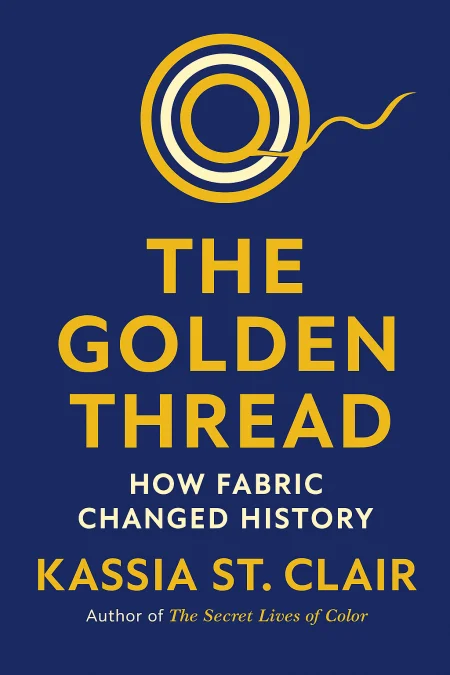
The Golden Thread
How Fabric Changed History
Book Edition Details
Summary
Threads of history unravel, revealing the vibrant tapestry of human progress in Kassia St. Clair's "The Golden Thread." From ancient textiles discovered in Georgian caves to the Indian calicoes that fueled the Industrial Revolution, each fabric tells a tale of innovation and transformation. This narrative isn't just about cloth; it's a tribute to the creative spirit that drove humans to conquer oceans, break records, and survive in the harshest environments. St. Clair introduces us to a diverse cast, from China's Empress Xiling to legendary figures like Richard the Lionhearted and Bing Crosby, exploring how textiles have shaped economies and societies, challenging the notion of textiles as merely "women's work." This book offers a new lens through which to view our past and future, celebrating the enduring thread of ingenuity woven through every culture and era.
Introduction
In a remote Georgian cave, archaeologists made a discovery that would rewrite our understanding of human history. Buried beneath layers of ancient sediment lay microscopic fibers, twisted and dyed with remarkable skill, dating back an astonishing 34,000 years. These threads represent more than mere survival technology—they mark humanity's first steps toward mastering the material world and reshaping it to serve our ambitions. This ancient discovery connects us to an extraordinary story of how textiles became the invisible force driving civilization forward. From the silk roads that carried ideas across continents to the cotton fields that shaped empires, fabrics have determined the rise and fall of nations, sparked international conflicts, and enabled humanity's greatest achievements. The spacesuit that protected Neil Armstrong on the moon's surface shares a direct lineage with those prehistoric fibers, representing humanity's continuous quest to transcend natural limitations through textile innovation. This exploration reveals how the simple act of spinning thread became one of our most transformative technologies, appealing to anyone curious about the hidden forces that built our modern world and continue to shape our future.
Ancient Origins: From Cave Fibers to Sacred Silk (34,000 BC-500 AD)
The story begins in darkness, where our ancestors first learned to transform wild plants into protective coverings that would enable human expansion across hostile environments. The Dzudzuana Cave fibers weren't crude survival tools but sophisticated textiles requiring specialized knowledge, coordinated community effort, and remarkable patience. Creating these early fabrics demanded understanding of seasonal plant cycles, complex processing techniques, and the delicate art of spinning consistent thread—skills that took generations to perfect. Ancient Egypt elevated textile production to divine status, with linen serving not merely as clothing but as the essential material connecting earthly life to eternal existence. Egyptian mummies weren't simply preserved bodies but textile sculptures, wrapped in layer upon layer of linen so fine it contained over 500 threads per inch. The quality of these burial cloths reflected both earthly wealth and spiritual preparation, with the finest examples requiring months of skilled labor to create. This wasn't mere craftsmanship but sacred technology that promised to transform the deceased into divine beings. Chinese silk production emerged as perhaps history's most closely guarded industrial secret, with revealing the process punishable by death. The Chinese understood that controlling silk meant controlling international trade, using their monopoly to extract enormous wealth from Roman markets while maintaining diplomatic leverage across Asia. Silk became more than luxury fabric—it served as currency, diplomatic gift, and weapon of cultural influence that shaped relationships between civilizations. These ancient innovations established fundamental patterns that would echo through millennia: the connection between textile mastery and political power, the role of specialized knowledge in creating economic advantage, and the way fabric production could determine the fate of entire civilizations. The threads spun in these early societies would eventually weave themselves into every aspect of human development.
Medieval Networks: Trade Routes and Wool Wars (500-1500 AD)
The medieval period transformed textiles into instruments of exploration and conquest, nowhere more dramatically than in the massive woolen sails that powered Viking expansion across treacherous northern seas. These expeditions weren't romantic adventures but sophisticated commercial operations requiring extraordinary textile resources—a single large warship needed sails woven from wool representing two million sheep. Viking women spent entire winters creating these maritime technologies, their spinning wheels and looms determining which expeditions could launch and which warriors could seek their fortunes across the ocean. The establishment of global trade networks created unprecedented demand for luxury textiles, with silk serving as the foundation of the world's first truly international economy. The Silk Roads carried far more than Chinese fabric—they transported ideas, religions, and technologies that would reshape entire continizations. Byzantine merchants paid fortunes for silk that Roman senators valued more highly than gold, while Chinese emperors used silk diplomacy to pacify nomadic neighbors and cement international alliances. Medieval England discovered that wool could serve as the foundation of national wealth and international influence. Cistercian monasteries transformed from spiritual retreats into commercial powerhouses, their white-robed monks overseeing vast flocks that generated revenue to ransom kings and finance crusades. When Richard the Lionheart needed funds to return from captivity, it was English wool—specifically the confiscated fleeces of monastery flocks—that provided the silver to secure his freedom and restore royal authority. This period established the template for how textiles would shape global politics: control over production meant economic leverage, technological advantages in processing translated to military superiority, and innovations in textile commerce laid the groundwork for modern international finance. The medieval world proved that whoever controlled the fabric trade controlled the future.
Industrial Revolution: Cotton Slavery to Synthetic Breakthroughs (1500-1950)
The transformation of cotton from luxury import to industrial foundation represents one of history's most profound and troubling chapters, demonstrating how technological progress could mask unprecedented human exploitation. The cotton gin didn't merely mechanize production—it created insatiable demand for enslaved labor that would define American society for generations. Cotton became so central to the global economy that by the 1850s, the profits from enslaved labor financed industrial development across both America and Britain, creating wealth that funded universities, built cities, and established family fortunes that persist today. The human cost of this textile revolution extended far beyond American plantations into the "dark Satanic mills" of industrial Britain, where workers including children as young as six labored in dangerous conditions to transform raw cotton into fabrics that clothed the world. Mill towns became laboratories for industrial capitalism, with factory owners experimenting with new forms of labor control while workers organized the first industrial unions. The wealth generated by this system enabled unprecedented technological innovation, but at enormous cost in human suffering and social disruption. The development of synthetic textiles promised liberation from dependence on natural fibers and the brutal labor systems they required. Companies invested millions in developing artificial materials, culminating in revolutionary products like nylon stockings that caused riots when they went on sale in 1945. These innovations suggested a future where chemistry could replace agriculture, where factories could produce any fabric imaginable, and where textile production might finally serve human needs rather than exploit human labor. Yet synthetic production brought new forms of environmental and human cost, with factories using toxic chemicals that poisoned workers and contaminated entire regions. The promise of technological liberation proved more complex than early innovators imagined, establishing patterns of hidden costs that continue to challenge the textile industry today.
Modern Era: Space Age Materials and Athletic Innovation (1950-Present)
The space age pushed textile technology to absolute limits, with astronaut survival depending entirely on fabrics engineered at the molecular level to protect against the vacuum of space, cosmic radiation, and temperature extremes ranging from minus 250 to plus 250 degrees Fahrenheit. NASA's spacesuits represent the pinnacle of textile engineering—twenty-one layers of specialized materials sewn together by seamstresses whose precision would have impressed medieval lacemakers. These life-support systems demonstrate how textiles evolved from passive protection to active enhancement of human capabilities. Athletic competition became another frontier for textile innovation, with high-tech materials fundamentally altering human performance. The controversy over polyurethane swimsuits in 2008-2009 revealed how advanced fabrics could compress muscles, reduce drag, and add buoyancy, essentially turning swimmers into more efficient machines. When swimmers wearing these suits broke records at unprecedented rates, sports governing bodies faced difficult questions about the relationship between technology and human achievement, ultimately banning the suits to preserve competitive integrity. Modern textile research pursues the ultimate goal of creating materials that combine the best properties of natural and synthetic fibers while eliminating their environmental costs. Scientists experiment with everything from spider silk proteins produced by genetically modified bacteria to smart fabrics embedded with sensors that can monitor health, generate electricity, or adapt to environmental conditions in real time. These innovations point toward a future where clothing might heal wounds, enhance physical performance, or seamlessly integrate with digital technologies. The development of sustainable textile production has become crucial as the industry grapples with fast fashion's environmental impact and the growing awareness of textile waste's global consequences. Modern innovations must balance performance with sustainability, learning from historical patterns of hidden costs while pushing the boundaries of what fabric can achieve.
Summary
The golden thread weaving through human history reveals that our relationship with textiles has always transcended mere utility, serving as the material foundation for social hierarchies, economic systems, and technological progress. From prehistoric cave fibers to space-age synthetics, fabric production has consistently translated into political and economic power, whether wielded by Chinese silk monopolies, English wool merchants, or modern synthetic manufacturers. This pattern demonstrates that controlling textile technology means controlling the future. The central tension throughout this history lies between innovation and exploitation, between technological possibility and human cost. Every major textile breakthrough—from the cotton gin to synthetic materials—has carried hidden consequences that took generations to fully understand. The wealth generated by textile production has funded humanity's greatest achievements while simultaneously enabling some of our worst exploitation, from slavery to environmental destruction. This duality reveals that progress without consideration of broader impacts inevitably creates new problems. Understanding this textile timeline offers crucial insights for navigating contemporary challenges. As we develop smart fabrics and bio-engineered materials, we must remember that the most successful innovations have balanced technological advancement with human welfare and environmental sustainability. The future of textiles lies not in choosing between tradition and innovation, but in learning from both to create systems that serve human needs while preserving our planet for future generations. The thread of human progress continues to spin forward, connecting our past achievements to future possibilities in ways we're only beginning to understand.
Related Books
Download PDF & EPUB
To save this Black List summary for later, download the free PDF and EPUB. You can print it out, or read offline at your convenience.
By Kassia St. Clair
